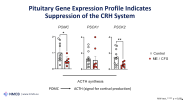
Loss of CRH neurons and other neural changes in ME/CFS autopsy study - University of Amsterdam

The authors gave a presentation about their findings on the NMCB meeting a couple of days ago. I've made a brief summary of the talk on social media:


1) Dr. Felipe Correa da Silva shared more info about the first 10 brain autopsies from the Netherlands. In this new thread, we made a brief summary of his presentation.
1770472572593.png

2) The Netherlands Brain Bank has 40 years of experience. Their ME/CFS program started in April 2024. They currently have 61 registrations and the aim is to have 200 by the end of their 5-year project.

3) They already did 10 autopsies but aim to do 50 over a period of ten years. They submitted a manuscript on their first findings titled “Hypothalamic-pituitary-adrenal axis dysfunction in Myalgic Encephalomyelitis/Chronic Fatigue Syndrome”.

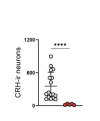
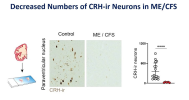
4) Below is a graph of their main result. They found an almost depletion of Corticotropin-Releasing Hormone (CRH-ir) neurons in the brains of ME/CFS patients.
1770472591314.png

5) Correa da Silva said they looked at the HPA axis because low cortisol has been linked to ME/CFS symptoms. But: “The magnitude of the changes in the brains of people with ME seem to be very high, much more than we expected initially.”

6) They also found a down-regulated expression of genes related to CRH signalling and lower cortisol levels in the cerebrospinal fluid.

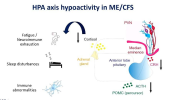
7) CRH is the key that starts the Hypothalamic-Pituitary-Adrenal (HPA) axis, the body’s primary stress response system. It goes something like this: Hypothalamus -> CRH -> Pituitary gland -> ACTH -> Adrenal glands -> Cortisol.

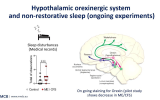
8 ) Lots of ME/CFS patients also have sleep disturbances, so the authors were also interested in orexin, a neuropeptide that keeps us awake and is disrupted in nacrolepsy. They plan to look at this more closely but preliminary results also suggest a decrease in ME/CFS.
1770472606096.png

9) The second talk of the presentation wasn't about the HPA axis or stress system but about microglia, the immune cells in the brain.

10) Correa da Silva explains: "something that was striking for us, is that we did not observe more microglia as we would expect in a neuro-inflammatory condition where there is infiltration of microglia..."

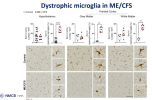
11) Instead, they saw that the microglia are dystrophic: they are fragmented. The cell body is not connected to the processes and the processes are also fragmented in itself.

12) This is a somewhat new histological feature. Not a lot of people in the world have described it. There’s no harmonized system to quantify this yet but they certainly see it in the brains of ME/CFS patients.
1770472621933.png

13) This was not only in the hypothalamus, but something that seems to be a widespread effect, in both gray and white matter.

14) The authors also looked at HLA which acts as a proxy for microglia activation and this showed no clear effect. They also found no evidence of abnormal T (CD3) or B (CD79a) cell presence in the central nervous system of ME/CFS patients.

15) Correa da Silva described the findings as follows: "So in the patients that donate their brains, possibly endstage patients, we do not see signs of classical neuro-inflammation, but we see dystrophic, rather senescent microglia."

16) "ME/CFS has been thought to be a neuro-inflammatory throughout the whole disorder but this might not be true. It might be that after a certain point the neuro-inflammation stops because the cells are senescent and cannot keep up with their continuous activation."

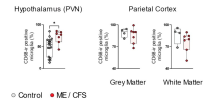
17) One extra interesting finding is that in the Hypothalamus (the PVN) they found increased CD68 positive microglia. CD68 is a protein found on the membrane of lysosomes so this points to increased phagocytosis (clean-up) and possibly micro-enviromental injury.
1770472639838.png

18) In other parts of the brain such as the the parietal cortex, they do not see that. So it seems to be triggered by local events, rather than a widespread mechanism.

19) So what's next? The researchers plan to also look at mitochondria-related changes and use other tools than histopathology. They got another grant for single cell transcriptomics (snRNA-seq) of 3 regions: the hypothalamus, frontal cortex and hippocampus.

20) The full presentation of Dr. Felipe Correa da Silva at the NMCB meeting can be watched here:
https://www.youtube.com/watch?v=30DkFAXHjDI
 
16) "ME/CFS has been thought to be a neuro-inflammatory throughout the whole disorder but this might not be true. It might be that after a certain point the neuro-inflammation stops because the cells are senescent and cannot keep up with their continuous activation."
A concerning thought. I've just checked and apparently microglia can regenerate so hopefully this is potentially reversible if it's true.


However it says they renew at 28% per year so if this were the cause of severe MECFS it wouldn't account for spontaneous improvement.


8 ) Lots of ME/CFS patients also have sleep disturbances, so the authors were also interested in orexin, a neuropeptide that keeps us awake and is disrupted in nacrolepsy. They plan to look at this more closely but preliminary results also suggest a decrease in ME/CFS.
This is interesting.
 
16) "ME/CFS has been thought to be a neuro-inflammatory throughout the whole disorder but this might not be true. It might be that after a certain point the neuro-inflammation stops because the cells are senescent and cannot keep up with their continuous activation."

Or that there is no neuroinflammation. Running out of inflammatory cells does not sound plausible to me.

The CRH cell finding stands out as interesting. Presumably if these cells are not working other signals are maintaining ACTH and cortisol levels.
 
And funnily enough cAMP/CREB is tied into the exact calcium and interferon-related pathways I’ve been theorizing about. Orexin signaling is another known required factor for CRH transcription, apparently.

8 ) Lots of ME/CFS patients also have sleep disturbances, so the authors were also interested in orexin, a neuropeptide that keeps us awake and is disrupted in nacrolepsy. They plan to look at this more closely but preliminary results also suggest a decrease in ME/CFS.
 
) Correa da Silva described the findings as follows: "So in the patients that donate their brains, possibly endstage patients, we do not see signs of classical neuro-inflammation, but we see dystrophic, rather senescent microglia."

16) "ME/CFS has been thought to be a neuro-inflammatory throughout the whole disorder but this might not be true. It might be that after a certain point the neuro-inflammation stops because the cells are senescent and cannot keep up with their continuous activation."

Urgh, it s bad for us... how is it possible to fix that ?
 
They also found a down-regulated expression of genes related to CRH signalling and lower cortisol levels in the cerebrospinal fluid
Thanks for the summary. Did they say what the specific genes were? I only had time to quickly skim through the video and couldn’t find the details.

I agree with @Jonathan Edwards that the findings are interesting but the team’s interpretation of what it points to should be taken with a hefty grain of salt.
 
Could it be said too that it hasn't ruled out the possibility of earlier neuroinflammation at some stage that has now gone but left damage in its wake?

It could but it begs the question why one should suggest that and exactly what would constitute this neuroinflammation. They seem very ready to assume received wisdom before challenging it. Better to assume we just didn't know?
 
This sounds very interesting.

I definitely had issues with abnormal regulation of glucose. I had to keep eating throughout the day or I would risk getting hypoglycemia. It wasn't dangerous (the drop in glucose was never deep) but every day I could sense that the body was stressed by having to avert impending hypoglycemia. And a single episode of hypoglycemia could leave me tired until into the next day. This constant stress contributed to exhaustion.

The first round of specialist investigation I received for was to rule out a hormonal issue, but the tests were normal other than finding a flattened pituitary and below normal salivary cortisol. Nothing came out of it, it wasn't considered concerning but it was clear to me something wasn't right with this system.

Nowadays it is much better. In the last 12 months, I remember one episode of feeling like I was about to go into hypoglycemia.

Also my first symptom was unrefreshing sleep.

At what point would it make sense to do a controlled study of narcolepsy drugs for ME/CFS?
 
Last edited:
3) They already did 10 autopsies but aim to do 50 over a period of ten years. They submitted a manuscript on their first findings titled “Hypothalamic-pituitary-adrenal axis dysfunction in Myalgic Encephalomyelitis/Chronic Fatigue Syndrome”.
Sobering (though by no means surprising) to see their time frame for moving forward on what is still essentially a preliminary exploration. I am really interested in these findings and in this approach; I wish it were more likely that I live to see where it leads.
 
Well because we don’t see normal functional glial cells but seriously disrupted ones. That could well be explained by chronic overactivation especially in late stage patients. It’s a hypothesis which he framed like that too but I do think it’s the most logical one for now.

Except that they didn't find markers of activation. The report of disrupted microglia is odd to me - I don't know how in tissue sections you can tell that glial processes are separated from cell bodies. The author said nobody much had seen this before. I think it would be important to have information about the circumstances of death because these might be terminal changes anyway.

I am not sure what is logical about postulating glial activation when we do not have evidence for it. It doesn' really explain anything anyway. To understand what is going on we need much more specific information.
 
At what point would it make sense to do a controlled study of narcolepsy drugs for ME/CFS?
We've seen a few, haven't we? Modafinil has come up pretty frequently with pretty mixed/poor results as I recall. Is there something specific (or some class of drugs) that you have in mind? Sodium Oxybate could certainly be interesting to look at, though that comes with a host of problems and the various difficulties involved with exploring its use for treating Fibromyalgia in the USA don't give much cause for optimism.
 
Ten years is an insanely long time. PwME, especially severe, die all the time sadly. Just this week there have been something like 4 deaths reported.

Why can't they do this faster considering how important this finding seems? I think we need better systems for posthumous donation for pwME. I would certainly sign up if there was any mechinism to do it in the UK.
 
Ten years is an insanely long time. PwME, especially severe, die all the time sadly. Just this week there have been something like 4 deaths reported.

Why can't they do this faster considering how important this finding seems? I think we need better systems for posthumous donation for pwME. I would certainly sign up if there was any mechinism to do it in the UK.
It would be at a pace of five new biopsies a year. Maybe that’s sadly all that biobank can deliver. I really do hope this inspires someone for example in the new German biobank program to focus on brain biopsies as well.
 
Why can't they do this faster considering how important this finding seems?

Probably because there are very few neuropathologists. AI says:
  • UK Context: The British Neuropathological Society has indicated that for adequate coverage, a target of 1 full-time equivalent (FTE) neuropathologist per 1,000,000 population is recommended, which is 0.1 per 100,000. There are only about 70 neuropathologists in total in the UK.

And they are probably quite busy.
 
Probably because there are very few neuropathologists. AI says:
  • UK Context: The British Neuropathological Society has indicated that for adequate coverage, a target of 1 full-time equivalent (FTE) neuropathologist per 1,000,000 population is recommended, which is 0.1 per 100,000. There are only about 70 neuropathologists in total in the UK.

And they are probably quite busy.
So what would be our best chance at more data in a timely manner, international small scale replications probably?
 
Back
Top Bottom