Loss of CRH neurons and other neural changes in ME/CFS autopsy study - University of Amsterdam

I’m quoting here (https://www.mdpi.com/2075-4418/6/2/16#:~:text=Likewise, Friedberg, Dechene, McKenzie,for many individuals with CFS.)

“Likewise, Friedberg, Dechene, McKenzie, and Fontanetta [11] found that individuals who have had the illness for a longer period of time have significantly higher illness severity than those with shorter illness duration. Specifically, those who have had CFS for ten years or more had worse cognitive functioning than those who had been sick for seven years or less. Furthermore, van der Werf and colleagues [12] found that patients with an illness duration of two years or longer reported more concentration problems, greater fatigue, and more functional disability than patients with a shorter illness duration.”

These results are not definite and sometimes contested but it seems longer illness duration has a trend toward more severity. Which I would in turn expect for people at the end of their lives along with comorbidity. Should there be MAID cases or suicides among the autopsies you’d expect the same trend. So it’s an educated guess and we won’t definitively know until the study is published.
Ah, I understand.

I think those studies have all kinds of potential issues with sampling bias. It’s a sign of how badly we’ve been treated that we don’t have good data on this yet.
 
There really needs to be a policy in place in perhaps two or three European countries for anyone dying with severe ME/CFS to have an autopsy if there is consent.
the people in this study were autopsied because they signed up to donate to the brain bank's ME/CFS program before they passed. (At least that is my understanding.)
I can confirm. There is an official government funded program for ME CFS research with this brain bank - under the supervision of the NMCB-consortium. I have a form somewhere.

I have not checked if the presentation given was based on the donations within that program.
(EDIT: I watched presentation, indeed part of ME CFS funded program)

As it’s the Netherlands. I presume it includes some cases of MAID
(EDIT: in the presentation Felipe Correa mentions that the 7 brains are probably from late stage severe ME patients)
 
Last edited:
These results are not definite and sometimes contested but it seems longer illness duration has a trend toward more severity. Which I would in turn expect for people at the end of their lives along with comorbidity.
For a start, the unremarkable fact of the additional burdens of normal ageing on top of serious chronic and very badly managed disease need to be factored in. If you are already barely functional it does not take much extra burden to crash the whole show.
I think those studies have all kinds of potential issues with sampling bias. It’s a sign of how badly we’ve been treated that we don’t have good data on this yet.
Indeed. The lack of decent epidemiological data after decades of 'study' tells you everything you need to know about how seriously this has not been taken (at least until recently). Should have been among the first major studies to be done.
 
There is an official government funded program for ME CFS research with this brain bank - under the supervision of the NMCB-consortium.
It's a terrific achievement to get that program in place.


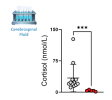
I think the relevance is mainly in the fact that CSF cortisol was measured in the NIH study and not found to be abnormal. That makes the result of abnormal CSF cortisol here less likely to be true, and contributes to the likelihood that something has gone wrong with the sampling that affected the integrity of the CRH cells.
Not sure. I think the possibility that the CRH cell findings are artifactual is probably an independent issue relating to histological methodology (not particularly sampling).
A problem with the cortisol measurement and a problem with the CRH cell findings could be separate issues. But finding one problem does tend to make it more likely that there is another, regardless of whether the problems are directly linked.

But, I hear @Arfmeister and others suggesting this team are good at what they do. I guess the published paper will go some way to answering our questions.
 
Not that you necessarily need this clarified, but just to make this thread as clear as possible: the people in this study were autopsied because they signed up to donate to the brain bank's ME/CFS program before they passed. (At least that is my understanding.)

I don't think the researchers have released any info yet about the patients, such as if they passed due to euthanasia, or how severe their ME/CFS was. (But please let me know if I just missed it.) It's true more severe patients might be more likely to sign up for a study like this, and also true that there are far more mild patients, so hard to know how the math works out there.

The brain bank says that their patient samples are "anonymized". I don't know if that just means that their names are not included, or if things like cause of death are going to be impossible to find out.
Yes, it's probably also worth mentioning that a standard post mortem is very different from what a brain bank does/can do. There seems to be some confusion about this - the idea that ME/CFS is not 'a classic neurological disease' because post mortems have been largely unremarkable has always been bogus and extremely superficial/premature. In fact, it's such a ridiculous idea that it's difficult to not see it as a political ploy.

Some of the more standard post mortems in the past have actually found stuff that 'made sense' like the DRG findings, but what little has been published or is known about it has never been systematized and/or is of low quality.
 
Last edited:
We might have a problem that a brain bank may not look at spinal cord. There was no mention of dorsal root ganglia in the CRH neuron study as far as I know and maybe they didn't look.
Absolutely, it would be a huge mistake to not include the spinal cord - I am not sure whether that's feasible within the brain bank framework. @Grigor do you have any knowledge of this and/or had prior contact with them and uncomplicated ways to ask them about it?
 
I no longer have access to mapMECFS, the platform for sharing raw data for the deep phenotyping study. But I previously posted about doing statistical tests on all 435 CSF metabolites, and cortisol was in fact one of the chemicals that was in the data.

And in another post where I posted the results for the top 40 most significant metabolites out of these 435 based on Mann-Whitney testing, cortisol was not one of those with high significance.
I was waiting to get a reply from someone at mapMECFS to see if it would be okay for me to still post the data I previously analyzed, and I was told I could.

I see it's already been mostly discussed at length, but they also suggested I note that there may be reasons for the differences, such as duration of illness, and the fact that cortisol fluctuates throughout the day, and possibly even changes significantly after death.

But here is the cortisol CSF data from the deep phenotyping study. There appears to be virtually no difference between the groups.

One note is that I have some concerns that there might have been some sort of issue with the CSF metabolomics part of the deep phenotyping study, as nearly all of the 435 metabolites (88%) were lower in ME/CFS. I posted about it on PubPeer. Although if metabolites were biased lower, presumably that would make a true low cortisol finding look even more significant, not less.
 
Last edited:
Back
Top