

Chandelier
Senior Member (Voting Rights)
Low serum selenium combined with SELENOP-autoantibodies are associated with persistent fatigue after SARS-CoV-2 infection
Study participants were categorized based on the presence of low selenium levels (<70 μg/L), low SELENOP levels (<4.1 mg/L), and SELENOP-aAb positivity (≥3.0 BI).
Regression models were fitted to assess associations between selenium determinants and persistent fatigue, adjusted for potential confounders.
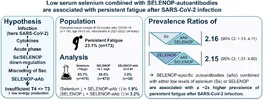
Low serum selenium was measured in 63.7% (n = 478), low SELENOP in 89.6% (n = 672), and elevated SELENOP-aAb in 3.9% (n = 29).
A combination of low selenium and elevated SELENOP-aAb was found in 1.9% (n = 14) participants, a combination of low SELENOP and SELENOP-aAb in 3.2% (n = 24). Individually, all three selenium-related determinants showed no strong indication for an association with persistent fatigue.
However, the combination of selenium deficiency and SELENOP-aAb positivity showed a prevalence ratio of 2.16 (95%-CI: 1.13-4.11), and the combination of SELENOP deficiency and SELENOP-aAb positivity a prevalence ratio of 2.15 (95% Cl: 1.01; 4.60) compared to the reference group.
Web | DOI | PMC | PDF | Redox Biology | Open Access
Schmidt, Börge; Asaad, Sabrina; Mavarani, Laven; Stang, Andreas; Chillon, Thilo S.; Minich, Waldemar B.; Renko, Kostja; Brenner, Thorsten; Schöler, Lara Maria; Dittmer, Ulf; Trilling, Mirko; Schomburg, Lutz
Abstract
Background
Cytokines found during post-acute sequelae after COVID-19 are known to reduce selenoprotein biosynthesis, raising the question whether low selenium, impaired selenoprotein P (SELENOP) production, and autoantibodies to SELENOP (SELENOP-aAb) are associated with persistent fatigue after SARS-CoV-2 infection.Methods
Persistent symptoms and selenium determinants were assessed on average 21.9 months after a PCR-verified SARS-CoV-2 infection in a cross-sectional population-based study (n = 750 adults, 54.1% female).Study participants were categorized based on the presence of low selenium levels (<70 μg/L), low SELENOP levels (<4.1 mg/L), and SELENOP-aAb positivity (≥3.0 BI).
Regression models were fitted to assess associations between selenium determinants and persistent fatigue, adjusted for potential confounders.
Findings
Persistent fatigue was self-reported by 23.1% (n = 173) of participants.Low serum selenium was measured in 63.7% (n = 478), low SELENOP in 89.6% (n = 672), and elevated SELENOP-aAb in 3.9% (n = 29).
A combination of low selenium and elevated SELENOP-aAb was found in 1.9% (n = 14) participants, a combination of low SELENOP and SELENOP-aAb in 3.2% (n = 24). Individually, all three selenium-related determinants showed no strong indication for an association with persistent fatigue.
However, the combination of selenium deficiency and SELENOP-aAb positivity showed a prevalence ratio of 2.16 (95%-CI: 1.13-4.11), and the combination of SELENOP deficiency and SELENOP-aAb positivity a prevalence ratio of 2.15 (95% Cl: 1.01; 4.60) compared to the reference group.
Interpretation
The study indicates that in a fraction of COVID-19 affected participants low selenium/SELENOP levels in combination with SELENOP-specific autoantibodies are associated with a two times higher prevalence of persistent fatigue after SARS-CoV-2 infection.Graphical abstract
Declaration of competing interest
The authors declare the following financial interests/personal relationships which may be considered as potential competing interests: Lutz Schomburg reports a relationship with selenOmed GmbH that includes: equity or stocks. If there are other authors, they declare that they have no known competing financial interests or personal relationships that could have appeared to influence the work reported in this paper.Web | DOI | PMC | PDF | Redox Biology | Open Access