Mast Cell Activation Syndrome (MCAS) - discussion thread

Status
Not open for further replies.
That’s the thing, no medical professional has been able to give me useful advice at all. It seems like we have no idea what this could be.

I get symptoms really typical of allergic reactions, but immediately after overexerting (for me that might just mean sitting up for 30secs or hearing a voice).

(diarrea, sneezing, skin feeling itchy, nausea, agitation, reflux, hive like things appearing). At the same time, it feels intimately linked to my ME, because its triggered by overexertion and nearly always means PEM is coming.

My doctor got me to try the main hyped MCAS meds and as expected nothing mych changed. I’ve kinda just accepted this is an unexplainable mystery. But yeah am wondering if anyone’s had anything similar and if it ever lead to breathing problems/anaphlyaxis.

My hunch is this is in some way related to ME, like it’s part of the mechanism for me, and it probably doesn’t entail classical allergy like reactions, just somehwhat coincidentally produces similar symptoms, but ofc I can’t be sure.
I have allergic type symptoms too since becoming severe/getting covid, and hands going bright red after I eat high histamine foods like curry. I decided to take it seriously after two occasions where I ate a heavily fermented food (kimchi on one occasion and yellow bean paste on another) and had intense symptoms.

After I was put on a low histamine diet a year ago I noticed a lot of symptoms decreased significantly, but the diet is utterly miserable and hard for my carers to stick to. I have tried H1 antihistamines twice, ceterzine made my brain fog worse and a recent trial of fexofenadine coincided with a period of frightening crashes. I have a backlog of famotidine I keep meaning to try.

I really want to reintroduce normal foods but every time I try I crash and feel unwell. This may be correlation not causation though, as it is miserably easy for me to trigger PEM.

I know someone with ME/LC who suffers terribly with MCAS/allergies, and have heard a lot of similar stories in support groups.

I do sometimes think the MCAS clincal category is too broad (Afrin claims it can cause everything under the sun), but imo there is definitely something happening here that sometimes accompanies ME/CFS and worsens with PEM.

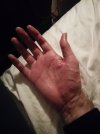
Attached two more extreme examples of said swelling and redness in hands.

Edit: Since covid/becoming severe I also find that black pepper, which I used to love, now burns my mouth, and if a crumb of it stays on my tongue it almost has a numbing effect. so i had to stop eating it.
 

Attachments
  • IMG_20230920_213502.jpg
    IMG_20230920_213502.jpg
    791.9 KB · Views: 12
  • IMG_20220529_233839 1.jpg
    IMG_20220529_233839 1.jpg
    775.6 KB · Views: 12
Last edited:
Attached two more extreme examples of said swelling and redness in hands.

It is difficult to work from. photos but those look like a vasoactive response of the sort one might see with an systemic autonomic response to something like capsaicin (chilli) mimicking a temperature response. I don't see mast cell features - the dermis is not actually oedematous as far as I can see.

I think these sorts of observations might turn out to be useful if we had some decnet academic physicians prepared to analyse them without preconceptions.
 
It is difficult to work from. photos but those look like a vasoactive response of the sort one might see with an systemic autonomic response to something like capsaicin (chilli) mimicking a temperature response. I don't see mast cell features - the dermis is not actually oedematous as far as I can see.

I think these sorts of observations might turn out to be useful if we had some decnet academic physicians prepared to analyse them without preconceptions.
Thanks - I do also get strange fluctuations in body temperature, and overreactions to heat and cold. So perhaps that makes sense.

I have never had any reactions like this to chilli before covid/severe ME (i deteriorated and then got covid shortly after and got even worse) and was a big fan of curry and spicy food generally so I would have noticed.
 
My hands and feet swell up and become red or purple. It almost always happens when they are below my heart, and sometimes just randomly when lying down as well.

I also have the temperature things @V.R.T. talks about. I’m currently lying with the window upen and no shirt, feeling in my upper body like I would at 35C in the sun by the pool when healthy, even though it’s 10C outside. My hands and especially feet are cold.
 
It almost always happens when they are below my heart, and sometimes just randomly when lying down as well.
Mine do this too. It is worse at night and much more noticeable when I have eaten foods like curry or chilli. Perhaps I need to see if it happens after a non spicy high histamine food like canned fish.
 
@V.R.T. I’ve had the same response post covid in palms, cheeks and ears. I think it’s a small fibre nerve/autonomic response causing vasodilation as in erythromelalgia. Eating is often a trigger for me and heat from external sources. I saw a “MCAS” specialist who thought it could be autonomic too.
 
MERUK wrote an article? about “MCAS”.

That looks unhelpful. It fails to quote the study that showed no overlap with ME/CFS. It also fails to point out that MCAS remains a fringe concept in general medicine that has no clear definition. Moreover, Bateman Horne are not a reliable source on things like this.

We now have DecodeME and some other genetic studies that have found nothing to suggest a link.
 
That looks unhelpful. It fails to quote the study that showed no overlap with ME/CFS. It also fails to point out that MCAS remains a fringe concept in general medicine that has no clear definition. Moreover, Bateman Horne are not a reliable source on things like this.

We now have DecodeME and some other genetic studies that have found nothing to suggest a link.

Doesn’t GWAS have some pretty big limitations? Particularly only picking up a small subset of traits and therefore link to illness
 
Doesn’t GWAS have some pretty big limitations? Particularly only picking up a small subset of traits and therefore link to illness

I don't think so in this context. The point of GWAS is to look for skewing of presence of groups of linked SNPs right across the genome.

For genetic predisposition to mast cell activation to be significantly linked to ME/CFS and nothing show up on a GWAS I think you have to concoct a pretty complicated story of lots of rare genes with no linked SNPs for any that show up more than very infrequently.

Nothing is impossible but when there was no good reason to think mast cell problems were linked to ME/CFS other than in the minds of fringe physicians I think it is relevant that nothing has been found.
 
Posts moved from this thread

What are you meaning by 'ME', rather than ME/CFS? The only set of criteria I know of that claim to identify 'ME' are the Carruthers International Criteria from around 2012. Hardly anyone uses them and they don't really make any sense and were never validated in any meaningful way.

MCAS is probably not a useful category. There is no generally accepted definition and I know of no reason to add the concept to what we already have (allergy, mastocytosis etc.) It is a name invented by a physician called Afrin who has never substantiated it.

Diagnostic criteria are by and large valueless, except for standardising certain types of research. I spent my career researching rheumatoid arthritis, working out mechanisms and developing treatments without ever remembering what the diagnostic criteria were supposed to be. I nsed any criteria in a clinic. They are not relevant to real clinical care. Every patient has a slightly different problem. Treatment choice depends on much more complex distinctions.
Thanks for elaborating.

How do you describe your symptoms? (I presume you have something "ME" like or you wouldn't participate here? Forgive me if that's too presumptuous.)

Have you read Larry Afrin's book, "Never Bet Against Occam," Amber Walker's "Mast Cells United," or any of Anne Maitland' journal publications, etc..., et al? (I'm not asking leading questions--only attempting to determine the best way for us to continue from here.) It's been substantiated ad nauseam.

Do you know of any primary sources attributing the coinage to Larry? I don't recall seeing any.

The basic utility of MCAS as a diagnosis per se is that is provides a distinction between between the Mast Cell Activation Diasease mastocytosis, which has a primary feature of mast cell overabundance, and MCAS, which devolves to mast cell dysfunction. Its basic utility there is that its multistemicity distinguished it from allergic reactions which are mostly dermal and/or respiratory. For example, I've experienced tremendous improvements from medicine adjustments, either by dose or by class, by treating my symptoms as MCAS indicated rather than allergy indicated.

I'm sympathetic to your n-of-1 complexity conclusion, but I think nosolological challenges are still too nascent to swept away piecemeal as without clinical value, and suspect that what gains have been made have been done by the heterogeneity of MCAS moving the pendulum towards appreciation of complexity in clinical choice making when presentations involving possible MCAD/allergy confounds.
 
Last edited by a moderator:
How do you describe your symptoms? (I presume you have something "ME" like or you wouldn't participate here? Forgive me if that's too presumptuous.)

You are not to know. I do not have ME/CFS or anything related and nor does anyone in my family. I am a full professor of connective tissue medicine/immunology at University College London, known mainly as having developed and validated what is known as B cell depletion therapy for autoimmune disease with drugs like rituximab. I got asked to advise on ME/CFS research because of the interest in rituximab and for the last ten years have spent much of my time trying to help set up high quality research and advocate for good clinical guidelines.

I am retired from research so have no competing interests and no investment in any particular theory, just good science.
Have you read Larry Afrin's book, "Never Bet Against Occam," Amber Walker's "Mast Cells United," or any of Anne Maitland' journal publications, etc..., et al? (I'm not asking leading questions--only attempting to determine the best way for us to continue from here.) It's been substantiated ad nauseam.

I tend to keep away from popular medical science books and stick to research publications. However, I have seen enough of the writings of these authors to know that the field of 'MCAS' is largely make-believe. You might be able to change my mind - I am always open to that - but having followed the story of misinformation on this for ten years I doubt it.

A useful index of the validity of a clinical category is a reasonably precise measure of prevalence. For 'MCAS' I have seen figures that vary by about 100-fold. That is not a useful category. Either it is as common as some claim, in which case it ought to be better defined by now, or it is a rare genetic group defined by abnormal tryptase metabolism or some such. Nobody seems to know. Moreover, I know of no reliable evidence for mast cell problems being associated with persistent disabling fatigue. Everything I have seen from epidemiology and lab research suggests there is no relation.
The basic utility of MCAS as a diagnosis per se is that is provides a distinction between between the Mast Cell Activation Diasease mastocytosis, which has a primary feature of mast cell overabundance, and MCAS, which devolves to mast cell dysfunction.

I am aware of that but since the evidence for 'mast cell dysfunction' is too vague to be of any use I fail to see the point.
Its basic utility there is that its multistemicity distinguished it from allergic reactions which are mostly dermal and/or respiratory.
Anaphylaxis is systemic. Which is why there is shock.
For example, I've experienced tremendous improvements from medicine adjustments, either by dose or by class, by treating my symptoms as MCAS indicated rather than allergy indicated.

I am sorry to appear so sceptical but personal claims of this sort abound for anything and everything including homeopathy, with nothing in it. What is the difference in 'indication' when as far as I know we have no reliable trials specific to MCAS?

I think nosolological challenges are still too nascent to swept away piecemeal as without clinical value

I have no idea what that means. Most people here have no idea what nosology is so it would help to use plainer English!
 
Do you believe official sources don't exist? If not, what would justify their authority?

What is an 'official source' for scientific information? Authority comes only from clear rational argument and reliable evidence. Diagnostic criteria committees usually have precious little of either.

What's the alternative to "empty" authority? Is it the same thing that enforces the "need" to understand criteria-less clinical diagnostics?

As above.
 
Welcome @hallmarkOvME !

Have you read Larry Afrin's book, "Never Bet Against Occam," Amber Walker's "Mast Cells United," or any of Anne Maitland' journal publications, etc..., et al? (I'm not asking leading questions--only attempting to determine the best way for us to continue from here.) It's been substantiated ad nauseam.
I don't think there are dedicated threads to most of these works here on S4ME but a few members with relevant background have commented on the books and its content at various timepoints. The views I've seen are always that it is nonsense (see for instance posts 1 and 2 or threads such as this one), should that not be the case it would be nice to see the arguments that are typically brought up against it to be refuted, especially given MCAS popularity in some circles.
 
Last edited:
Just chiming in that opposition to the concepts of MCAS, hEDS, POTS, PENE, etc. does not mean that anyone distrusts someone when they say they experience symptoms.

The problem with all of these concepts is that they try to tie all kinds of symptoms together with unevidenced, speculative, and usually just plain wrong stories about pathology.

This usually happens when we lack an understanding of the actual pathology, and some doctors see fit to give their own explanation - often for their own gain. They provide unevidenced treatments because that claim it’s unethical to not help, but completely ignore that they have no proof they are actually helping.
 
Status
Not open for further replies.
Back
Top Bottom