Apologies for any confusion! I simply wanted to avoid giving the impression that I was speaking for you in posting the criteria details.My view is you only need to Conenssu 2 to diagnose. But if I were a Consensus 1 believer, I would confess I don't understand your question. I doubt it has much if anything to do with your question's quality, but rather my ignorance. Perhaps if you dumb it down some?

- Home
- Forums
- Discussion topics
- Other specific illnesses discussions
- Immune: Autoimmune and Mast Cell Disorders
You are using an out of date browser. It may not display this or other websites correctly.
You should upgrade or use an alternative browser.
You should upgrade or use an alternative browser.
Mast Cell Activation Syndrome (MCAS) - discussion thread
- Thread starter Dakota15
- Start date
Regarding Consensus-2, the origin of the term appears to be in this paper by Afrin et al:
Edited to correct some confusion on my part.
Just to be clear, as the AI-response did not include the details, is this the MCAS criteria you have been talking about, @hallmarkOvME ?
Diagnosis of mast cell activation syndrome: a global “consensus-2"
Which, as part of its supplemental material, includes critiques of existing MCAS criteria. Which designates the criteria developed by Molderings et al. and refined in a 2017 paper as Consensus-2:Risk of solid cancer in patients with mast cell activation syndrome: Results from Germany and USA
This latter paper includes two sets of criteria as part of its supplementary data. The first is what Afrin et al designate as Consensus-2:
Table S2 Criteria defining Mast Cell Activation Syndrome (MCAS)
1. Constellation of clinical complaints attributable to pathologically increased MC activity (MC mediator release syndrome)
Minor criteria
1. Multifocal or disseminated infiltrates of MCs in marrow and/or extracutaneous organ(s) (e.g., gastrointestinal or genitourinary tract; >19 MCs/high power field)
2. Abnormal spindle-shaped morphology in >25% of MCs in marrow or other extracutaneous organ(s)
3. Abnormal MC expression of CD2 and/or CD25 (i.e., co-expression of CD117/CD25 or CD117/CD2)
4. MC genetic changes (e.g., activating KIT codon 419, 509 or 560 mutations) shown to increase MC activity
5. Evidence (typically from body fluids such as whole blood, serum, plasma, or urine) of above-normal levels of MC mediators including:
6. Symptomatic response to inhibitors of MC activation or MC mediator production or action
Criteria proposed to define mast cell (MC) activation syndrome when all other diagnoses that could better explain the full range and chronicity of the findings in the case have been excluded (modified from [16]). The diagnosis mast cell activation syndrome is made upon fulfilment of the major criterion plus at least one minor criterion.
Edited to correct some confusion on my part.
Just to be clear, as the AI-response did not include the details, is this the MCAS criteria you have been talking about, @hallmarkOvME ?
Last edited:

hallmarkOvME
Senior Member (Voting Rights)
I'm pissed at the AI and at myself for trusting. I put up screen shots from the Walker book asap and AI posts. Sorry for wasting you and the mod's time.Regarding Consensus-2, the origin of the term appears to be in this paper by Afrin et al:
Diagnosis of mast cell activation syndrome: a global “consensus-2"
Which, as part of its supplemental material, includes critiques of existing MCAS criteria. Which designates the criteria developed by Molderings et al. and refined in a 2017 paper as Consensus-2:
Risk of solid cancer in patients with mast cell activation syndrome: Results from Germany and USA
This latter paper includes two sets of criteria as part of its supplementary data. The first is what Afrin et al designate as Consensus-2:
Edited to correct some confusion on my part.
Just to be clear, as the AI-response did not include the details, is this the MCAS criteria you have been talking about, @hallmarkOvME ?
Last edited:
hallmarkOvME
Senior Member (Voting Rights)
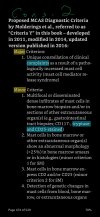
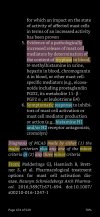
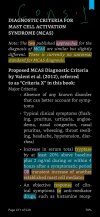
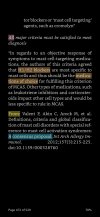

Jonathan Edwards
Senior Member (Voting Rights)
I am completely confused by all this . Are we supposed to look at criteria X or Y? Is one of them consensus 2?
Jonathan Edwards
Senior Member (Voting Rights)
In general I don't think these criteria make sense as ways to identify a particular pathological entity. Like the ICC ME/CFS criteria they include preconceptions and interpretations that will bias clinicians. They also appear to be a scattershot set of abnormalities that are quite likely each to relate to quite different pathologies.
Sets of criteria like this with 'major' and 'minor' criteria hark back to the Duckett Jones criteria for rheumatic fever maybe seventy year ago. Real medicine has largely moved on from this sort of pick and mix approach to focus on individual measurable abnormalities.
The core problem is that , as for ICC, clinicians and lab workers in private clinics can apply these criteria so loosely that anybody can be diagnosed. And that seems to be exactly what happens.
I have worked with histology of mast cells in both human and rodent tissues. They are all over the place in normal tissue, especially gut, where they are the most common cause of staining artefacts.
Sets of criteria like this with 'major' and 'minor' criteria hark back to the Duckett Jones criteria for rheumatic fever maybe seventy year ago. Real medicine has largely moved on from this sort of pick and mix approach to focus on individual measurable abnormalities.
The core problem is that , as for ICC, clinicians and lab workers in private clinics can apply these criteria so loosely that anybody can be diagnosed. And that seems to be exactly what happens.
I have worked with histology of mast cells in both human and rodent tissues. They are all over the place in normal tissue, especially gut, where they are the most common cause of staining artefacts.
Thank you for digging these up and sharing them - I know it's a pain. As I have just discovered myself, the multiple revisions for both sets of criteria across a series of publications (each buried in supplemental material) don't make it easy.
The work is appreciated.
hallmarkOvME
Senior Member (Voting Rights)
Great! Thank you. I'd love to see what you think of the data. But like you said, it's hard and takes time, especially when you're sick like most of us are.Thank you for digging these up and sharing them - I know it's a pain. As I have just discovered myself, the multiple revisions for both sets of criteria across a series of publications (each buried in supplemental material) don't make it easy.
The work is appreciated.

Murph
Senior Member (Voting Rights)
Update: 11 months later and I have histamine almost wholly under control despite bringing back dexamfetamine, fish oil and coffee.I've done six things at the same time to help get rid of my histamine intolerance and they seem to have worked. I will now test them one at a time to see what was the biggest and most important part.
1. Cut out shark liver oil which I was taking; fish are famously a source of histmaines and the timeline lines up.
2. Cut out sodium butyrate, this supplement is supposed to help the gut. The timing lines up but I don't think it's my prime suspect -I started taking it after my gut went bad (I think).
3. Cut out dexamfetamine. My POTS doctor prescribed this and I think it helps me, but taking it correlates with having red spots on my face. There is absolutely no published data or theory linking dex to histamine whatsoever but nevertheless it is my prime suspect!! I had increased my dose recently at the time my histamine intolerance got very bad.
4. DAO. I started taking a DAO supplement, it is supposed to help break down histamine. I reckon this is important.
5. daily antihistamines, I started taking fexofenadine in the morning and loratadine at night. idk if these make a big difference - need to test each individually.
6. I cut out coffee. (still taking caffeine in other forms). this has defintiely reduced the gut symptoms of histamine intolerance. I really love coffee and really want to bring this back!
the most recent thing I've added that seems to have coincided with far better gut health is a new brand of sodium butyrate that actually contains sodium butyrate. (Turns out the one I was taking last year contained sodium and also butyrate. )
I think timely application of DAO, regular antihisatmines, and avoiding histamine foods has helped most. I've also got quercetin in the mix.

Exclusive | The unpredictable disease attacking women 5 times more than men — doctors only study it for ‘one minute’
The condition is elusive and shifts without warning. Patients eat normally one day, then go into anaphylaxis the next. Reactions can be triggered by stress, environment or even sunlight.
 nypost.com

Sly Saint
Senior Member (Voting Rights)
Woman allergic to almost everything from food to weather and her sofa
A woman has revealed she can only eat 25 foods without risking death as her body keeps developing new allergies – but there’s one thing keeping her alive. Kate Hegan, 22, spends each day worrying it’ll be her last as her body keeps developing new allergies.
Kate, a teaching student from Somerset, said: “Currently, I can only eat around 25 foods without my life being on the line. And it’s not just food that my body reacts to; it’s even my own hormones, bodily processes, smells and temperature changes.
“Now, it’s our sofa. It’s absolutely terrifying, as when I go into anaphylaxis, I’ve got minutes before I’m dead. I’m trying to live as normally as possible, with caution, but with every meal, everything I do, I’m so scared.
Kate was diagnosed with mast cell activation syndrome (MCAS) just before her 18th birthday in 2022. The warning signs of a potentially life-threatening reaction include facial flushing, gastrointestinal issues, extreme fatigue, brain fog, rashes, sore skin, swelling of the eyes and wheezing.
She currently takes 15 medications a day to help reduce the severity of the attacks, as well as paying £1,000-per-month for antibody injections since this isn’t covered on the NHS.

Woman allergic to almost everything from food to weather and her sofa
22-year-old Kate Hegan says there is just one thing allowing her to live an almost normal life
How should phenomena like elevated interleukins be seen in the context of inflammatory/anti inflammatory activity or indeed as per your cotton picking analogy not relevant either way?Nobody has any real idea. It isn't inflammation, I think we can be sure, because all the body's indicators of inflammation are negative. It has nothing to do with mast cells, I think we can be pretty sure, since it bears no resemblance to mast cell phenomena. Some people with ME, like the rest of the population, may get mast cell activation as part of allergy or non-allergic responses but the only meaningful studies I have seen show no special link between this and ME.
The only thing that is consistent is that there is a group of physicians who like to build stories about linked illnesses, half of which do not really exist. I have worked closely with these people and my view is they have no understanding how to gather reliable evidence. They are really only concerned with kudos and fees. To put it bluntly I would not pay any attention to doctors who think MCAS is part of the ME/CFS picture. The field is simple, nothing to dissect, - it is 90% bullshit. The bit that matters is just plain old ME.
Last edited:
Jonathan Edwards
Senior Member (Voting Rights)
How should phenomena like elevated interleukins be seen in the context of inflammatory/anti inflammatory activity
Elevated interleukins provide circumstantial evidence for inflammation but not direct evidence. If the direct evidence is negative that overrides any signals measured in blood that might be a spin off if inflammation was there.
And we do not find elevated interleukins consistently anyway.