Brainnwahable or notPoint 6 of the inlusion criteria:
"Scoring higher in contemplation, action or maintenance scores than the precontemplation phase on the readiness to change questionnaire"
Can someone help me understand what that means?

- ME/CFS and Long Covid research
- ME/CFS and Long Covid research
- Psychosomatic research - ME/CFS and Long Covid
You are using an out of date browser. It may not display this or other websites correctly.
You should upgrade or use an alternative browser.
You should upgrade or use an alternative browser.
Protocol McMaster University conducting an LP trial (FALCON)
- Thread starter rvallee
- Start date

Lou B Lou
Senior Member (Voting Rights)
Point 6 of the inlusion criteria:
"Scoring higher in contemplation, action or maintenance scores than the precontemplation phase on the readiness to change questionnaire"
Can someone help me understand what that means?
From The Study Plan -
'Preparation consists of an audio home-study module (about 4 hours total) and about 1 hour of preparatory coaching by telephone or videoconference in the days to weeks before delivery of the LP intervention to orient participants to the approach and address any questions.'
Perhaps they will do the 'Readiness to Change' questionnaire before and after the Preparatory coaching.
The purpose of Lightning preparation is to get them to stop asking awkward questions.
To 'Be Ready to do Lightning Process' is to become Compliant/Obedient in advance of doing it.
If they persist in asking awkward questions, expressing doubts, then they are deemed 'Not Ready'. Being 'Not Ready to do the Lightning Process' means they are not motivated, not willing or eager enough to Stop Being Sick.
After all, this study does not want to enroll those unmotivated types who just want to wallow in their illness for ever, not even trying to get better. As is spelled out in the study overview - this study only wants those who are "motivated and show willingness to change their condition through intervention."
Edit add - the study applicants who are considered to be motivated to get better through interventions are only those who are, or become, Compliant and Obedient to Lightning Process Trainers commands.
Though exactly what the 'contemplation, action or maintenance scores' refer to is still obscure.
.
Last edited:

Copying from another thread, but I think it bears repeating when we are considering who funds the McMaster university department:
"McMaster University helpfully has a feature article on Edward J Mills.
"McMaster University helpfully has a feature article on Edward J Mills.
The People Behind the Impact with Edward Mills: A collective responsibility to look after each other
Edward Mills, a part-time professor in the Department of Health Research Methods, Evidence, and Impact, is also a generous donor, guided by a strong sense of responsibility to care for one another.
The Department of Health Research Methods, Evidence, and Impact (HEI) can thrive thanks to the generous support of donors who share its commitment to advancing health research.
Among them is Edward Mills — “Call me Ed,” he says — a part-time HEI professor motivated by what he describes as “a collective responsibility to look after each other.”
Mills first connected with the department in 2002, when HEI was still known as the Department of Clinical Epidemiology and Biostatistics. He collaborated as a researcher with HEI distinguished professor Gordon Guyatt, who encouraged Mills to pursue a PhD focused on clinical epidemiology in the Health Research Methodology program.
“It was during this time that I met and developed friendships with other students who would later become brilliant faculty,” Mills shares. This includes current HEI faculty members P.J. Devereaux, Holger Schunemann, Elie Akl, and Jason Busse.
Mills describes his HEI learner experience as profound. “I was given the confidence to pursue an academic career and subsequently a business career in a closely aligned area,” he shares. “McMaster has always been a very collegial environment and so I worked closely with colleagues across the department and would subsequently also start businesses with them.”
Redwood Outcomes appears to be a 'Systematic Health Research reviews for hire' company. They also do PR for companies wanting to promote health products.Mills is referring to his friend and colleague Kristian Thorlund, a part-time HEI assistant professor. Both have previously created and exited companies including Redwood Outcomes and MTEK Sciences.
More than ever, our clients in the pharmaceutical and biotech industries need to demonstrate from which of many competing treatments patients are most likely to benefit."
Trish made a thread a while back - it seemed that the McMaster ideas had spread to the University of British ColumbiaWhat is it with McMaster University?
Is it just the one in Canada or are there more of them that aren't like this (ie is McMaster a bigger brand or just the local name)
I am starting a thread about Professor Ric Arseneau because I have come across some information about him that is concerning. I understand he gave an online presentation to people with ME/CFS, FM and related conditions.

Utsikt
Senior Member (Voting Rights)
I found this page on google, and it referenced this youtube video that is private.DNRS feature McMaster on their website, as far as I know this study was never done, not published, and you cannot find it:
Ongoing Research | Dynamic Neural Retraining System | DNRS
Explore ongoing research on DNRS, a neuroplasticity-based program for chronic illness recovery. See how science supports DNRS.retrainingthebrain.com
I wonder what makes McMaster an easy target for these scams. I had an MD reference this website to me as proof it works. Seriously the MD didn’t even google if this study exists. They still stand by it.
Edit: this just brought back so much frustration I emailed that MD’s office the studies they are presenting do not exist.
I can’t find anything about the supposed study on researchgate.Dr Dale Guenter, DNRS research results at NAPCRG conference 2019 (video) – YouTube 18.43min
I found this on the page of NAPCRG:
MB14: Neuroplasticity-based treatment for fibromyalgia, chronic fatigue and multiple chemical sensitivity: feasibility and outcomes (Pearls) (Multimorbidity)
×Date
11/17/2019
Time
11:00 am - 12:00 pm
Room
Pier 3
Presenters
Dale Guenter, MD, MPH, CCFP,FCFP
Abstract
Context:
Persistent distressing symptoms that are difficult to categorize diagnostically are common in primary care, disabling for people who experience them, and frustrating for those providing care.
Objective:
Evaluate the feasibility of research involving participants in the Dynamic Neural Retreating System (DNRSTM), and impact on a variety of symptoms.
Design:
Quasi-experimental feasibility study with 1 year follow-up and analysis of outcomes for signal of change.
Setting:
8 in-person 5 day training programs in community settings in 4 countries over 1 year.
Population Studied:
102 adults with persistent distressing symptoms who attended a DNRSTM training seminar in one of 4 countries.
Intervention:
Participants attended 28 hours of training in the DNRS™ treatment approach over 5 days. This approach combines aspects of CBT, MBSR and other modalities with the objective of decreasing stimulus of neural pathways involved in the threat response, and increasing stimulus of neural pathways involved in a healthy and adaptive cognitive, emotional and sensory experience.
Outcome Measures:
Primary outcome at 3, 6 and 12 months was health status using SF-36.
Secondary outcomes were chemical sensitivity (MCS) using Quick Environmental Exposure and Sensitivity Inventory (QEESI), fibromyalgia (FM) symptoms with Symptom Impact Questionnaire (SIQR), chronic fatigue (CFS) with Fatigue Severity Scale (FSS), anxiety with Generalized Anxiety Disorder 7-Item Scale (GAD-7) and depression with Patient Health Questionnaire (PHQ-9).
Results:
Feasibility was good with 68% of training program participants agreeing to research, 85% completing at least 1 follow-up time point, and 63% completing 12 month time point.
Baseline SF-36 scores were comparable to fibromyalgia populations described in the literature.
All SF-36 domains improved markedly, with greatest improvement of 45 points for Role Physical (95% C.I. 30.7,59.6).
In addition the proportion of participants meeting criteria for MCS, CFS, FM, depression and anxiety decreased by 61% (FM in SIQR) to 88% (anxiety in GAD-7).
All scores at all follow-up time points showed sustained improvement, and were different from baseline measures with p<0.001.
Conclusions: This study provides support for a unifying theory of central sensitization for many overlapping chronic conditions. Neuroplasticity principles provided improvement in symptoms greater than other approaches in the literature, for this specific population.
Upon completion of this session, participants should be able to:
- Describe the unifying theory of central sensitization, and the role of neuroplasticity, in the pathophysiology of persistent distressing symptoms
- Explain how specific measures may be applied through a quasi experimental study in a treatment population
- Identify which symptoms are likely to improve through neuroplasticity-based treatment

SugarSquared
Senior Member (Voting Rights)
As a Canadian, McMaster University is just a university in Hamilton, Ontario. I’ve never heard of them more than just one university among the many in Ontario.What is it with McMaster University?
Is it just the one in Canada or are there more of them that aren't like this (ie is McMaster a bigger brand or just the local name)

It probably just comes with being all-in on psychobehavioral evidence-based medicine. It's mainly a vehicle to promote a particular brand of quackery, so it naturally comes with a lot of quackery.What is it with McMaster University?
Is it just the one in Canada or are there more of them that aren't like this (ie is McMaster a bigger brand or just the local name)
Seems mainly to be the equivalent of "do you accept the flying spaghetti monster as your lord and savior?" as an entry test for belonging to the church of the flying spaghetti monster.Point 6 of the inlusion criteria:
"Scoring higher in contemplation, action or maintenance scores than the precontemplation phase on the readiness to change questionnaire"
Can someone help me understand what that means?
Others might frame it as something like "do you believe that ghosts reside in your body and are causing sickness?" or "do you believe in chakras?" And it won't bother anyone because hope and faith in treatment has pretty much become the dominant approach in the last decade. It's been turned into a good thing to maximize all the biases. They still have to coat it in some bullshit academese, but it's the same thing.

Kalliope
Senior Member (Voting Rights)
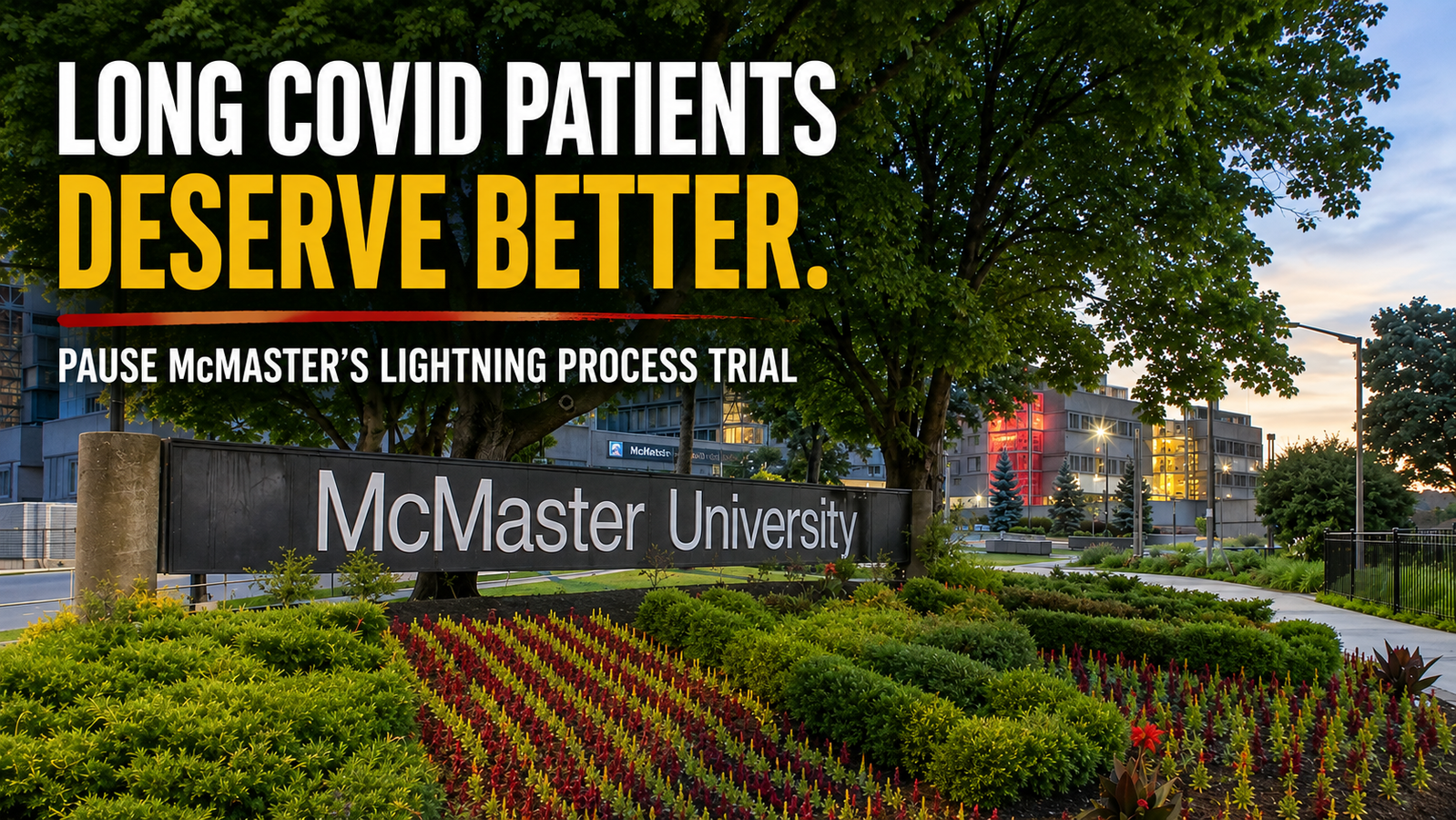
There is a petition initiated by Robert DeRosa asking to pause the trial:
Long COVID Patients Deserve Better: Pause McMaster's FALCON Lightning Process Trial
 www.change.org
Long COVID Patients Deserve Better: Pause McMaster's FALCON Lightning Process Trial
The Issue
Petition to McMaster University, the Hamilton Integrated Research Ethics Board, the Faculty of Health Sciences, and the funders of the FALCON study.
McMaster University has launched the Fatigue in Long COVID (FALCON) clinical trial (ClinicalTrials.gov ID: NCT07697261), which compares the commercially branded Lightning Process with activity pacing in people living with Long COVID.
We are calling on McMaster University to pause recruitment for the FALCON trial until an independent scientific, ethical, and patient-led review has addressed serious concerns regarding the study's design, transparency, participant protections, conflicts of interest, commercial relationships, and use of objective outcome measures.
This is not a call to stop Long COVID research.
It is a call for better Long COVID research.
Why this matters
More than six years after the pandemic began, millions of people continue to live with Long COVID.
Patients still face enormous barriers to diagnosis, treatment, disability support, and recognition. At the same time, Canada has committed relatively limited resources to Long COVID research compared with the scale of the crisis.
Every Canadian treatment trial matters.
Every research dollar matters.
That is why many patients are deeply concerned that one of Canada’s leading medical institutions has chosen to study a commercially branded program focused on changing how people think about, interpret, and respond to their symptoms, rather than prioritizing research into the underlying biology of this disease.
Our concerns
1. Long COVID is increasingly understood as a complex biomedical illness.
Research from around the world continues to identify abnormalities involving the immune system, viral persistence, the vascular system, autonomic function, metabolism, inflammation, and other biological processes.
Psychological support can be an important part of living with any chronic illness.
However, psychological support is fundamentally different from testing an intervention whose central premise is that changing thoughts, beliefs, language, and behavioural responses may substantially improve the illness itself.
Many patients fear this risks reinforcing the psychologizing of Long COVID—a narrative that has already contributed to stigma, delayed diagnosis, barriers to disability benefits, and dismissal within healthcare.
2. The study appears heavily dependent on subjective outcomes.
The FALCON trial is open-label, meaning participants know which intervention they receive.
Its primary outcome appears to rely on self-reported fatigue.
This raises an important scientific concern.
A program specifically designed to change how participants perceive and describe their symptoms is being evaluated largely by asking participants whether those symptoms have changed.
Patients deserve to know:
Objective improvement—not simply changes in symptom reporting—should be central to evaluating any treatment.
- Will participants objectively regain physical function?
- Will they be able to walk farther?
- Return to work?
- Care for their families?
- Increase daily activity without worsening?
3. Canada’s scarce research capacity should be used wisely.
Canada already conducts relatively few Long COVID treatment trials.
Patients continue to wait for meaningful biomedical therapies while researchers around the world investigate:
With so little Canadian research capacity available, many patients are asking:
- viral persistence
- immune dysfunction
- endothelial injury
- autonomic dysfunction
- metabolic abnormalities
- biomarkers
- antiviral therapies
- immune-modulating treatments
Why is this where our limited resources are being directed?
4. Greater transparency is needed.
The Lightning Process is a commercially branded program delivered by trained practitioners.
Patients deserve complete transparency regarding:
Transparency should be expected—not requested.
- who is funding this trial;
- the total value of the grant;
- any licensing or trademark fees;
- payments made to practitioners;
- commercial relationships;
- potential conflicts of interest;
- and whether anyone connected to the Lightning Process participated in designing the study.
We respectfully call on McMaster University to:
Long COVID patients deserve better.
- Pause recruitment until an independent scientific, ethical, and patient-led review has addressed concerns regarding the study's methodology, transparency, participant protections, commercial relationships, conflicts of interest, and objective outcome measures.
- Publicly disclose all funding sources and commercial relationships connected to the trial.
- Publish the full study protocol and statistical analysis plan.
- Clearly explain what objective measures—not simply self-reported questionnaires—will determine whether participants have truly improved.
- Demonstrate how the study will detect post-exertional symptom worsening, deterioration, adverse events, and loss of function.
- Meaningfully involve people living with Long COVID in reviewing the study’s design.
People living with Long COVID have spent years fighting to have this illness recognized as real.
They deserve rigorous science.
They deserve transparency.
They deserve meaningful biomedical research.
Most importantly, they deserve research that does not risk returning this illness to a framework centred on patients’ thoughts and behaviours before its underlying biology has been adequately understood.
McMaster University has an opportunity to lead.
We urge McMaster University to pause recruitment until these concerns have been independently reviewed and publicly addressed, ensuring that any future Long COVID research meets the highest standards of scientific rigor, transparency, participant safety, and accountability.
Please sign this petition if you believe Long COVID patients deserve research that is transparent, scientifically rigorous, and worthy of the people whose lives depend on it.
Sign the Petition
Long COVID Patients Deserve Better: Pause McMaster’s FALCON Lightning Process Trial
www.change.org
DNRS feature McMaster on their website, as far as I know this study was never done, not published, and you cannot find it:
I wrote about it here. https://virology.ws/2020/09/02/trial-by-error-what-is-the-dynamic-neural-retraining-system/

ChronicallyOverIt
Senior Member (Voting Rights)
lol it’s worse than I imagned

shak8
Senior Member (Voting Rights)
It's always the same scenario. Someone suffers, they get better over time and attribute it to a miracle theory that they've devised.
They feel like a savior and feel impelled to spread the word of their miracle and profit from it, of course, trade-marked.
This belongs in the wellness industry which rakes in billions each year. No cure, no disease treatment, just fads.
They feel like a savior and feel impelled to spread the word of their miracle and profit from it, of course, trade-marked.
This belongs in the wellness industry which rakes in billions each year. No cure, no disease treatment, just fads.
Last edited:

Chandelier
Senior Member (Voting Rights)
From the article:
Also interesting:DNRS founder Annie Hopper, a compelling speaker, is not a doctor or a scientist and does not pretend to be.
The website identifies her as a “limbic system rehabilitation specialist.”
In 2004, according to the website, Hopper was fully engaged as a “core belief counselor, newspaper columnist and talk show guest as an expert in Emotional Wellness.”
Then Hopper’s health began to deteriorate, for unknown reasons.
As the website explains:
“Mysterious symptoms like insomnia, headaches, body aches and pains, chronic exhaustion and an increasing list of sensitivities ensued.
Toxic overload was the eventual diagnosis.
But even after undergoing detoxification treatments and an extensive list of healing treatments from over thirty different practitioners, her symptoms continued to escalate.
This was the beginning of what can only be described as a type of science fiction nightmare.
After almost 4 years of suffering that eventually led to homelessness, Hopper deduced that a toxic brain trauma was most likely at the root of her suffering.
Hopper went on to creatively rewire the neural circuits in her brain that had been altered due to toxic trauma and the symptoms of illness eventually dissipated.
In 2008, as a result of her own experiences, Hopper launched DNRS, which offers five-day in-person workshops as well as individual coaching, online courses, access to support groups, and so on.
In a 2013 critique of “brain retraining” programs like DNRS on the site Science-Based Medicine, Yale neurologist and professional skeptic Steven Novella noted the following: “Just doing something, anything, to address a chronic problem is likely to make someone feel better. In the case of “brain training” interventions, there are real cognitive benefits to the increased mental activity.
The problem is the layer of pseudoscience placed on top of this legitimate but limited intervention.”
Kalliope
Senior Member (Voting Rights)
Trial by Error: Canada's McMaster University Launches Trial of Lightning Process for Long Covid
quote:
Now we have the announcement of this Lightning Process trial—another development in the ongoing debate over whether mind-body interventions lead to significant improvement and full recovery in people suffering from ME/CFS, Long Covid, and related disorders. These mind-body programs all invoke the concept of “neuroplasticity” to make their scientific case. They generally include a range of modalities, including meditation, relaxation techniques, positive affirmations, and so on. They postulate that symptoms are caused by an overactive and/or dysregulated nervous system; the interventions are designed to calm it down.
 virology.ws
quote:
Now we have the announcement of this Lightning Process trial—another development in the ongoing debate over whether mind-body interventions lead to significant improvement and full recovery in people suffering from ME/CFS, Long Covid, and related disorders. These mind-body programs all invoke the concept of “neuroplasticity” to make their scientific case. They generally include a range of modalities, including meditation, relaxation techniques, positive affirmations, and so on. They postulate that symptoms are caused by an overactive and/or dysregulated nervous system; the interventions are designed to calm it down.
Trial By Error: Canada's McMaster University Launches Trial of Lightning Process for Long Covid | Virology Blog
By David Tuller, DrPH McMaster University in Hamilton, Ontario, has launched a clinical trial of the Lightning Process (LP), a well-known “mind-body” interv ...
virology.ws
lelelemonade
Established Member
I was looking for info on what LP actually is because I just couldn’t imagine how they made a whole course out of positive thinking and self gaslighting, and found this article by @dave30th
virology.ws
The fact that this is the “treatment” being investigated by a respectable research university is outrageous.
Trial By Error: Joan McParland's Lightning Process Experience | Virology Blog
by David Tuller, DrPH Aura-reader and Tarot expert Phil Parker, also known as the founder of the Lightning Process, has posted a video on YouTube of an &quo ...
virology.ws
The fact that this is the “treatment” being investigated by a respectable research university is outrageous.

Peter T
Senior Member (Voting Rights)
a respectable research university
I am not sure this description applies in relation to their involvement with ME/CFS and now Long Covid.
Kalliope
Senior Member (Voting Rights)
Edzard Ernst has written about the study:
quote:
By investigating a proprietary, fee-based intervention without incorporating objective biological markers, the trial risks lending academic legitimacy to bogus quackery. In other words, it is debatable whether a study of a treatment as implausible as LP is needed at all. However, if a trial were to be conducted, it would seem to be essential that it is rigorous with as little room for bias as possible. To be blunt: the new study is not going to advance our knowledge one iota.
quote:
By investigating a proprietary, fee-based intervention without incorporating objective biological markers, the trial risks lending academic legitimacy to bogus quackery. In other words, it is debatable whether a study of a treatment as implausible as LP is needed at all. However, if a trial were to be conducted, it would seem to be essential that it is rigorous with as little room for bias as possible. To be blunt: the new study is not going to advance our knowledge one iota.
The ‘Lightning Process’ – a new trial is starting
McMaster University has launched a trial to evaluate the Lightning Process (LP). We have discussed the LP before, e.g.: Almost anyone can recover from long Covid: just pay a lot of money for the ‘Lightning Process’ – no, please don’t; I was joking! ME/CFS: Yes, the ‘Lightning Process’ is...
edzardernst.com

NelliePledge
Senior Member (Voting Rights)
Short and to the point 
That's obviously the goal. I don't understand pretending otherwise, nothing is gained from not simply stating obvious facts. Trials like this are explicitly meant to provide marketing for psychosomatic ideology, validating what is true and/or effective is not and has never been part of it. The medical profession has been promoting bogus quackery like this for decades, as a matter of preference over letting go of massively harmful psychosomatic models.By investigating a proprietary, fee-based intervention without incorporating objective biological markers, the trial risks lending academic legitimacy to bogus quackery
This has been going on for decades and amounts in the thousands of individual trials based on this approach. Health care seems to be an industry that has effectively rooted out every last bit of ability to stand up and call out that the emperor is not only naked, but is an absolute ass about it.