Preprint Microbiota-induced intestinal barrier disruption drives BAFF-mediated B-cell dysregulation and autoimmunity in long COVID, 2026, Doyon-Laliberté et al

Covidivici

Established Member (Voting Rights)
Microbiota-induced intestinal barrier disruption drives BAFF-mediated B-cell dysregulation and autoimmunity in long COVID

Doyon-Laliberté, Kim; Aranguren, Matheus; Gao, Fandi; Leclerc, Laurence; Fourcade, Lyvia; Patel, Suhani; DuSablon, Charlotte; Conde, Estefania Rivera; Munoz, Diana Cabrera; Purchase, Ludhovik; Nayyerabadi, Maryam; Villard, Alexandre; Darbinian, Emma; Desjardins, Aléhandra; Martineau, Evelyne; Paul, Marie-Lorna; Joshi, Swarali; Mlaga, Kodjovi; Massé, Chantal; Chandrasekaran, Prabha; Poudrier, Johanne; Falcone, Emilia

Abstract
Abstract Long COVID (post-coronavirus disease 2019 (COVID-19) condition) is an infection-associated chronic condition that can follow severe acute respiratory syndrome coronavirus 2 (SARS-CoV-2) infection and persist for months to years1-3. Symptoms can be severe and significantly impact functional status and quality of life2,4,5, but the mechanisms linking barrier dysfunction to systemic immune dysregulation remain unclear. Markers consistent with impaired intestinal mucosal barrier integrity and microbial translocation have been linked to long COVID6. Here we show that non-hospitalized individuals with long COVID have intestinal barrier dysfunction associated with increased B-cell activating factor (BAFF), perturbation of the B cell compartment and autoimmunity that peak at 12 months after infection and begin to resolve by 24 months. Transfer of faecal microbiota from individuals with severe long COVID into germ-free mice is sufficient to reproduce intestinal barrier dysfunction, systemic immune dysregulation with autoimmunity, and neuroinflammation. Treating recipient gnotobiotic mice with a BAFF-neutralizing monoclonal antibody, an approach supported by BAFF biology and clinical efficacy in autoantibody-mediated disease7,8, markedly improves these abnormalities. Together, these findings implicate microbiota-linked intestinal barrier disruption as a driver of autoimmunity and end-organ complications in long COVID and identify BAFF as a therapeutic target.

Web | DOI | Research Square | Preprint (Under Review by Nature Portfolio)
 
1775522688349.png
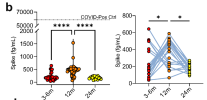
Right off the bat something strikes me as weird. They're showing spike protein quantification from the blood. All the ones that are in the "high" half at 3-6m drop together to the "low" half at 12m, and vice versa for the "low" half (save one participant). Was the assay done in batches or something else weird to explain this?

They don't include the pre-pandemic controls even though the next figure (1C) includes them, and then they are excluded again from 1D for a non-COVID-related measurement (they are COVID-naive samples, so I can understand the justification for excluding them from COVID protein quantification in 1B but not for the following measurements).
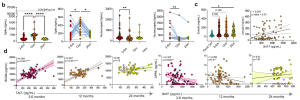
1775524132801.png

I don't really have time to do a breakdown of the whole paper and all my questions/concerns. What I'll just point out is the inconsistency in how the data is presented across all the figures, without much logical justification for why the groups should be broken down one way or another. Sometimes it's stratified by timepoint, sometimes it's by "low-medium-high" groups for another measurement (zonulin or BAFF), sometimes its "mild vs. severe LC". For some reason they've done half the measurements including pre-pandemic controls and half without. [edit: or, if I’m leaning into the cynicism, they did include the controls in the assay and just didnt plot rhe results]. They report having stool samples available for the pre-pandemic controls for the fecal transfer experiment but only show data from the mild and severe LC groups.

Their proof of "autoimmunity" is 1) LC samples have more positivity for specific ANAs in the blood and 2) that stool from severe LC induces different proportions of IG isotype-specific B cells than mild LC stool, which are also different in mice given a BAFF inhibitor compared to "isotype controls" (what??)

Maybe I'm just getting too cynical but it all makes me....a little hesitant to invest much more time in the paper. I'm sorry @Covidivici it seemed you were very excited about these results
 
Last edited:
View attachment 31626
Right off the bat something strikes me as weird. They're showing spike protein quantification from the blood. All the ones that are in the "high" half at 3-6m drop together to the "low" half at 12m, and vice versa for the "low" half (save one participant). Was the assay done in batches or something else weird to explain this?

They don't include the pre-pandemic controls even though the next figure (1C) includes them, and then they are excluded again from 1D for a non-COVID-related measurement (they are COVID-naive samples, so I can understand the justification for excluding them from COVID protein quantification in 1B but not for the following measurements).
View attachment 31627

I don't really have time to do a breakdown of the whole paper and all my questions/concerns. What I'll just point out is the inconsistency in how the data is presented across all the figures, without much logical justification for why the groups should be broken down one way or another. Sometimes it's stratified by timepoint, sometimes it's by "low-medium-high" groups for another measurement (zonulin or BAFF), sometimes its "mild vs. severe LC". For some reason they've done half the measurements including pre-pandemic controls and half without. They report having stool samples available for the pre-pandemic controls for the fecal transfer experiment but only show data from the mild and severe LC groups.

Their proof of "autoimmunity" is 1) LC samples have more positivity for specific ANAs in the blood and 2) that stool from severe LC induces different proportions of IG isotype-specific B cells than mild LC stool, which are also different in mice given a BAFF inhibitor compared to "isotype controls" (what??)

Maybe I'm just getting too cynical but it all makes me....a little hesitant to invest much more time in the paper. I'm sorry @Covidivici it seemed you were very excited about these results
No apologies necessary! On this one, I’ll freely admit I suffer from proximity bias. This is my clinic—literally down the street from my place. I’ve spoken with the senior researcher who was quite encouraged by their findings.

Could the discrepancies in terminology/categories be due to different researchers contributing different graphs/data to the final paper? No clue. Though I agree with you — coherence would have been far better.

Seeing as it’s under review, maybe your reservations will be addressed in a future revision. If so, we can revisit the findings. Big if.

I appreciate the input — always.
 
Could the discrepancies in terminology/categories be due to different researchers contributing different graphs/data to the final paper?
Perhaps but would be very unusual. I was one of 4 co-first authors on a big paper and we were constantly checking in with eachother to make sure things were consistent across the manuscript.

I’m trying to interpret the findings in good faith but I’ve seen it over and over again that when results are presented in a strange inconsistent way it’s because the first few ways of doing the analysis didnt yield anything paper-worthy.
 
Back
Top Bottom