Million Veterans Program (MVP) data on ME/CFS

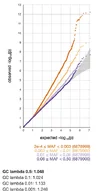
There were almost 5000 of these ME/CFS-like cases in the MVP database which is divided into different ethnicity groups: African, Admixed American and European. The numbers are given below (taken from the supplementary material of Verma et al. 2024).


EthnicityCasesControlsTotal
AFR648119584120232
AMR4095851558924
EUR3891439202443093
TOTAL4948617301622249

The ethnicity matters for genetic analyses, as you have to compare like with like. This means there are two main ways to analyze this data. The first is to do a meta-analysis of the three comparisons per ethnicity group. The other main option I see is to focus on the European group only as it compromises around 80% of cases.
 
So I filtered out rare variants (MAF > 0.01). I also don’t want signals that came from only one ethnicity group only, as this might more likely reflect bias. The meta-analysis hasa column called ‘direction’ that indicates if the signal was found in the three substudies. So I required this and only filtered out high heterogeneity in the signal (I^2 < 50%).

After applying this, there was still a significant hit on chromsome 5 with ATP10B being the closest gene. Here’s a plot of the region:
1780650531032.webp
In the European-only analysis ATOP10B is also a top signal but with a lower p-value around 10*p^-6. ATP10B is involved in lipid transport and has been associated with Parkinson’s disease.

The MAGMA gene expression analysis showed no significant hits for tissue or gene enrichtment sets. Although ‘nerve’ was among the top in the tissue it’s hard to separate noise from signal here.

1780651485908.webp
 
Last edited:
Here's the cell type analysis for the 461 cell types from the Siletti et al. brain atlas (same pipeline as Duncan et al. 2025).

The data below shows the European MVP subgroup only (this dataset includes a column imputation quality so I filtered r2 > 0.6). The one for the MVP-meta analysis is very similar though. Nothing close to significance but there does seem to be a signal for for eMSN in this dataset (which was also apparent in Paolo's analysis).


1780650689434.webp
 
Looking closer at ATP10B :

ATP10B encodes a P-type ATPase that functions as a phospholipid-transporting ATPase with glycosylceramide flippase and phosphatidylcholine flippase activity. It participates in lipid translocation and lysosomal membrane organization, placing it in the machinery that moves lipids across membranes. The protein is found in the endoplasmic reticulum, late endosome membrane, and lysosomal membrane.

At the molecular level, ATP10B is part of a phospholipid-translocating ATPase complex and acts in phospholipid transport and lipid transport. Its membrane localization is consistent with a role in translocating lipids within intracellular membrane systems. Expression measurements show RNA expression in the gastrointestinal tract and protein expression in the hematopoietic system.

My understanding is that this gene is important for phospholipid transport @TamaraRC.

We also have a thread about phospholipid dysregulation
 
The data on ME/CFS is based on electronic health records using PheCode 798.1. This not only maps to G93.3 in the ICD-10 CM but also a chronic fatigue unspecified (R53.82). So it’s likely a broader group than just ME/CFS.
I spent a while a couple weeks ago trying to figure out if this cohort contained gulf war illness but never got anywhere too conclusive.

I was curious because I've seen people on reddit say that GWI veterans in the US are just coded as generic CFS. This slide show from veterans affairs seems to confirm that the R53.82 code was used for GWI fatigue until 2025. They have now introduced more specific codes.

Super interesting analysis in either case, thanks for sharing.
 
Back
Top Bottom