
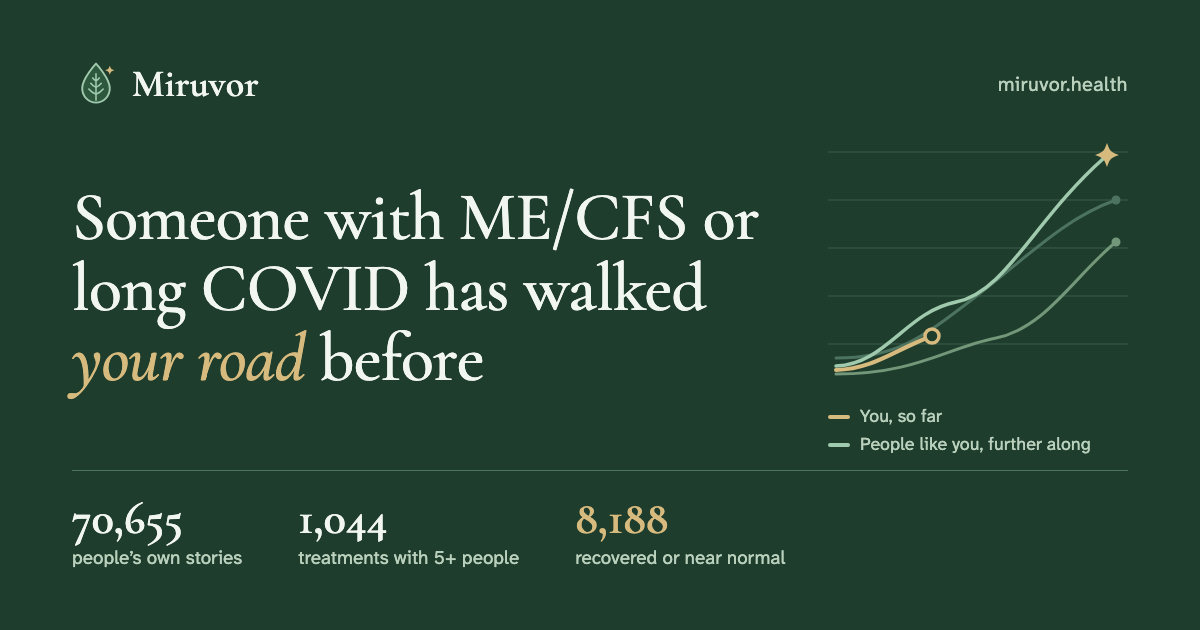
Miruvor: an analysis of patient experiences

rvallee

Administrator
Staff member

This is an AI-driven analysis of tens of thousands of reports on various social media. Utility as research is limited, but the quality of the outcome is excellent, far above what academics typically produce.
Miruvor collects what people with ME/CFS and long COVID wrote about what they tried: published stories, forum posts and Reddit posts and comments. These are their own reports, not clinical trials, and nothing here is medical advice. Talk to a doctor who knows ME/CFS or long COVID before starting or stopping any treatment.
Research is debatable, so could better suit in another forum. Especially as it's not published or reviewed, but plenty of similar research of lower quality has been published, although I find the utility limited other than showing how it simply confirms that nothing works, that all sorts of people will credit all sorts of things for whatever reasons.

The premise as a product is the most problematic, the idea of finding similar courses to one's own to help recovery. All the data are free, matching with personal data is a paid subscription.

I still find that this is overall by far the best analysis of patient reports. Frankly, as quality goes, I see very little out of academia that does any better where it counts, plenty use this approach of Internet-sourced data, but the analysis done here is far superior. It also shows the promise of AI research, and it's important to consider that AI will only get massively more capable over time.
 
This is an AI-driven analysis of tens of thousands of reports on various social media. Utility as research is limited, but the quality of the outcome is excellent, far above what academics typically produce.
How is it anywhere near good enough when the front page claims that this can provide data on «what worked» for others, and that the data can «guide your own recovery»?
When I click on the question about if I can recover and the time it will take, this is the answer I get:
Full recovery does happen for some people with ME/CFS and long COVID, and the stories here describe a wide range of recovery times, from a few months to many years. How long it will take for you, no one can say: the times below are what individual people reported, not a prediction.
Apparently, it’s not a question of if it will happen, just how long time it will take.

All this is going to achieve is 1) cost people money to use, 2) cost people money from buying interventions, 3) cause harm from some of the interventions, and 4) give people unrealistic expectations that can cause all kinds of issues in their lives.
 
The premise as a product is the most problematic, the idea of finding similar courses to one's own to help recovery. All the data are free, matching with personal data is a paid subscription.
Desperate sick people as a business opportunity. Perhaps they should ask their chatbot to write an ethics.md skill for itself.

At least the website has the typical AI look, hopefully that serves as an extra warning sign that there isn't much good behind this.

It also shows the promise of AI research, and it's important to consider that AI will only get massively more capable over time.
I find this project illustrates the bad of AI more than it does the good.
 
Apart from the serious issues mentioned above and that patient posts are being monetized, it is kinda useful if you want to find anectodes for some drugs.

Came up with quite a bit of stories for Cabergoline but nothing for Lemtrada.

Also, I found no stories from S4ME (e.g., for Dara) so far (which is good).
 
Back
Top Bottom