News from Germany


Dresden Biobank Specifically Collects Samples from Children and Adolescents

A pediatric biobank for Long COVID research is being established in Dresden. Blood, urine, and hair samples are being collected there to help researchers better understand the causes of the condition.
Yes, they are also collecting samples from severe patients at home, let’s go! :party::party:

According to the University Hospital, patient samples such as blood, urine, hair, as well as nasal and throat swabs, are being collected under strict quality standards and made available for research projects through a special allocation process. The goal is to identify new biomarkers, understand the causes and mechanisms of Long COVID–like illnesses, and ultimately develop targeted treatment approaches.

In line with guidelines for the collection of pediatric samples, a joint biobank infrastructure has been established at the Dresden and Freiburg sites, reports Dr. Nicole Töpfer. The physician at the University Hospital heads Pednet-LC, a federally funded network dedicated to researching post-infectious diseases in children and adolescents.

In the long term, the facility will be able to store up to five million different samples. At present, 220,000 samples are already stored.

Until now, the biobank’s primary focus has been on cancer therapy. With the establishment of the pediatric biobank, researchers also hope to achieve scientific breakthroughs in the study of rare diseases, according to Prof. Reinhard Berner, Head of Pediatrics and Adolescent Medicine at the University Hospital.

One special feature of the pediatric biobank is the possibility of collecting samples at home. Using specially designed self-sampling kits, even severely ill patients can participate in the research.
 

Direct link for donations:

Martin Rücker is a German journalist that publishes a lot of articles on ME/CFS.
He is part of the cooperative RiffReporter.
Many libraries in Germany offer free access to their articles.
A major source of funding has been lost and thus they are forced to run a crowdfunding campaign.

RiffReporter is under economic pressure. We are asking for support to ensure independent reporting on issues that affect people in their everyday lives – topics that other media outlets often drop far too quickly.

What is this project about?​

RiffReporter is an independent, ad‑free online magazine. We are not backed by a publishing house but by a cooperative of freelance journalists. What defines RiffReporter is this: our authors don’t chase quick headlines. They stay with the issues that matter — care work, Long Covid, women’s health, mobility, biodiversity, climate, science, and the digital public sphere.

RiffReporter has now reached a critical moment. A major source of funding has fallen through. We have already reduced costs, redistributed tasks, and streamlined our structures. Even so, we need additional support so that our authors can continue researching and reporting in the coming months.

That is why we are launching this campaign. Over six weeks, we will show why the topics our authors cover are essential to people’s everyday lives. Each week offers a different perspective:

1. For health that doesn’t leave anyone behind​

Illness changes families, work, finances, daily routines, and dignity. Our authors report on what people face when they must care for loved ones or when they fall ill with Long Covid or ME/CFS. They cover gaps in healthcare, chronic illnesses, family caregivers, and the question of what people need when the system leaves them on their own.
 

The writer and theatre director Ivna Žic is affected herself and, in her award‑winning essay “Die Unversehrten”, she explores the illness in literary form.
She skillfully links it with themes such as capitalism and neoliberal health policy.
For this, she will receive the 2026 Wortmeldungen Literature Prize in Frankfurt on Friday.
The prize is endowed with 35,000 euros.

In the interview, she talks about Long Covid, formative trips to the USA and encounters with Trump voters, as well as her new “normality” after the coronavirus infection.
 
"First Funding Guidelines for the 'National Decade Against Post-Infectious Diseases' published – Analysis and commentary" by the ME/CFS Research Foundation


mecfs-research.org


Das Bundesministerium für Forschung, Technologie und Raumfahrt (BMFTR) hat am 1. Juni 2026 erste Fördermaßnahmen der „Nationalen Dekade gegen Postinfektiöse Erkrankungen“ ausgeschrieben. Forschende in Deutschland können sich bis zum 2. September 2026 auf Projektförderung für klinische Studien...

mecfs-research.org
mecfs-research.org


In german.
 
Paywall

A family fighting for their right for a robot that would allow their son to participate in school.

Long Covid: District of Gifhorn Abandons 13‑Year‑Old Grammar School Student
Meinersen. Why a family from Meinersen is hiking up the Zugspitze for their son Jacob — and how the experience gives them strength. How an avatar could help.

“It was a good initiative,” says Anja le Campion.
Together with her husband Philippe and daughter Isabelle, she hiked up the Zugspitze.
Around 50 people took part in the project ME/CFS pushes us to the top to raise awareness for the severe illness that falls under the umbrella term Long Covid.
And awareness seems urgently needed, as becomes clear in her account.


One fact that also falls under the category of “abandoned” is something the mother only mentions at the very end of the conversation: “We’ve been waiting for a year for an avatar so that Jacob can take part in lessons.”
So far, she has only been sent from one authority to the next.
The grammar school student would very much like to see his class again, but the district of Gifhorn does not have an avatar — a telepresence robot.
The small device would at least allow virtual participation.
Jacob could join via tablet or smartphone and interact with classmates.
According to the association “Nichtgenesenkids,” the costs amount to around 4,500 euros for purchase and about 300 euros in monthly operating costs.

Two grammar schools have a need for a school avatar

The family and the school principal even contacted District Administrator Philipp Raulfs (SPD) directly, but so far nothing has happened.
When our editorial team asked on Monday, the district’s press office replied: “Our Department of Schools and Sports, or the district as the school authority, is already in contact with the school administrations of the Sibylla‑Merian‑Gymnasium Meinersen and the Humboldt‑Gymnasium Gifhorn.
Each of the two grammar schools has one student who cannot attend classes in person due to a long‑term illness.
Next week, further discussions will take place to clarify the conditions under which a telepresence robot can be used at school and how technical support or procurement can be handled. It is the district’s goal to make schooling in this form possible in the future.”
 
ME/CFS Research Foundation Facebook:

Erstmals verursacht ME/CFS höhere gesellschaftliche Kosten als Long COVID.
Im Erstbericht vom Mai 2025 lag Long COVID noch knapp vorn: 32,2 Mrd. € gegenüber 30,9 Mrd. € (ME/CFS) für 2024. Das Update zeigt: Der Kostenschwerpunkt hat sich gedreht. Jährliche gesellschaftliche Kosten 2025: 32,8 Mrd. € für ME/CFS vs. 31,6 Mrd. € für Long COVID.

Dieser Wendepunkt war absehbar. Viele Long COVID-Betroffene entwickeln im Verlauf ME/CFS, die Genesungsraten sind extrem niedrig, und ME/CFS-Erkrankte sind im Schnitt schwerer und länger betroffen.

Die ME/CFS-Kosten steigen seit 2020 ohne Unterbrechung, von 20,9 auf 32,8 Mrd. €, allein höher als der gesamte Verkehrsetat des Bundes (27,9 Mrd. €).

ME/CFS ist keine Randerscheinung. Es ist die langfristige Krise innerhalb der Krise. Genau hier braucht es biomedizinische Forschung. Dafür setzen wir uns ein.

--------

For the first time, ME/CFS causes higher societal costs than Long COVID.
In our first report from May 2025, Long COVID was still narrowly ahead: 32.2bn € versus 30.9bn € (ME/CFS) for 2024. The update shows the balance has shifted. Annual societal costs for 2025: 32.8bn € for ME/CFS vs. 31.6bn € for Long COVID.

This turning point was foreseeable. Many Long COVID patients develop ME/CFS over time, recovery rates are extremely low, and people with ME/CFS are on average more severely and longer affected.

ME/CFS costs have risen without interruption since 2020, from 20.9 to 32.8bn €, alone higher than Germany's entire federal transport budget (27.9bn €).

ME/CFS is not a side note. It is the long term crisis within the crisis. This is exactly where biomedical research is needed. That is what we are working for.

#mecfsresearch #mecfsforschung #research #forschung #LongCovid #PostCovid #mecfs
 

A book for pwME with children.

Machine translated:
Mastering Everyday Family Life with ME/CFS A Guide for Affected Parents and Their Families

Den Familienalltag meistern mit ME/CFS​

Ein Ratgeber für erkrankte Eltern und ihre Familien​

by Anne Ritschel, Verena Klingen
Parents with ME/CFS face the dual task of managing symptoms while also supporting their children’s development. This guide offers practical strategies for energy management, reducing daily burdens, and strengthening children’s resilience. It includes scientific background information, systemic and cognitive‑behavioral exercises, as well as helpful worksheets.

This guide is intended for:Parents living with ME/CFS, their partners and other family members, as well as professionals in the fields of medicine, psychotherapy, psychology, counseling, social pedagogy, child and youth services, disability support, and rehabilitation.

Blurb​

The neuroimmunological illness ME/CFS is far more than “fatigue”: people affected by ME/CFS experience a wide range of symptoms, but above all a profound intolerance to exertion, meaning that even minimal effort can worsen symptoms and severely impact daily life. Many affected individuals are parents and face the challenge of supporting their child’s healthy development while also attending to their own needs so their condition does not deteriorate.

This guide explains how everyday family life with ME/CFS can be made more manageable. Parents with ME/CFS learn to understand their energy levels and break the vicious cycle of overexertion and symptom flare‑ups. Children can be supported in experiencing safety, care, and positive moments despite the initially frightening nature of their parent’s illness. In addition, both ill and healthy parents are encouraged to draw on helpful sources of strength and to seek social support so the crisis can be navigated together.

The guide reflects the current state of research on ME/CFS and offers concrete exercises based on cognitive‑behavioral and systemic methods, which can be used independently by affected families or within counseling and therapy. Helpful worksheets can be downloaded from the Hogrefe website after registration.

Table of Contents

Foreword … 7

1 The Clinical Picture of ME/CFS

  • 1.1 What is ME/CFS? … 10
  • 1.2 What does ME/CFS look like in everyday life? … 12
  • 1.3 Who is affected? … 14
  • 1.4 How are ME/CFS and Long Covid connected? … 15
  • 1.5 What causes the symptoms? … 16
  • 1.6 How are patients cared for? … 20
  • 1.7 What helps professionals when working with parents affected by ME/CFS? … 24

2 The Foundation: Understanding Your Own Energy Level

  • 2.1 What is pacing? … 27
  • 2.2 Learning to recognize bodily signals … 29
  • 2.3 What pacing strategies exist? … 34
  • 2.4 Finding personal pacing routines in family life … 36

3 Supporting Your Child Step by Step

  • 3.1 How do children experience and process a parent’s illness? … 47
  • 3.2 Control: Understanding the world around them … 49
    • Step 1: Establishing routines … 52
    • Step 2: Age‑appropriate explanations … 54
    • Step 3: Regular communication … 58
  • 3.3 Attachment: Strengthening a loving relationship … 62
    • Step 1: Examining your own expectations … 62
    • Step 2: Strengthening the relationship … 64
  • 3.4 Self‑efficacy: Experiencing personal success … 67
    • Step 1: Praise and appreciation … 67
    • Step 2: Making space for emotions … 69
    • Step 3: Avoiding over‑responsibility … 79

4 Taking Care of Yourself

  • 4.1 Finding acceptance … 80
  • 4.2 Self‑compassion instead of self‑criticism … 82
  • 4.3 Dealing with your own emotions … 83
  • 4.4 Changing recurring thoughts … 84
  • 4.5 Noticing the positive … 92
  • 4.6 Pleasant activities … 96

5 Living Partnership

  • 5.1 Tips for the healthy parent … 102
    • Dealing with emotions … 102
    • Redistributing roles and helpful everyday strategies … 105
    • Using sources of strength … 106
  • 5.2 Shaping the couple relationship … 107
    • Changes within the couple system … 109
    • Communication in the relationship … 110
    • Positive shared time … 115
    • Experiencing closeness … 116

6 Using Networks

  • 6.1 Support from family and friends … 117
  • 6.2 Professional support services … 119
References … 123

Appendix

  • Activity Log … 135
  • Evaluation of the Activity Log … 137
  • Pacing Diary … 138
  • Pictograms for Daily Planning … 140
  • Emotion Emoji Collection … 141
  • List of Pleasant Activities … 142
  • Notes on Online Materials … 146
 

A new column by journalist and pwME Margarete Stokowski.

Machine Translation:
Long Covid column: Why people with ME/CFS avoid the emergency department
In the emergency department everyone does their best. But that is not always good for people with ME/CFS as Margarete Stokowski explains in her Long Covid column.

After an accident you call emergency services or drive to the nearest emergency department.
So much for the theory.
Unfortunately, people with ME/CFS are not really accounted for in this system, even though the illness occurs more than twice as often as multiple sclerosis.

If you have severe ME/CFS you have to lie alone in a dark, quiet room.
Even the sound of someone putting a glass down on a table is too much.
The nerves overreact; it hurts like an electric shock.

ME/CFS? “That doesn’t mean anything to me”
But what happens if you call emergency services, for example because you’ve fallen?
Paramedics come in, stomping in heavy boots, they switch on the lights and ask loudly, as if you were hard of hearing: “Can you hear me? What happened?”
Even when a relative at the door says, “She has ME/CFS, please don’t be so loud,” the reply is often: “That doesn’t mean anything to me. We’ll check the vital signs first.”

Of course, everything is done with the best of intentions.
The aim is to determine, in a very short time, whether there is a life‑threatening situation.
And whether you need to be admitted to the emergency department — a place that is bright and loud and where someone is constantly crying, screaming, or vomiting.
For such situations I carry an emergency note with the most important information about my illness.
Also because when I’m in bad shape I can’t speak well.
That note is enormously helpful and, sadly, urgently necessary.

They glued the head wound and off you go
Since I became ill four years ago I have been to the emergency department four times. None of the paramedics knew about ME/CFS, and among the doctors: one.
The first time a concussion after a fall was not recognized because they said the symptoms — dizziness, headache, nausea — could all also be caused by ME/CFS.

They glued the laceration on my head and sent me on my way.
Another time I phoned the on‑call service and said I was afraid I was going to die, something was wrong.
The doctor on the phone thought that, given my preexisting condition, I should see a psychiatrist at some point.
He still sent a doctor, who within minutes diagnosed excsiccosis, a life‑threatening loss of fluids.
“You must go to hospital. IV fluids, tonight. Tomorrow morning is not enough.
I’ll arrange transport now.”

The doctor in the emergency department was very kind, but she also said, “Unfortunately none of us here are familiar with ME/CFS.
There are special clinics for that.”
No, there aren’t.
The place she meant is a center for diagnosis and research, not an emergency clinic.
There isn’t a single hospital bed there.
For all these reasons many people with ME/CFS avoid going to hospital.
The fear that the condition will only get worse is great and justified.

Once I was lucky.
The paramedic read my emergency note and told the doctors, “She needs a dark single room.”
And I got one.
 

Podcast directed at GPs with what seems to be some good info on ME/CFS.

O-Ton Allgemeinmedizin, Episode 76
What GPs Should Know About ME/CFS
“Take Your Patients Seriously!”
Podcast | Published on: 02 July 2026

A patient comes into the practice.
He is exhausted, the lab results are unremarkable, the imaging shows nothing.
And yet the man is seriously ill.
ME/CFS, Myalgic Encephalomyelitis/Chronic Fatigue Syndrome, affects an estimated 650,000 people in Germany and is still too often overlooked or misinterpreted.

Privatdozent Dr. Karin Storm van’s Gravesande cares for children and adolescents with ME/CFS and post‑infectious diseases at the University Medical Center Freiburg. In the podcast O‑Ton Allgemeinmedizin, she explains what lies behind the condition, how to make the diagnosis, and what physicians can concretely do.

The core symptom of the disease is severe, persistent exhaustion that does not improve with rest. Additional symptoms include sleep disturbances, cognitive impairments up to word‑finding difficulties, as well as autonomic symptoms such as cardiovascular problems and sensitivity to light or noise. What distinguishes ME/CFS from other fatigue‑related illnesses is the so‑called post‑exertional malaise: after physical, mental, or emotional exertion, the condition of those affected worsens significantly—sometimes only hours or days later. In the worst case, this leads to a crash with weeks of symptom deterioration. The fact that this mechanism can be triggered by something as everyday as a conversation with friends or writing a school exam makes the condition difficult for many to understand.

The path to diagnosis is often challenging and takes far too long for many patients. There are no biomarkers or imaging findings that clearly prove ME/CFS. It is a diagnosis of exclusion that requires an interdisciplinary team and careful differential diagnostics, explains Dr. Storm van’s Gravesande. Many patients wait months, some even years, before receiving a correct classification.

For children and adolescents, the number of affected individuals is estimated at 40,000 to 90,000, with a high number of unreported cases assumed, according to the expert. The COVID‑19 pandemic has not only increased case numbers but also raised awareness of the disease. According to Dr. Storm van’s Gravesande, many physicians now take the condition more seriously than they did a few years ago, and schools are increasingly sensitized to affected students.

How to reliably make the diagnosis, which laboratory values should be checked when ME/CFS is suspected, and what therapeutic options already exist—she explains all of this in this episode. She also discusses what the care project MOVE ME/CFS BW provides and which support services are available for patients across Germany. Tune in!
 
It is a diagnosis of exclusion that requires an interdisciplinary team and careful differential diagnostics, explains Dr. Storm van’s Gravesande. Many patients wait months, some even years, before receiving a correct classification.

I may have a very sceptical view of interdisciplinary (multidisciplinary) management/'treatment' teams, for good reason.

But I do think there is a case, at least at this stage of knowledge about the condition, that initial diagnosis requires a robust exclusion of a range of alternative diagnoses that can be easily mistaken for ME/CFS, and vice-versa (ME/CFS can be easily mistaken for those diagnoses).

Or where they co-exist to make sure both are accurately weighted for contributions to overall disease burden, and potential management/treatment.

Patients, for their part, need to accept that this may be an extended process over several months or even longer, and the temporary uncertainty that comes with that. In part also because that process will often need to be deliberately drawn out to avoid overloading patients already struggling with understanding, accepting, and adapting to the major changes in their lives, independent of the diagnosis.

Early diagnosis is a high priority for almost all conditions, and critical for many. But accurate diagnosis is just as important.
 
The big German newspaper DER SPIEGEL with a 2200-word article.
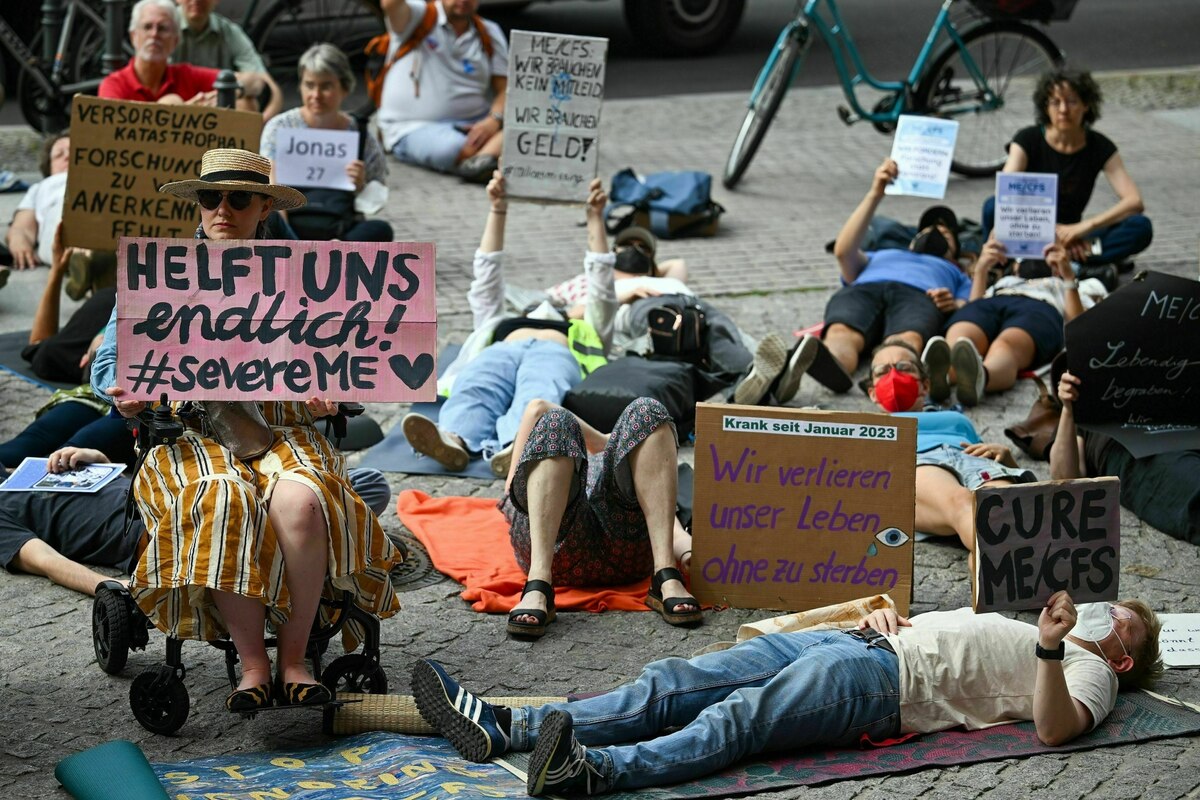
They are raising awareness for how people with ME/CFS are slipping through the cracks of the social safety net.

“They think I’m faking it”​

Many long-Covid patients suffer from the exhaustion illness ME/CFS. They can barely leave their bed—and have to fight private insurers that deny them an occupational disability pension.

By Henning Jauernig
July 2, 2026
In March 2020, at the start of the pandemic, Mischnick contracted coronavirus.
Since then her life has mostly taken place between bed and sofa.
Her parents bring her food and do the household.
If she wants to shower, she has to rest for days beforehand so her body can build up reserves.
It is similar when she has to leave the house for a doctor’s appointment.
“Then I do nothing in the days before, nothing in the days after, and nothing else on that day either,” she says.

There are people who have been hit even harder than Mischnick.
Some patients can neither get up nor speak and lie permanently in a darkened room; some wear eye patches and ear protectors to shut out all stimuli.
Some sufferers feel as if they were “buried alive.”
According to studies, people with ME/CFS have a significantly increased risk of suicide because patients can no longer bear their situation — and there is little prospect of a cure

There is something else that drains her energy: a year and a half ago her statutory sickness benefit ran out, and since then she has had no income.
For years Mischnick has been paying into a private occupational disability insurance that could step in in such cases.
But LVM Versicherung refuses to pay her a pension.
The German Pension Insurance (DRV), which could pay a monthly reduced-earning capacity pension, has also rejected payments.
Both argue that, in their view, Mischnick is still able to work.
They base this on expert reports. “When I received the rejection notices, I was speechless,” says Mischnick.
“Apparently they think I’m a malingerer.”

Her private occupational disability pension would amount to €800 a month — just enough to cover her fixed costs.
Mischnick has now handed her case to a lawyer who has filed a lawsuit.
SPIEGEL investigations show that many people with ME/CFS fall into financial distress because private insurers refuse payments.
The statutory pension insurance also makes things difficult for those affected.
Patients exchange information in self-help groups, reporting an insurance system that has no understanding for patients whose illnesses have symptoms that are hard to measure.
“The burden of proof lies with the insured; they must prove that they are permanently unable to work,” says Matthias Neeb, a specialist lawyer for insurance law from Münster.
For most people that is hardly feasible.
“Hardly anyone can even fill out the application on their own.
”How many applications are rejected nationwide is unclear.
No data are collected. But the large number of lawyers who specialize in the topic already gives an idea of the scale.
“Insurers often try to attack the diagnosis,” writes the law firm Wirth-Rechtsanwälte from Berlin on its website.

The problem is not limited to Germany. Investigations by ORF, APA and “DOSSIER” uncovered a scandal in Austria in April: internal training materials from pension insurers apparently sought to systematically sow doubt about the clinical picture of ME/CFS.
The suffering is linked there to the psychiatric condition neurasthenia — also known as “nervous weakness” — even though this disorder is largely considered outdated and is no longer classified as a disease by the World Health Organization (WHO).
The papers were aimed at doctors who prepare expert reports on behalf of the pension insurers.
Austrian experts accused them of trying to “make it harder for patients to access social benefits.”

Insurers and social security agencies usually employ medical assessors to evaluate patients’ health.
For Nele Mischnick, the visits to the assessment institute were a torture.
At the time, in 2024 and 2025, she hardly felt able to leave the house.
“But what else could I have done, I was so dependent on the benefits,” she says.
Once she dragged herself to an appointment on a rollator, accompanied by her mother, she recounts.
There, Mischnick could do nothing but remain half‑reclined on the chair because she lacked the strength to sit upright.
The psychiatrist’s report states that she had taken a seat in a “casually relaxed, sprawled‑over‑the‑chair position.”
In a questionnaire Mischnick had listed a number of “bizarre complaints,” and there was an “pronounced tendency to symptom simulation.” LVM Versicherung says on request that in medically ambiguous cases it relies on external, professionally qualified assessors.
“In principle we place great value on assessments being conducted respectfully,” a spokeswoman said.
The company declined to comment further on the ongoing court case.
The DRV states that the medical investigation has been difficult since the application was rejected, and therefore a new assessment has been arranged.
As soon as “assessment capacities allow,” Mischnick is to receive an invitation.
According to lawyer Neeb, unsuitable assessors are often used, for example psychiatrists who are not familiar with the clinical picture of ME/CFS.
They often issue psychosomatic diagnoses by mistake.
No doctor disputes that ME/CFS can also have psychological consequences.
When sufferers can no longer perform their job, can hardly manage daily life and their quality of life is sometimes even worse than that of many people with heart failure or cancer, they can become depressed.
“But when people with ME/CFS are first shoved into the ‘only psychosomatic’ drawer, they are simply treated incorrectly,” says medical professor Stallmach.
They are often prescribed activity and exercise, whereas the patients need the opposite.

Mischnick and other sufferers report that they had to complete concentration tests on a computer in front of the assessors.
It did not matter whether they developed severe headaches or how they felt after the test.
Many patients suffer from an exercise intolerance known by the technical term “post‑exertional malaise,” or PEM.
Any form of exertion, whether physical or mental, worsens the disease symptoms.
“None of that mattered for the assessments,” says Mischnick.

Lawyer Joachim Laux criticizes that “sheer arbitrariness” prevails in the review procedures.
Certain insurers that offer cheap tariffs are more likely to deny benefits.
“Apparently since Corona the calculations in companies no longer add up because there has been a large number of benefit claims,” says Laux.

He considers the assessors’ evaluation system to be “extremely problematic.”
Insurers send people to assessors who usually decide in the insurers’ favor, after all they are paid by them.
He knows of one assessor who has never recognized occupational disability for any of his clients.
 
Back
Top Bottom