News from Germany

Off-label use is use outside of the license that the drug has. In the UK formal approval for use of drugs for off-label indications would be via the commissioners. So either the ICBs or NHS England (for drugs used in specialised services). An example of the later would be the clinical commissioning policy for anakinra for HLH.

So this is essentially a budget decision rather than anything else.

Approval for rare diseases tends to be an exception because trials are not feasible.

But for more common things all these various levels of 'approval' make for both confusion and resentment.
 
So this is essentially a budget decision rather than anything else.

Approval for rare diseases tends to be an exception because trials are not feasible.

But for more common things all these various levels of 'approval' make for both confusion and resentment.
It is about budgets, yes, because there is only a limited amount of money and the aim is to provide the maximum health benefit for the population for the money available. It would be nice to have more but that's a decision of the government unfortunately. But also the aim is to ensure that treatments are evidence based as much as possible, and also to ensure that all appropriate patients have access to the same care to prevent some getting worse care than others.
 
But also the aim is to ensure that treatments are evidence based as much as possible

Yes, but having a system that approves beyond evidence that is adequate for a formal indication runs the risk with conditions like ME/CFS of perpetuating the lack of evidence-gathering. One can argue that if a health system is sufficiently convinced that a drug should be approved for a condition when there is no reliable evidence it should commit itself to making sure that evidence is gathered as soon as possible. Either the softer evidence is enough to justify a proper trial or it is not enough to justify a formal budget approval.

The inclusion of agomelatin seems very strange. It has never even been discussed in UK working groups.
 

The VdK is asking for your questions and experiences with invisible symptoms for an upcoming podcast:
Making invisible symptoms count

Anyone living with invisible symptoms knows the situation: their limitations are underestimated and not adequately taken into account in recognition proceedings. How can these impairments be convincingly documented? Where can people find experienced doctors and appropriate treatment options? And what can help them assert their social-law entitlements? The Social Association VdK Nord will address these questions in a video podcast produced in collaboration with the German Multiple Sclerosis Society (DMSG), Schleswig-Holstein, and the Hamburg regional group of Fatigatio e.V., the patient organization for people with ME/CFS.

What’s on your mind? Submit your questions for our video podcast using the form below by October 20. Experts in social law and neurology, along with representatives of patient organizations, will answer selected questions and share insights from their day-to-day work.

Please note: Individual advice cannot be provided in this format. Your name will not be mentioned in the podcast.

Unsichtbare Symptome durchsetzen​

Wer mit unsichtbaren Symptomen leben muss, kennt die Situation: Die Einschränkungen werden unterschätzt und in Anerkennungsverfahren nicht ausreichend berücksichtigt. Wie lassen sich die Beeinträchtigungen überzeugend darlegen? Wo findet man erfahrene Ärztinnen und Ärzte sowie geeignete Behandlungsmöglichkeiten? Und was hilft bei der Durchsetzung sozialrechtlicher Ansprüche? Darüber will der Sozialverband VdK Nord in einem Video-Podcast in Zusammenarbeit mit der Externer Link:Deutschen Multiple Sklerose Gesellschaft (DMSG) Schleswig-Holstein und der Externer Link:Regionalgruppe Hamburg des Fatigatio e.V., der Patientenorganisation für Menschen mit ME/CFS, informieren.

Was beschäftigt Sie? Bringen Sie Ihre Fragen für unseren Video-Podcast bis zum 20. Oktober über das untenstehende Formular ein! Expertinnen und Experten aus Sozialrecht, Neurologie und Patientenorganisation beantworten im Video-Podcast ausgewählte Fragen und teilen ihre Erfahrungen aus der täglichen Praxis.

Bitte beachten Sie: Eine individuelle Beratung kann in diesem Rahmen nicht erfolgen. Ihr Name wird im Podcast nicht genannt.
 
From Bluesky:


Mirja Nicolas @privilegienschreck.bsky.social

In this six-page article (dating back to August) on the so-called "pandemic review," there is exactly one—in numbers: 1 (!)—sentence on Long COVID. Not a single one on ME/CFS. And for some reason, people, nearly all of whom now know someone affected in their social environment, don't feel collectively mocked.

From a social-psychological standpoint, I find this absolutely surreal.
​

In diesem 6-seitigen Artikel (bereits aus August) zur sog. „Pandemieaufarbeitung“ ist genau ein (in Zahlen: 1 (!)) Satz zu Long COVID. Kein einziger zu ME/CFS. Und aus irgendeinem Grund fühlen sich Menschen, die inzwischen fast alle Betroffene im sozialen Umfeld haben, nicht kollektiv verarscht.

Ich finde das sozialpsychologisch betrachtet schlichtweg abgefahren.

 
The German Association for Psychiatry, Psychotherapy and Psychosomatics (DGPPN) will hold a symposium at their upcoming congress in November called:
“Who Develops Post-COVID?”
Very good news: a symposium on ME/CFS by Schomerus et al. is met with rapidly increasing interest from German psych professionals.

From Bluesky:


​
In addition to the severe damage inflicted, I find the oversimplified 'pop psychology' proclaimed by proponents of psychosomatics—and the smugness with which they do so—to be utterly embarrassing.​
​

​
This alone should compel all principled professionals in the field of psychology and psychiatry to take a stand. This is an objective I intend to pursue.​
​
Regardless, the venue for our symposium at the #DGPPN [German Association for Psychiatry, Psychotherapy and Psychosomatics] is approximately six times larger this year than it was previously. Furthermore, it will almost certainly be broadcast to those not attending the congress, ensuring that our message will be heard.​
​


Neben dem ganzen furchtbaren Schaden, finde ich das auch immer wieder so peinlich, was für eine vereinfachte Küchenpsychologie die Freund*innen der Psychosomatik in die Welt posaunen und sich dabei ganz oberschlau vorkommen.

Allein schon deswegen müssten ja eigentlich alle anständigen PSYCH-Personen auf die Barrikaden gehen. Ich werde daran arbeiten

Der Saal für unser Symposium bei der #DGPPN ist dieses Jahr jedenfalls ungefähr 6 mal so groß wie letztes Jahr und übertragen wird es (für zum Kongress abgemeldete Personen) ziemlich sicher auch, also wir werden schwer zu überhören sein.
 
The arbitrary separation of pre-COVID ME/CFS suggests, as expected, a rigged political process that is not concerned with outcomes, and is simply running out the clock. Hopefully it can be influenced in some ways to salvage a part of it, but the process remains completely rigged against the patients and objective reality.

As is tradition. I hate this tradition.
 
From Bluesky.
Machine Translation:
Dt. Ges. für ME/CFS @dgmecfs.bsky.social

#MECFS – People affected by ME/CFS are often denied access to essential social benefits and support services, such as disability pensions (reduced earning capacity) or care grades. In these situations, social associations such as the VdK provide legal assistance. Their volunteer guides dedicate part of their free time to advising individuals on health-related and social law issues.

To equip its guides with the necessary expertise to support those living with ME/CFS, VdK Baden-Württemberg invited the German Society for ME/CFS to deliver an online presentation. This provided an opportunity to raise awareness about the condition and share essential tips for the individual counseling of affected persons.

We would like to thank VdK Baden-Württemberg for the invitation and the constructive exchange!

Link to the post: https://www.mecfs.de/vortrag-beim-vdk-bawue [Google Translate link.]
 

Article about a young German woman who raised money for a two-week stay in a Michigan chiropractor clinic.
She finds that practicing her spatial vision abilities ameliorates her POTS.
Back in Germany, the "specialists" still treat her free of charge.
She keeps on practicing for 4 hours a day.

POTS patient from Dachau pushes her wheelchair on the journey home​

Published: 9 October 2026, 7:03 p.m.
By Nikola Obermeier

Lena Bartmann used to be able to leave her home only in a wheelchair. After two weeks in Michigan, she now walks several times a day. And after twelve years, she no longer wears glasses.
...the specialists found a connection between her condition and a problem Lena Bartmann had long had with her eyes. “I can’t see in 3D—but I thought that had nothing to do with POTS.”

The chiropractors took a holistic approach to Lena Bartmann’s treatment. It began with passive movements while she was lying down and eye exercises, followed by red-light therapy and cycling.

Throughout, they continually checked her reflexes and monitored her exhaled breath and vital signs. “On the GyroStim, which moves horizontally back and forth like a ride at an amusement park, I had to keep my eyes fixed on a visual target.”

The Brock string—a cord with beads—trained her eyes to focus at the same distance and bring the images together. Lena Bartmann noticed that, little by little, her 3D vision returned.

Exercises show results

Sensory exercises designed to train the brain helped restore the feedback from her arms and legs. To Lena Bartmann, it was “chiropractic magic”: “I can feel my hands again, and I can hold them still.” She cried after that session. “I felt as though I could feel the world again.”

And see better, too: “I didn’t know how 3D vision worked,” says the 24-year-old. “Now I see the world more clearly; I experience three-dimensional vision.” She no longer wears the glasses she had worn for twelve years, which were fitted with a prism.

“And what’s interesting is how this affects my circulation overall: by the end, I was walking several times a day!” At home in Dachau, she had recently been spending the entire day in a wheelchair. On the journey home after the two weeks, she pushed her wheelchair and put her luggage on it.

She has already gone to the supermarket by herself several times. “I can’t do it every day, but at least I can manage it now and then,” Lena Bartmann says.

She spends about four hours a day doing the exercises the chiropractors showed her.
This could be the clinic: https://www.greatlakesneurology.com/
 

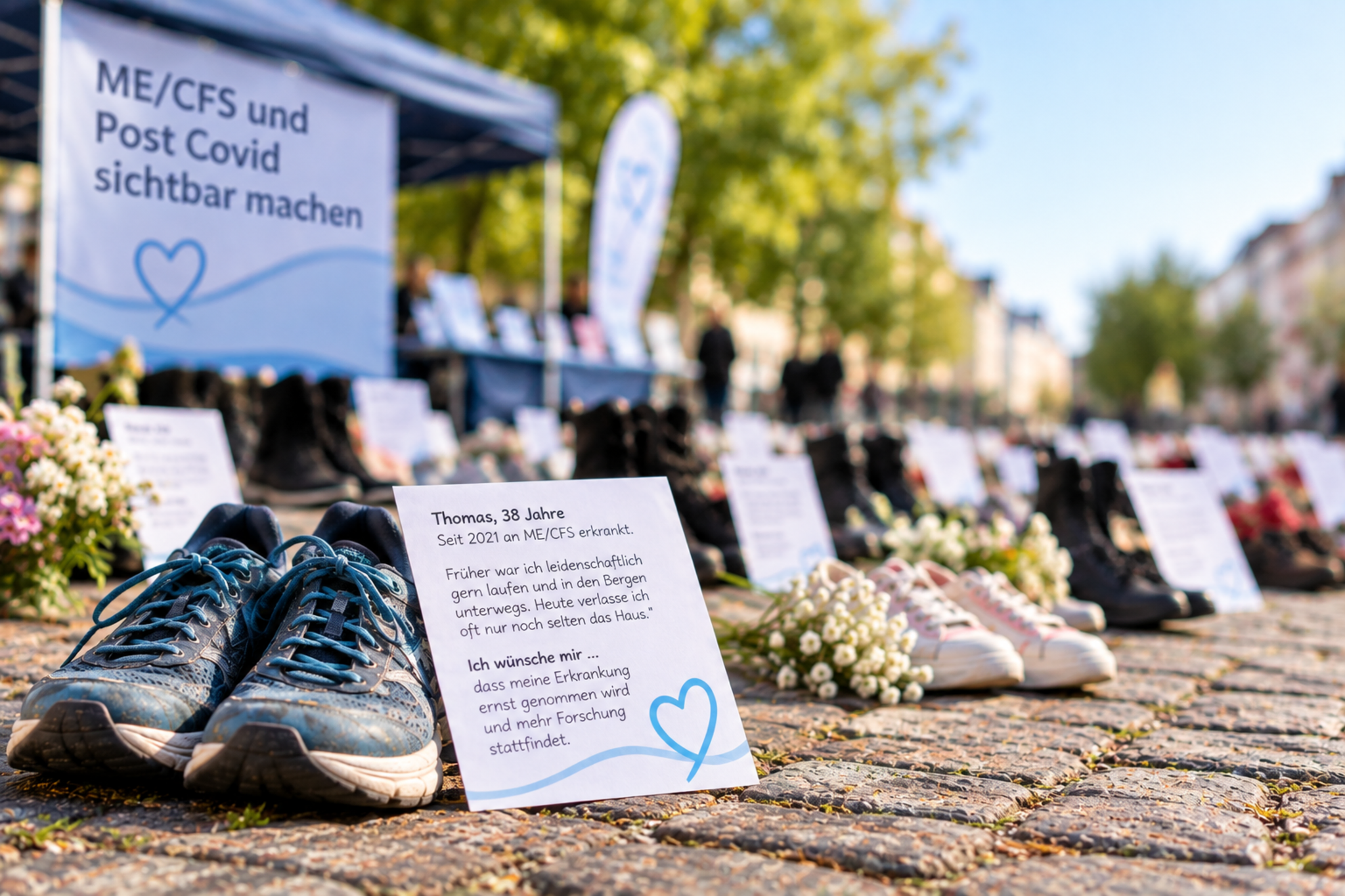
Shoe Installation on October 18 at the Altpörtel – behind every pair is a person with their own story
Speyer. On Sunday, October 18,

1891142_L.webp


Liegenddemo Speyer will raise awareness of the situation of people with ME/CFS and Post-COVID through a special event. From 11 a.m. to 1 p.m., shoes will be displayed at the Altpörtel, acting as representatives for those affected. These will be accompanied by short profiles providing insight into the personal stories of the patients.

How old are those affected? How long have they been ill? And what do they hope for their future? These questions are at the heart of the event. The profiles are intended to show who is behind the shoes and how diverse these individuals' life and struggle stories are.

"Behind every pair of shoes is a person with their own story, with wishes and hopes, but also with many limitations. We want to make these people visible and show that ME/CFS and Post-COVID are by no means marginal phenomena," explains Zschocke.

ME/CFS and Post-COVID can severely limit the lives of those affected. Many are no longer able to work, can hardly participate in social life, or are so severely ill that they can rarely leave their homes or even their beds. At the same time, many sufferers still lack public recognition and understanding of their situation.

The shoe installation is intended to address exactly this. The shoes and the personal profiles give those ill a face and a voice. They make it clear that behind these illnesses are people who have their own wishes and whose lives have often changed dramatically.

Information on site In addition to the shoes, there will be an information booth at the Altpörtel. There, interested parties can learn more about ME/CFS and Post-COVID and engage in conversation with the activists of Liegenddemo Speyer. Liegenddemo Speyer invites everyone interested to come by on October 18 and engage with the living conditions of those affected.

Event Details
What: Shoe installation for greater visibility of ME/CFS and Post-COVID
When: Sunday, October 18, 2026, 11 a.m. to 1 p.m.
Where: Information booth at the Altpörtel, Speyer
Organizer: Liegenddemo Speyer

Follow us on Instagram: https://www.instagram.com/liegenddemo.speyer
 
Long Covid Qualifies as a Severe Disability: GdB 50 Recognized by Court

A man from Rhineland-Palatinate fought for years for the recognition of his post-COVID syndrome as a severe disability. The authority wanted to grant him a degree of disability (GdB) of only 30. Now, the Speyer Social Court has ruled that his condition is significantly more severe than previously assumed. The ruling is likely to be landmark for many people affected by Long COVID in Germany.

Key points at a glance
  • From a mild infection to a life of withdrawal
  • Court: Lack of organic findings is not a reason for exclusion
  • Why Chronic Fatigue Syndrome serves as a benchmark
  • Abandoned profession as a strong indication of the degree of severity
  • What a GdB of 50 specifically means
  • A ruling with a signaling effect for those affected by Long COVID
  • Frequently asked questions regarding post-COVID and severe disability
  • Sources
 

Pflegegrad-Verschärfungen: VdK ruft Mitglieder zum Handeln auf​

Mit dem für 2027 geplanten Pflegeneuordnungsgesetz könnte sich der Zugang zu einem Pflegegrad deutlich erschweren.
Der VdK Nord ruft seine Mitglieder deshalb dazu auf, schnell noch einen Erstantrag zu stellen.

900-word article.


Abolition of Care Level 1​

Without Marc, it’s impossible​

Guest commentary by Katharina Schwedt​
​
If Care Level 1 is abolished, it makes daily life harder for those affected, from shopping and household assistance to accompaniment. A mother shares her story.​
​
October 13, 2026​


Instead of help with shopping, it seems we will soon be given the advice to do gymnastics
 
There will be a series of Zoom presentations on ME/CFS organized by the Pankow Public Library in Berlin:
Window to the World: Living with ME/CFS

Marina Weisband has been living with ME/CFS since 2020. As a mother, social entrepreneur and politically engaged person, this represented a major disruption to her life. As a psychologist, however, she has worked out how, with the help of grief work, self-efficacy, creativity and humour, she could not only come to terms with her illness, but also build a life in which she is happy today—despite all the limitations and frustrations.

Date: 23 September 2026
Time: 6:00–7:00 p.m.
Guest: Marina Weisband
Moderator: Alexandra Steidel

Online event: Register for the event and you will subsequently receive the Zoom link to participate.

Register here

Categories: Information events, Health, Environment, Readings, Talks

District: Pankow
https://www.berlin.de/land/kalender/index.php?detail=292573


Window to the World: Medical Insights—Understanding Long COVID and ME/CFS

with Dr Christian Gogoll

Are you living with Long COVID or ME/CFS and looking for well-founded medical answers? In this one-hour Zoom session, Dr Christian Gogoll will present important insights from his book and answer your questions afterwards. Join us from the comfort of your own home for an accessible space dedicated to knowledge, exchange and orientation.

Date: 30 September 2026
Time: 5:00–6:00 p.m.
Guest: Dr Christian Gogoll
Moderator: Daniela Süß-Borowsky

Online event: Register for the event and you will subsequently receive the Zoom link to participate.

Register here

Categories: Information events, Health, Environment, Readings, Talks

District: Pankow
https://www.berlin.de/land/kalender/index.php?detail=292732


Window to the World: Investigating Long COVID and ME/CFS

As part of our “Window to the World” event series, we welcome Martin Rücker, who will read from his book Anna und das Biest. The book sensitively portrays Anna’s view of the world and offers a personal insight into her experiences and perceptions. The series is aimed at people living with Long COVID and ME/CFS, as well as anyone interested in the subject. There will be an opportunity to ask questions and engage in discussion afterwards.

Date: 7 October 2026
Time: 5:00–6:00 p.m.
Guest: Martin Rücker
Moderator: Alexandra Steidel

Online event: Register for the event and you will subsequently receive the Zoom link to participate.

Register here

Categories: Information events, Health, Environment, Readings, Talks

District: Pankow
https://www.berlin.de/land/kalender/index.php?detail=292927


Window to the World: Individual Support for People Living with ME/CFS

with Silke Horn

What support is available to people living with ME/CFS when their need for assistance increases? This talk provides information about outpatient care, integration assistance and personal assistance, and outlines ways of arranging individual support at home—for greater security and self-determination in everyday life.

Since 2012, Sozialhummel has been committed to enabling people with disabilities and chronic illnesses to live self-determined lives. Its services include personal assistance, outpatient care, integration assistance and social counselling. Silke Horn is the managing director of the Sozialhummel group and has spent many years focusing on individual care options, particularly for people living with ME/CFS and those with high support needs.

Date: 19 October 2026
Time: 5:00–6:00 p.m.
Guest: Silke Horn (Sozialhummel)
Moderator: Alexandra Steidel

Online event: Register for the event and you will subsequently receive the Zoom link to participate.

Register here

Categories: Information events, Health, Environment, Readings, Talks

District: Pankow
https://www.berlin.de/land/kalender/index.php?detail=293032


Window to the World: Muskeln aus Plastik—Reading and Conversation with Kay Matter

On living with Long COVID / a chronic illness, gender identity and the art of reinterpreting one’s own body: Kay Matter will read from his book Muskeln aus Plastik and share personal, candid perspectives.

As part of our “Window to the World” series, we create a safe space for dialogue, diversity and new perspectives—without the need to travel, and with the opportunity to join comfortably from your sofa or bed via Zoom.

Date: 27 October 2026
Time: 5:00–6:00 p.m.
Guest: Kay Matter
Moderator: Daniela Süß-Borowsky

Online event: Register for the event and you will subsequently receive the Zoom link to participate.

Register here

Categories: Information events, Health, Environment, Readings, Talks

District: Pankow
https://www.berlin.de/land/kalender/index.php?detail=293041

Reminder:


Window to the World: Individual Support for People Living with ME/CFS​
​
with Silke Horn​
​
What support is available to people living with ME/CFS when their need for assistance increases? This talk provides information about outpatient care, integration assistance and personal assistance, and outlines ways of arranging individual support at home—for greater security and self-determination in everyday life.​
​
Since 2012, Sozialhummel has been committed to enabling people with disabilities and chronic illnesses to live self-determined lives. Its services include personal assistance, outpatient care, integration assistance and social counselling. Silke Horn is the managing director of the Sozialhummel group and has spent many years focusing on individual care options, particularly for people living with ME/CFS and those with high support needs.​
​
Date: 19 October 2026​
Time: 5:00–6:00 p.m.​
Guest: Silke Horn (Sozialhummel)​
Moderator: Alexandra Steidel​
​
Online event: Register for the event and you will subsequently receive the Zoom link to participate.​
​
 
The inclusion of agomelatin seems very strange. It has never even been discussed in UK working groups.
Bad experiences with Agomelatin reported by a user on Twitter:

Machine translation:
M͓̽e͓̽c͓̽k͓̽e͓̽r͓̽ₘᵤₜₜᵢ @MeckerMutti
Since my condition still hasn’t improved significantly after taking agomelatine, I’ve now filed a side-effect report with the BfArM. Surely they can’t prescribe people with #MECFS something that ends up harming them!

@NoHealthNoFun
Fe.@NoHealthNoFun
The evidence from studies was already very thin, and no country—not a single one—prescribes agomelatine for LC. The fact that something like this gets waved through in Germany (while, for example, LDN doesn’t) is a disgrace. I’m so sorry you’re the one suffering because of health policy driven by lobbyists.

@MeckerMutti
M͓̽e͓̽c͓̽k͓̽e͓̽r͓̽ₘᵤₜₜᵢ @MeckerMutti
My autonomic nervous system is going completely haywire. My baseline is still at about half of what it was before. And that’s after starting at Bell 20. I’m absolutely furious.
My quality of life has been severely reduced.

@NoHealthNoFun
Fe.@NoHealthNoFun
A disaster. And something like this gets prescribed so casually, with no plan for dealing with side effects.
It makes me furious that people are profiting off our dead bodies.

@MeckerMutti
M͓̽e͓̽c͓̽k͓̽e͓̽r͓̽ₘᵤₜₜᵢ @MeckerMutti
Grossly negligent. Because all they want is to push the cheapest option on us. This is costing me dearly.

@birgi1964
Birgit R@birgi1964
What side effects did you have? I took it for a few weeks too, but I’m stopping today.

@MeckerMutti
M͓̽e͓̽c͓̽k͓̽e͓̽r͓̽ₘᵤₜₜᵢ @MeckerMutti
My nights became an absolute disaster. From the very first dose, I felt like my autonomic nervous system was going completely haywire. My ME/CFS got much worse, with severe PEM within three weeks. Even four weeks after stopping, my baseline is still wrecked.
 

Bayerischer Rundfunk (BR) broadcast a short clip about ME/CFS.

Expert discussion in the state parliament: Long COVID in children | BR24​


Machine translation:
The authorities responsible for assessing and deciding on possible support are not always sufficiently familiar with post-COVID, says Magdalena Riepel. There is also too little clinical support for those most severely affected, says the mother of a post-COVID patient who is receiving intensive medical care.

“We need care, we need understanding, we need structures. That really would be the most, most important thing. These children have been lying in dark rooms for five, six, seven years. They need a prospect—that’s really important, and I need one too, as their mother.”

The Greens’ education spokesperson in the state parliament is calling on the state government to set up a coordination office for those most severely affected.

“We need to rouse the existing structures from something close to a deep slumber, so that we can move forward and connect the school system with the medical system.”
 
Expert discussion in the state parliament: Long COVID in children
Google Translate
1000-word article.


Expert discussion on the effects of COVID at thestate parliament​
Long Covid: Too ill for school​
October 14, 2026​
​
Years after the pandemic, some children and teenagers are still suffering from Long Covid. Some are so ill that they can barely attend school—or cannot go at all. How can they be helped?​
​
By Nina von Hardenberg​


News: The DGN had planned to present the findings of its working group on #MECFS at a press conference on November 3rd and subsequently at the major #Neurology Congress; the goal was a joint paper with the @dg_mecfs. The topic has now been CANCELLED for the press conference—a joint paper is off the table.
...finished, nor will it be ready in time—or so I hear from the DGN. The press conference agenda is being changed and the topic dropped; it is currently unclear when the working group led by Prof. Franke will reach a consensus. Originally, everything was supposed to be done before the #MECFS conference ↘️
...to be completed in Berlin in May; the goal—as DGN Secretary General Prof. Berlit once told me—was a paper intended to replace the DGN’s position statement from last year, which had drawn such fierce criticism.
 
10min clip by the German TV station RTL:

Machine translation:


She chose assisted suicide: How Kathi's family is coping today​
​
For months, 30-year-old Kathi fought the severe illness ME/CFS, eventually deciding on assisted suicide. Now, RTL presenter Roberta Bieling visits her mother, Ruth, once again. She speaks about the final moments with her daughter—and how the family is finding its way back to life despite all the grief.​
​


How does life go on when your own daughter is gone?​
​
RTL presenter Roberta Bieling visits Kathi's mother, Ruth, at home once again. Kathi suffered severely from ME/CFS and eventually chose assisted suicide. Her mother speaks of their final moments together and how the family lives with the loss today.​
​
Son Luis has since turned Kathi's former room into his football room. And Ruth, too, allows herself to experience happy moments again alongside her grief—just as Kathi had wished for her loved ones.​


Back
Top Bottom