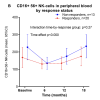
Trial Report Plasma cell targeting with the anti-CD38 antibody daratumumab in ME/CFS -a clinical pilot study, 2025, Fluge et al

No, I am saying I am suspicious because

1. There is no baseline pre run in measurement, for both groups, whereas in Dara we know the run in baselines for 90 days.
2. There is no data on the severity of these patients pre treatment, whereas in Dara we know severity pre treatment. By severity, I mean step count, not survey score.
3. The step counts were recorded for a period of 4-6 days, in contrast to a period of 9 months pre and post treatment in Dara.
Gotcha.

I don't think these things matter as much as we might think they would.

The part of the placebo response that is drug-related starts when the drug starts (unless the participants know the drug would not be expected to have an effect till X weeks). The run-in data is still useful to have, but it's not relevant for the point we're debating here.

It's true that we don't have baseline step counts for ritux in the phase II trial, but we do know that the responders were a little, but not a lot, less severe than the non-responders (mean SF36 PF at baseline 42.9 vs 36.5, table 4), and steps per day correlate well with SF36 PF (van Campen et al. 2020).

Continuous measurement is likely to give more representative data for individuals, but when we're comparing group means to determine if something is effective or not, I'm not sure there'll be an advantage over shorter-term measurements.

None of these points can explain normal or near-normal step counts of responders in the phase II rituximab trial. But the placebo response can.

Editing to add this graph from van Campen et al. 2020:

 
Last edited by a moderator:
Gotcha.

I don't think these things matter as much as we might think they would.

The part of the placebo response that is drug-related starts when the drug starts (unless the participants know the drug would not be expected to have an effect till X weeks). The run-in data is still useful to have, but it's not relevant for the point we're debating here.

It's true that we don't have baseline step counts for ritux in the phase II trial, but we do know that the responders were a little, but not a lot, less severe than the non-responders (mean SF36 PF at baseline 42.9 vs 36.5, table 4), and steps per day correlate well with SF36 PF (van Campen et al. 2020).

Continuous measurement is likely to give more representative data for individuals, but when we're comparing group means to determine if something is effective or not, I'm not sure there'll be an advantage over shorter-term measurements.

None of these points can explain normal or near-normal step counts of responders in the phase II rituximab trial. But the placebo response can.

Run in baseline is most important because we don't have any baseline reference for these step counts and continuous is important because we need to see if these increases are sustained over a year or a Hawthorne effect.

For example, does this armband overestimate steps and baselines might be 6k on average? Were the responders with the armbands purposely stepping up their counts just for the period of being measured?
 
For example, does this armband overestimate steps and baselines might be 6k on average? Were the responders with the armbands purposely stepping up their counts just for the period of being measured?
What's nice is, if Fluge & Mella do a phase III, we will know, because they put it all in their papers for everyone to pore over.
 
My worry is that there is an effect, because of the LLPC depletion, but Dara in general is too weak. We know in MM results vary with Dara, not because it doesn't work, but because the strength or effectiveness varies amongst patients.

So put it in the Phase 2 study, and there will be some effect, but some non responders too, even with higher NK cells.

For example, maybe some plasma cells, the faulty ones, have less CD38 on them? Maybe in some people their immune systems are too weak for Dara to work? Since Dara does not kill anything directly, it flags the CD38 cells, and lets the bodys immune system kill them.

The problem is, right now there is no way of identifying the antibodies, and also, no way of sampling the plasma cells, assuming a small fraction are the bad actors. You would have to take bone marrow samples of ME patients. Which is very painful and intrusive I presume.
 
Survey data is only reliable if it correlates with step count data. In Ritux P3, it did not, in Dara, it did.
Coming back to this point. Can you explain what you mean by saying that in the phase III rituximab trial, the SF36 PF did not correlate with step count data?

As far as I can see, it correlated very well. Looking at table 2 of the 2019 paper:
  • The rituximab group improved by roughly 10 points on the SF36PF and 480 steps.
  • The placebo group improved by roughly 13 points on the SF36PF and 671 steps.

And looking at Appendix table 4 of the 2019 paper:
  • At baseline, those who went on to worsen had both lower SF36 PF and lower steps than the other two groups, and those who continued with stable symptoms had higher mean SF36PF and higher steps than the other two groups. (When I say lower and higher here I do not mean statistically significantly lower or higher, just that the numbers are slightly lower or higher.)
What am I missing?
 
Last edited:
Back
Top Bottom