Trial Report Plasma cell targeting with the anti-CD38 antibody daratumumab in ME/CFS -a clinical pilot study, 2025, Fluge et al

Did anyone look at the recruitment of Ritux P2? Is there any info on this?

I just think on a first principles basis it is impossible to go from 3k to 9k steps consistently on a pure placebo effect. How many of you would be able to do that, and consistently hold it for a year?

Therefore, IMO this deduction leads to me thinking there is something wrong with the Ritux P2 step count measurement. Especially given the step counts in P3.

Either recruitment or the measurement was wrong. Again this argument is built on the idea of tripling step count over a year being not possible unless being cured.
 
Last edited:
On step counts, the assumption that step counters are impartial and accurate is IMHO a very questionable one. I’ve found them unreliable, admittedly I’m severe and haven’t tried all the devices, but that’s the point, they have different hardware and algorithms and suitability. One I had counted mainly how much I was moving my hands (like washing them) rather than anything related to steps, because my steps were so few. In all I’ve used measures were erratic and didn’t reflect how good I felt or active I was. They also completely ignore cognitive or sensory load which is vital for many of us at least.

I’m all for the idea of objective measures, but assuming a ‘device’ or ‘step counts’ is objective is something I would strongly question. Maybe they work well for mild people or in specific circumstances but knowing what those circumstances is is just as important as knowing which circumstances subjective measures are and are not suitable.
 
I’ve found them unreliable, admittedly I’m severe and haven’t tried all the devices, but that’s the point, they have different hardware and algorithms and suitability. One I had counted mainly how much I was moving my hands (like washing them) rather than anything related to steps, because my steps were so few.

They do this when you move around in a powered wheelchair too. Also, despite living in a level access bungalow and only visiting places that also have level access, they somehow manage to record me climbing steps every day.
 
I think if you want to actually count steps accurately for a clinical trial you need an ankle worn monitor, or better still, both ankle and wrist so arm movements can be estimated. I would only consider consistent changes of long term averages of over about 50% or 2000 steps clinically significant, given quite big percentage fluctuations are normal.

My daughter is amused that her steps went up from well under 1000 to over 10,000 on days she's knitting. Each stitch counts as about 4 steps on her fitbit.

I find mine useful as a rough guide. I like it counting arm movements, as I find things like folding laundry, dressing and undressing, and drying myself after a shower even more exhausting than walking.
 
So this might be a very stupid question.

But given the new focus on the immune system and brain due to the genetic studies being done....

IF the Ptwo study ultimately turns out successful, would it be any use to ask patients what symptoms improved first? Could this give any further insights into the disease mechanisms of the disease? Or would it just be noise? As in.... maybe hypothetically... The first symptoms to improve would be symptoms typically associated with... the brain? Or maybe the first symptoms of improvement could be a noticeable improvement in digestion for example.
 
IF the Ptwo study ultimately turns out successful, would it be any use to ask patients what symptoms improved first?

My experience of remissions, and of recovery from illness generally, is that everything improves more or less at once. You feel better in every respect.

One of the interesting things about remission is that you discover you had symptoms you weren't even aware of. They were buried in the all-round feeling of illness, so you didn't notice them till they stopped. For instance, I'd no idea I had constant low grade stomach discomfort until it went away—suddenly I wasn't 'aware' of my stomach all the time, it just got on quietly with its job.
 
Did anyone look at the recruitment of Ritux P2? Is there any info on this?

I just think on a first principles basis it is impossible to go from 3k to 9k steps consistently on a pure placebo effect. How many of you would be able to do that, and consistently hold it for a year?

Therefore, IMO this deduction leads to me thinking there is something wrong with the Ritux P2 step count measurement. Especially given the step counts in P3.

Either recruitment or the measurement was wrong. Again this argument is built on the idea of tripling step count over a year being not possible unless being cured.

Here's what Fluge et al. themselves write in the 2019 paper on the phase III trial (RituxME):
This discrepancy between results of RituxME and previous trials has several possible explanations.
First, placebo mechanisms…
Second, …natural symptom variation over time…
Third, unintended patient selection effects may have contributed to the positive results, especially in our open-label rituximab maintenance study (7)…[that's the 2015 phase II study, bolding added]
[Fourth] In the RituxME trial, the rituximab maintenance doses were 50% to 60% lower than those in the previous maintenance study. However, rituximab dose reductions are not a plausible main cause for the lack of clinical efficacy because early responses should nevertheless have been more frequent in the rituximab group than in the placebo group.

That third point is the one that is relevant to your question about recruitment. They're saying that the way they selected patients in the phase II trial may have been what created a (false) positive result in 2015.

All 29 patients in the 2015 study fulfilled both Fukuda and Canadian criteria, but if I've counted correctly, 22/29 had participated in previous studies by Fluge et al. That might make them an unrepresentative sample. For example, those early trials might have attracted more people with an autoimmune family history, because Fluge et al's hypothesis that "ME/CFS in a subgroup is associated with a variant of an autoimmune pathomechanism" was in the public domain. Or they might differ from the wider ME/CFS population in some other way.

On the idea that massive increases in step count are not possible unless someone has been genuinely cured by an effective treatment, I don't agree. If you look at actual data of people with ME/CFS, there are always some whose physical function scores shoot up by a large amount, even though we don't have effective treatments yet. Some drop back over time, but more remain at the higher level.
 
Last edited:
I figured people would improve slightly differently just as they’re ill slightly differently.

That each of us has slightly different symptoms we see as dominant is reflective of that along with what @Kitty says about noticing different things (I sometimes take painkillers for a headache and realise bits of me I didn’t realise were hurting feel better). And of course we live different lives and many have been ill for many years so may have picked up other things along the way. We may well all get better in the same fundamental way as we got ill, but may experience it differently.
 
I figured people would improve slightly differently just as they’re ill slightly differently.

We just don`t know though, since no intervention in MECFS has ever been found to work.

Having a questionnaire ask what the first sign of improvement was could be very low effort for high reward. But maybe you don`t want to burden patients with too much.

But yeah the most likely outcome would probably be that the questionnaire wouldn`t be of much if any use, and that it would just end up as noise. It`s just the recent genetic studies that have gotten me curious. It feels like we are narrowing in for sure now.
 
We just don`t know though, since no intervention in MECFS has ever been found to work.
Agreed. I think it would be difficult to tell if a symptom is a ‘brain’ symptom given how little we understand about what is ‘brain’ and ‘not brain’ (my view is it’s very blurry) and given all the other points I mentioned that may confuse how people report what/how they improve. But that’s just an opinion and I agree getting information from a questionnaire may be interesting.
 
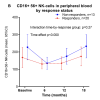
Alright people, friend posted this. NK cells in cyclo. Supports the idea it’s not a subgroup.

Btw: Here's I think a good hint, that non-responders in the dara study with low NK cells are not a different subgroup - in the CycloME study patients with higher NKs tend to be non-responders.
 

Attachments

  • image.png
    image.png
    86.4 KB · Views: 36
Alright people, friend posted this. NK cells in cyclo. Supports the idea it’s not a subgroup.

Btw: Here's I think a good hint, that non-responders in the dara study with low NK cells are not a different subgroup - in the CycloME study patients with higher NKs tend to be non-responders.
A bit brain fogged right now - So are you saying this supports the idea that people with lower NK cells have the same pathology and are not a different subgroup in that sense. And that the response to dara is tied to NK cells (in a different, opposite way than cyclo?)

Or are you saying it supports the idea that the NK cell separation in the dara pilot is a fluke and had nothing to do with why people responded.
 
Not a subgroup. I raised my NK cells from 60 to 450 in a week with Anktiva. This was one month before my first Dara dose a few weeks ago.

So if there was a low NK subgroup, I am officially not in it anymore. I've been trying to raise my NK cells since September with supplements. Only Anktiva moved the needle.
 
Not a subgroup. I raised my NK cells from 60 to 450 in a week with Anktiva. This was one month before my first Dara dose a few weeks ago.

So if there was a low NK subgroup, I am officially not in it anymore. I've been trying to raise my NK cells since September with supplements. Only Anktiva moved the needle.
I mean the proof of that would surely be if you and others who raise their NK cells in such a way respond to dara (which I hope you do!). It could be that low NK cells indicate a different pathology that can't be altered by just artifically raising NK cells. I don't know if you're allowed to post about how your dara trial goes here but I'd be interested to know. That is a really impressive NK cell increase.

The idea that people who don't respond to dara might respond to cyclo is interesting too.
 
Btw did you have any significant side effects from this? Or feel any better? It's been trialled for long covid in The US but I'm very skeptical it could help.

Yes I had plenty of side effects, mainly fever and chills and swollen lymph nodes. No I did not feel better because there is no viral persistence lol.


Also I had very bad muscle pain around the abdomen for one week. But that was the first injection and probably I went too deep.

It was so painful I sneezed and nearly died of pain. So I spent one week basically trying not to move at all.


However, subsequent injections were much milder and tolerable.
 
Last edited:
Back
Top Bottom