Trial Report Plasma cell targeting with the anti-CD38 antibody daratumumab in ME/CFS -a clinical pilot study, 2025, Fluge et al

We have seen in 2022 Fluge and Mella wisely did a step count study with no intervnetion to understand the properties of natural step count variation in ME/CFS patients. And it looks like the average natural variation is around a 1k increase.

We have also seen in a placebo controlled study, improvements were on average a 1k increase too.

Now we have a small study with a 4k increase in average with 6 people. And people here are saying that this could still be due to chance.

Anyone up to buy some lottery tickets? :laugh:
 
Now we have a small study with a 4k increase in average with 6 people. And people here are saying that this could still be due to chance.
Not even that is the case. If you want to look at means you'll at least have to look at the 10 people in the study. 4 had no improvements if I remember correctly?
 
Yes, so we have 6 people that increased steps by 4k on average and 4 people that increased steps by precisely 0 on average.
 
Yes, so we have 6 people that increased steps by 4k on average and 4 people that increased steps by precisely 0 on average.
If we're talking about averages, it has to be about the whole group. Otherwise, it would be cherrypicking - the same as if we found one person in the Rituximab study with a 5000 step count increase, called them a responder, and were comparing to that.

From Dara trial:
Mean steps per 24 h was 3,359 (range 1,493–6,277) at baseline. At 8–9 months, the mean number of steps was 5,862, and 7,392 in the six responders.
So average increase of 2503 steps at 8-9 months.
 
If we're talking about averages, it has to be about the whole group. Otherwise, it would be cherrypicking - the same as if we found one person in the Rituximab study with a 5000 step count increase, called them a responder, and were comparing to that.

From Dara trial:

So average increase of 2503 steps at 8-9 months.

@forestglip


Pooling response by survey/SF36 data:

Responders in P3/Dara:

Average responder P3 n=46: 1k - 2.2k to 3.2k.

Average responder Dara n=6: 4k- 3k to 7k.

Non responders in P3/Dara:

Average stable symptoms P3 n=90: 1.5k - 2k to 3.5k

Avreage worsening symptoms P3 n=15: 0.6k - 1.8k to 2.4k

Average non responder Dara n=4: 0 - 3k to 3k

------------------------------------

In ritux P3, step effect does not correlate with SF36 response. In Dara, step effect correlates with SF36 response quite well.

Surveys like SF36 are breeding grounds for placebo effects, step counts are not.
 
Last edited:
There are good reasons to be cautious, I think.

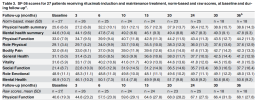
In the dara pilot, the SF36 physical function scores of people given rituximab increased by a mean 29 points (from a mean 26 to a mean 55) over [timeframe unclear to me] months.

In the phase II rituximab study (Fluge et al. 2015) , the SF36 physical function scores of people given rituximab increased by around 28 points by 20 months (from a mean 40 to a mean 68), and stayed there to 36 months (see last line of table below):

1770383053577.png
 
Average responder step count increase in P3 n=46: 1k steps.

Average responder step count increase in Dara n=6: 4k steps.
Ah, sorry. I didn't realize you were comparing to responders in the Rituximab study.

I think there might be some statistical issues with comparing averages of responders only. One way to think of it is, imagine both studies have a small number of individuals with a huge step count increase of 4K due to natural recovery. These people go into the responder category. And imagine Rituximab is the drug that actually works and increases step count an average of 750 steps, while Dara does nothing.

We imagine there are many "responders" in the ritux study who improved by about 750 steps, and maybe when we average with the natural recovery people, it comes out to 1000 steps.

With dara, we imagine there was no real benefit, so the only "responders" are the ones with natural recovery of 4000 steps.

So we'd be seeing 4000 in dara vs. 1000 in ritux, even though ritux is where it worked. It's better to look at the overall group for statistical inference, before any such selection bias can occur.
 
There are good reasons to be cautious, I think.

In the dara pilot, the SF36 physical function scores of people given rituximab increased by a mean 29 points (from a mean 26 to a mean 55) over [timeframe unclear to me] months.

In the phase II rituximab study (Fluge et al. 2015) , the SF36 physical function scores of people given rituximab increased by around 28 points by 20 months (from a mean 40 to a mean 68), and stayed there to 36 months (see last line of table below):

View attachment 30449

I think phase 3 proves that survey data is meaningless and step counts are the true revealer.

Survey data is only reliable if it correlates with step count data. In Ritux P3, it did not, in Dara, it did.

Again, self reported outcomes vs observed outcomes.
 
Ah, sorry. I didn't realize you were comparing to responders in the Rituximab study.

I think there might be some statistical issues with comparing averages of responders only. One way to think of it is, imagine both studies have a small number of individuals with a huge step count increase of 4K due to natural recovery. These people go into the responder category. And imagine Rituximab is the drug that actually works and increases step count an average of 750 steps, while Dara does nothing.

We imagine there are many "responders" in the ritux study who improved by about 750 steps, and maybe when we average with the natural recovery people, it comes out to 1000 steps.

If a drug increases step counts by a mean of 750, then by definition it cannot work. If it cures ME, over time, people return to normal life, and their step count shoot up.

I don't see any evidence that natural recovery happens at all. If it did, and there is a small % of people who do (which it does not), then the odds of selecting 6 natural recovery patients in Dara are simply too low for this to be true, as I previously said.
 
Last edited:
If a drug increases step counts by a mean of 750, then it can't be defined as working.
Ok, but this doesn't change the issue outlined in the scenario above.

If a study puts the people who have a small increase in step count due to a (very minor) benefit from Rituximab, along with naturally recovered individuals, into a responder group, while it doesn't put anyone taking Dara, apart from those with natural recovery, into a responder group, then Dara will look better.
 
Ok, but this doesn't change the issue outlined in the scenario above.

If a study puts the people who have a small increase in step count due to a (very minor) benefit from Rituximab, along with naturally recovered individuals, into a responder group, while it doesn't put anyone taking Dara, apart from those with natural recovery, into a responder group, then Dara will look better.

I already addressed this issue. If we assume the odds of picking a "natural recovery" patient from a population are low, then the odds of picking 6 natural recovery patients from a sample of 10 in Dara are impossibly low. To which the counterargument was that we don't know the parametric distribution of natural recoveries.

The statistic 5% of people naturally recover literally assumes a binomial/bernoulli distribution.

Also, where is the evidence for natural recoveries? Many arguments are built on this. To me, natural recovery stories come from Long Covid patients who had some post viral covid fatigue, not ME, and it went away naturally. That's not ME.
 
Last edited:
I already addressed this issue. If we assume the odds of picking a "natural recovery" patient from a population are low, then the odds of picking 6 natural recovery patients in Dara are impossibly low.
Is it 6? Looking at the 6 "responders" in Supplementary Table 1, these are the changes in step count over a year:
-155, 1307, 3205, 6132, 6634, 6727

And the non-responders:
-360, -227, 215, 710

Also, are the criteria for being classified as a responder and the time period for step count measurement the same when you talk about 1000 step count improvement in responders in Rituximab?
 
Also, are the criteria for being classified as a responder and the time period for step count measurement the same when you talk about 1000 step count improvement in responders in Rituximab?
Yes this is in the table I posted.

Well by max Sf36 difference, its 6, but by step count, its really 4/5. There is one patient, green line, who relapsed.

Assume 5% naturally recover. By binomial distribution, odds of 4/10 natural recoveries is less than 1%. It's 1 in 1000.

If 1% naturally recover, the odds are 1 in 500k. At those odds one should buy lottery tickets. I hope this helps debunk the natural recovery argument. You can work out the number @forestglip

10C4 x 0.01^4 x 0.99^6
 
Last edited:
Yes this is in the table I posted.
In this post? https://www.s4me.info/threads/plasm...ilot-study-2025-fluge-et-al.44736/post-672520

That table is showing baseline steps. I see Table 2 in the study has step count at 17–21 mo, but on a skim, I don't see a step count value for 12 months like Dara.

For "response" criteria, in the Phase 3 Ritux paper, I see this:
The scale for symptom change was adapted from a Clinical Global Impression scale previously used in CFS (18). The relative scale for each symptom was 0 to 6, in which 3 denoted no change from baseline; 4, 5, and 6 slight, moderate, and major improvement, respectively; and 2, 1, and 0 slight, moderate, and major worsening, respectively. The primary variable, fatigue score (scale, 0 to 6), was calculated as the mean of the following 4 items, which correspond to the 4 fatigue-related symptoms: “fatigue,” “postexertional exhaustion,” “need for rest,” and “daily functioning.”
The median time to first clinical response (that is, fatigue score ≥4.5 for ≥8 consecutive weeks) was 41 weeks among 46 patients who fulfilled the response criteria for the fatigue measure, and time lags were comparable for responders in both treatment groups.

For Dara, I see this:
The characterization of patients with clinical improvement or no improvement during follow-up, was based on the clinical assessment at investigator visits in addition to patient-reported measures and Fitbit data.

It seems like it may have been easier to be labeled a responder in the Ritux trial, since it was just based on a questionnaire, while in the Dara trial, it was based on several factors, including step count. If the criteria made it easier to become a responder in the Ritux trial, then the average step count improvement for responders in the Ritux trial will be lower.
 
I don't see any evidence that natural recovery happens at all. If it did, and there is a small % of people who do (which it does not), then the odds of selecting 6 natural recovery patients in Dara are simply too low for this to be true, as I previously said.
There is evidence that people with MECFS sometimes improve a little or a lot. It is not the norm but it is common enough, especially early on. This is probably why so many people think they recovered from brain retraining and stuff.

The odds of 6/10 patient with MECFS as we understand it naturally improving, 5 of whom improve to a remission like state, during a drug trial, do seem vanishingly small. But it's just not enough data to be confident dara works.

If the higher NK cell severe patients they are treating currently respond in a similar manner I will start to get excited, but even then it won't be proof until we have the placebo controlled study results.
 
The odds of 6/10 patient with MECFS as we understand it naturally improving, 5 of whom improve to a remission like state, during a drug trial, do seem vanishingly small. But it's just not enough data to be confident dara works.
With a binomial distribution of 1% odds the odds are literally 1 out of 500,000. That is basic probability. At 5% its 1 in 1000. Still impossibly low.
 
With a binomial distribution of 1% odds the odds are literally 1 out of 500,000. That is basic probability.
As Jonathan already said you can never safely assume that a clinical trial is randomly sampling out of a natural distribution. Things like selection criteria can and do introduce a lot of bias that even the investigators are unaware of, the intramural study is proof of that too. That’s the whole point of doing a placebo control arm.
 
Can you give some exaemples of biased selection criteria then?

They put out an advert for a study in Bergen. People respond.

If picking 10 patients from a pool of ME patients is not randomly sampling out of a natural distribution, then what is it? You are picking out of people who want to apply for the study. I assume you would only want to apply for the study if you were desperate enough to want treatment.

So the distribution is people who are aware of these studies and want to get in. If you are aware, it means you have probably been following ME research for a while, and also you wish to improve so much that you want to take a shot at a clinical trial. It also means you have tried alot of things, nothing has worked, and you are kind of desperate.

There were also no mild patients. This actually helps the argument.
 
Last edited:
Back
Top Bottom