Predictive processing, predictive coding - a BPS theory of causation

I think it's important to take a few steps back and note how there is no such thing as "brain training" or "re-training", as it's usually called, it's just a marketing term equivalent to detoxifying. It clearly resonates in a way that convinces a lot of people, but there is zero basis behind any of this, it's just a mish-mash of every bad pop psychology that's ever been fashionable.

It's conversion therapy, derived from a belief in the conversion disorder. I have no idea why people started adopting this obvious propaganda.
Bus she said my brain doesn’t feel safe but my brain isn’t its own person with feelings?
 
Last edited:
I'm aware this is a lot to go through but it's all interesting and at least should reassure you that brain retraining is not some 'cult.' There IS theory and science underpinning the ideas:

https://link.springer.com/article/10.3758/s13415-021-00958-x - this is good

Also really interesting:

Mats Lekander, 'The Inflamed Feeling' is a very good book laying things out in a way that is more readable.

Predictive processing pain papers are also key (as they seem to be the same mechanism, just different symptoms), such as:

No rush to read it all.


Starting to look at these:

From the Amazon description of the book recommended:

Inflamed feeling: The Brain's Role in Immune Defence​

by Lekander (Author) Format: Paperback
5.0 5.0 out of 5 stars (1)

What do feeling sick and being afraid of strangers have in common?

The answer is that these feelings represent a behavioural drive which evolved in our ancestors to combat the most dangerous threat to survival: infection.

Behaviour and emotions play pivotal roles in the struggle for good health. When your body is telling your brain that you are sick, you are experiencing survival strategies that developed years ago. Listening to these feelings will allow you to save energy that can be used for recuperation and recovery. Urges of staying still, noticing pain, feeling sorry for yourself, and focusing inward are bodily messages that benefit immune defence.

For our forefathers, in whom these strategies evolved, it wasn't enough to change behaviour once sick. Defensive behaviours to be able to avoid infection in the first place were also needed. Thus, tools for detecting illness in others evolved. This is why superficial signs of ill-health, or maybe even the prejudicial idea of a person with a foreign bacterial culture, can cause anxiety and avoidance. Not surprisingly, having a too high or too low sensitivity to inner or outer disease signals is connected to mental as well as somatic disorders.

In this book, Mats Lekander explains the science behind perceived health, using Barbie dolls, visual illusions, personal experiences, placebo, hypochondriacs and historical anecdotes. Placed against a back-drop of the latest neuroscience and psychoneuroimmunology he explains why you feel healthy or sick. He describes when he poisoned himself at work and enjoyed it, and why white blood cells and inflammation are key players when our brains trys to guess what is going in our inner worlds.

The result is an absorbing and eye-opening book, one that seems so relevant in the current times
Honestly, I'm not inclined to spend £41 on a pop science book full of irrelevant anecodotes and barbie dolls. Let's focus on evidence.
_______________________

Next:

It is terrible.

"The metacognitive theory of dyshomeostasis (Stephan et al., 2016) states that pathological fatigue emerges from the metacognitive mechanism in which the detection of persistent mismatches between prior interoceptive predictions and ascending sensory evidence (i.e., prediction error) signals low evidence for internal generative models, which undermine an agent’s feeling of mastery over the body and is thus experienced phenomenologically as fatigue."

This is just blather, and as i pointed out, backwards.

Can you not see that? Are you unable to understand the basics of the theory?
So no thanks to that one.
____________________________

Next:
https://www.tandfonline.com/doi/full/10.1080/17437199.2023.2171900#abstract

Social Safety Theory: Conceptual foundation, underlying mechanisms, and future directions, 2023, George M. Slavich et al

ABSTRACT

Classic theories of stress and health are largely based on assumptions regarding how different psychosocial stressors influence biological processes that, in turn, affect human health and behavior. Although theoretically rich, this work has yielded little consensus and led to numerous conceptual, measurement, and reproducibility issues.

Social Safety Theory aims to address these issues by using the primary goal and regulatory logic of the human brain and immune system as the basis for specifying the social-environmental situations to which these systems should respond most strongly to maximize reproductive success and survival.

This analysis gave rise to the integrated, multi-level formulation described herein, which transforms thinking about stress biology and provides a biologically based, evolutionary account for how and why experiences of social safety and social threat are strongly related to health, well-being, aging, and longevity. In doing so, the theory advances a testable framework for investigating the biopsychosocial roots of health disparities as well as how health-relevant biopsychosocial processes crystalize over time and how perceptions of the social environment interact with childhood microbial environment, birth cohort, culture, air pollution, genetics, sleep, diet, personality, and self-harm to affect health. The theory also highlights several interventions for reducing social threat and promoting resilience.
Given that the theorising and discussion in this paper seems to be all about the effect of threatening social situations on health, I can't see any relevance to ME/CFS, so that's another no from me.
____________________________

More in my next post.
 
Last edited:
Continuing from my previous post

Next:

We have a thread on this:
Prediction bias for physical exertion in chronic fatigue: Evidence from an observational paradigm 2026 Kubis et al
A bunch of psychologists getting people with 'chronic fatigue' seemingly from any illness judging by the abstract to watch videos of people exerting and rate the level of exertion. The fatigued people predicted a higher level of exertion than the healthy controls. Somehow this was interpreted as "Chronic fatigue relates to higher prediction bias for exertion for observed exercise tasks."
Well of course. Why wouldn't we. It's not something wrong with our brains, it's a reflection of different experience. It's certainly not a new paradigm as claimed.
Forum discussion dismissed it as silly. I can't see any relevance to predictive processing or to brain retraining or to ME/CFS.
_____________________

Next

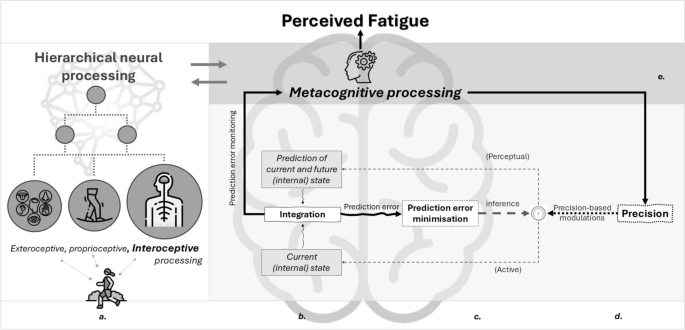
A New Framework to Understand and Study Exercise-Induced Perceived Fatigue as a Metacognitive Inference of Dyshomeostasis
Review Article. Published: 24 June 2025, Jeanne Dekerle et al

Abstract
Novel theories have emerged in the past decade pertaining to how the brain processes internal body sensations and how such processes underpin not only perception but also how we act in the world. These neuroscientific advances offer new perspectives for research and practice allied to medicine, sport and exercise science.

The construct of perceived fatigue has been understudied until recent recognition of its prevalence and influence on perceptions and behaviours in health, diseases and performance.

The aim of the present perspective piece is to propose a theoretical and conceptual framework for understanding perceived fatigue and its emergence during exercise.

We encourage the use of the definition proposed by Micklewright et al. (2017), that is “a feeling of diminishing capacity to cope with physical or mental stressors, either imagined or real”, from a critique of contemporary taxonomies and a distinction made with other key percepts in the field of medicine, sport and exercise.

We also offer some methodological considerations for its measure. We then succinctly describe a neurobiologically plausible mechanistic underpinning of exercise-induced perceived fatigue based on the theory of predictive processing applied to homeostatic regulation through allostatic control and metacognition.

Finally, we position the model of perceived fatigue through Metacognitive Inference of Dyshomeostasis (MID) within the wider corpus of knowledge. We first contrast the MID model with the most dominant biology-grounded models of perceived fatigue proposed in the literature to then provide preliminary evidence in support of the MID model and suggest some testable predictions for future research.
This is published in a sports science journal. It appears to be a hypothesis paper.
The focus is stated here as:
The aim of the present perspective piece is to propose a theoretical and conceptual framework for understanding perceived fatigue and its emergence during exercise
Since it's paywalled, I have no idea what the proposed theory is, and whether it has any evidence base or relevance to ME/CFS, let alone to brain retraining.
Since you recommended it, @UkPoster, I assume you have read and understood it, so can explain it's relevance.

Edit; I looked up the lead author:
https://research.brighton.ac.uk/en/persons/jeanne-dekerle/
She is a sports scientist with a focus on fatigue and the effects of exertion, she lists exercise based rehabilitation as an area of interest and includes ME/CFS in conditions she's interested in. Draw your own conclusions.
_____________________________

More in my next post
 
Last edited:
Next:
Predictive processing pain papers are also key (as they seem to be the same mechanism, just different symptoms), such as:
https://www.sciencedirect.com/science/article/pii/S1053811924002052

An Embodied Predictive Processing Theory of Pain Experience, 2022, Kiverstein et al

Abstract
This paper aims to provide a theoretical framework for explaining the subjective character of pain experience in terms of what we will call ‘embodied predictive processing’.

The predictive processing (PP) theory is a family of views that take perception, action, emotion and cognition to all work together in the service of prediction error minimisation.

In this paper we propose an embodied perspective on the PP theory we call the ‘embodied predictive processing (EPP) theory. The EPP theory proposes to explain pain in terms of processes distributed across the whole body.

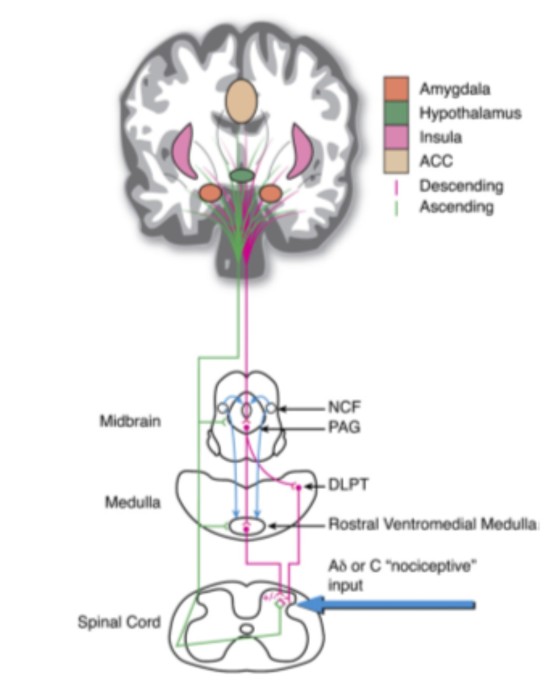
The prediction error minimising system that generates pain experience comprises the immune system, the endocrine system, and the autonomic system in continuous causal interaction with pathways spread across the whole neural axis.

We will argue that these systems function in a coordinated and coherent manner as a single complex adaptive system to maintain homeostasis. This system, which we refer to as the neural-endocrine-immune (NEI) system, maintains homeostasis through the process of prediction error minimisation.

We go on to propose a view of the NEI ensemble as a multiscale nesting of Markov blankets that integrates the smallest scale of the cell to the largest scale of the embodied person in pain.

We set out to show how the EPP theory can make sense of how pain experience could be neurobiologically constituted. We take it to be a constraint on the adequacy of a scientific explanation of subjectivity of pain experience that it makes it intelligible how pain can simultaneously be a local sensing of the body, and, at the same time, a more global, all-encompassing attitude towards the environment. Our aim in what follows is to show how the EPP theory can meet this constraint.

I've run out of energy to explore this further. The pdf is available, maybe we need a thread on it. I can't see it's relevance to the assumptions being made by @UkPoster. Maybe they can enlighten us.
__________________
 
Last edited:
Next

The body does not keep the score: trauma, predictive coding, and the restoration of metastability

An opinion article about models of how PTSD affects the body and treatment approaches to restore what they call 'flow' which seem to involve exercise for people with PTSD. It includes explaining and commenting on various people's theories about PTSD.

I've only skimmed the article, here are a few fairly random quotes:

For nearly a decade, the idea that “the body keeps the score” has shaped public and clinical understanding of trauma (van der Kolk, 2014). It is an enticing metaphor—implying that experience is literally inscribed in flesh, that the body bears the scars of what the mind cannot face. Yet recent advances in computational and systems neuroscience reveal that this image, while emotionally compelling, is biologically inaccurate. The body proper does not store trauma; the brain dynamically reenacts it through maladaptive inference. What endures after trauma is not a memory lodged in non-innervated tissue but a collapse of flexibility—a loss of metastability, the brain's ability to fluidly switch among semi-stable network states.

The practical question becomes: how can flexibility be restored when it is lost? Evidence now points to a surprising candidate—flow states. Flow, the state of complete absorption in a meaningful, high-challenge activity, may produce the very network dynamics that PTSD disrupts. During flow, the prefrontal cortex undergoes localized transient hypofrontality—reduced self-referential processing—while frontoparietal and sensory-motor networks exhibit rapid, adaptive reconfiguration.

Understanding trauma as a dysregulation of metastability may also dissolve a long-standing paradox in mental health: why so many diverse treatments—exposure therapy, EMDR, mindfulness, exercise, psychedelics, flow-inducing pursuits—can all succeed. Each, in its own way, restores flexible coupling between large-scale networks, quiets maladaptive self-referential loops, and rebalances neuromodulation. The mechanism is not specific content but dynamic reorganization. The nervous system learns to balance oscillation and homogenization, inhibition and excitation.

An important limitation of our framework deserves emphasis: the core theoretical claim—that PTSD specifically involves reduced metastability—has not yet been directly tested using established metastability metrics in PTSD populations.

Lead author:
Steven Kotler is a New York Times–bestselling author, award-winning journalist, and Distinguished Research Fellow at the Center for Complex Systems and Brain Sciences at Florida Atlantic University, where his work focuses on the neuroscience of flow, intuition, creativity, consciousness, and human performance. He is the founder and executive director of the Flow Research Collective, a research and training organization dedicated to advancing performance neuroscience for the future of brain health.

It looks interesting, but again I can't see the relevance to either ME/CFS or brain retraining. The solution hypothesised but not tested for treating PTSD is about challending the body not the mind, as far as I understand it.
__________________

So I have looked at all the references @UkPoster suggests as supporting brain retraining and their version of predictive processing. I have found nothing here that seems either relevant or to support the treatment they describe.
 
Last edited:
I've run out of energy to explore this further. The pdf is available, maybe we need a thread on it. I can't see it's relevance to the assumptions being made by @UkPoster.

It simply illustrates the bogus language these people use. I note they bring in Markov blankets, which are abstract concepts of closed dynamic systems that the new brain gurus love to invoke but which are completely irrelevant because a brain is the opposite of a closed system - for obvious reasons.

This is high class blather salad, to be taken with not just a spoonful of sea salt but at least six glasses of home made ouzo to ensure you remember none of it.
 
Another article that heavily criticizes the book The Body Keeps the Score:
 
You must be good at controlling saccades!
I’m not sure. I think I’m doing it wrong, or maybe there’s something wrong with my vision. I couldn’t finish the experiment because I still saw the thing I was focusing on. My vision went grey only around the edges. And then my eyes started to water and I couldn’t keep them open anymore. Maybe it’s just eye strain. I’ll try again when I’m feeling better
 
Back
Top Bottom