REACH-OUT: Caring for the healthcare workforce post-COVID-19, 2026

Chandelier

Senior Member (Voting Rights)
REACH-OUT: Caring for the healthcare workforce post-COVID-19
A longitudinal mixed-methods study of post-COVID-19 outcomes in healthcare workers from diverse ethnicities
4th report (final)


No authors mentioned.

Aim

In 2021, the NHS Race and Health Observatory partnered with the United Kingdom Research Study into Ethnicity and COVID-19 Outcomes in Healthcare Workers (UK-REACH), to undertake a longitudinal study looking at the impacts of long-COVID on the physical and mental health of healthcare workers, and the broader impacts to their working, social and family lives.

Summary

Healthcare workers (HCWs), particularly those from ethnic minority backgrounds, are at increased risk of COVID-19 infection and adverse outcomes.
A proportion of COVID-19 survivors experience prolonged symptoms, a condition now widely known as “long COVID”.
The estimated burden of long COVID, and related poor mental, physical and occupational outcomes in HCWs is likely to be large, and to significantly impact on the delivery of safe and high-quality care.
However, these impacts on HCWs and on the health service and patient care are as yet unknown.

This study aimed to estimate the prevalence of long COVID among HCWs, characterise the syndrome, and understand the impacts of medium-term and post-acute/long COVID illness on the mental, physical, and occupational health of diverse communities of HCWs in the UK, and their work and home lives.

Methodology

This is a mixed-methods study which included:
  1. a systematic review and meta-analysis to estimate the prevalence of long COVID among HCWs globally and identify symptoms of long COVID (and their clustering);
  2. analysing baseline and follow-up questionnaire data by conducting a longitudinal quantitative survey study to estimate the prevalence of long COVID in HCWs, and whether this differs by age, sex, ethnicity and occupation;
  3. conducting qualitative research with HCWs, their families and their colleagues to understand the short- and medium-term impacts of long COVID. We will use the evidence generated to better understand how HCWs can be supported as they recover, and to make policy recommendations to support the recovery of the health care system.
This report is the forth and final update of a three-year study.

You can download the three previous update reports below.

Report one focuses on outlining the rationale and methodology that will drive the work,

report two includes an exploration of global research about long COVID and outlines some implications for health and care policy.

The third report explores the variable factors associated with long COVID, insights from questionnaires, workforce implications and the need for targeted policy recommendations to address ongoing challenges.


Web | DOI | PDF | Open Access
 

Quarter of health workers report long Covid symptoms​

by Nic Paton 11 Aug 2026
The qualitative interview data suggested long Covid resulted in healthcare workers being absent from work, or staying in work but experiencing guilt, stigma and blame.

This often manifested itself as an internalised pressure to continue performing as normal so as not to be seen to be exaggerating the severity of their condition.

Interviewees pointed to a limited understanding of long Covid among clinicians and managers and inconsistent and insufficient support available for those with long Covid working in the NHS.

Professor Katherine Woolf, professor of medical education research at UCL’s Medical School, said: “This research highlights how much impact the Covid pandemic continues to have on healthcare workers, with up to one in four still experiencing symptoms following infection.

“Supporting those affected and preventing similar impacts on healthcare staff in future pandemics should remain a priority,” she added.


The UK data suggested that, six years on from the start of the pandemic, long Covid still represents a substantial, prolonged burden on care, with some of those afflicted reporting symptoms lasting over a year which affect their daily function.

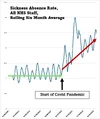
NHS sickness absence rate 2009-2025:
 
Interviewees pointed to a limited understanding of long Covid among clinicians and managers and inconsistent and insufficient support available for those with long Covid working in the NHS.

Professor Katherine Woolf, professor of medical education research at UCL’s Medical School, said: “This research highlights how much impact the Covid pandemic continues to have on healthcare workers, with up to one in four still experiencing symptoms following infection.

“Supporting those affected and preventing similar impacts on healthcare staff in future pandemics should remain a priority,” she added.
After 6 years, this is an absolutely pathetic state of affairs, made even worse by the complete indifference of the institutions of the health care industry. But the idea that anything competent would be done in a future pandemic while nothing is being done right now is just ludicrous. Does anyone saying this crap even pretends to believe it? They can't now know it's complete BS. All of this is a choice, including the choice to continue pretending otherwise.

And notice the talk of "the pandemic", as a cover for the fact that such chronic illnesses come from common infections. This is to make it all about "the event", in the past, a social event, not anything to do with infectious illnesses.
 
Tern has posted a thread on Twitter with a lot of different graphs, each ranging from 2019-2026, showing absence rates broken down to different categories like
  • Nervous system disorders
  • Migraines
  • Flu
  • Pregnancy related disorders
  • Cardiac problems
  • Endocrine problems
  • Eyes
  • Dental
And that for different health care workers like doctors, nurses etc.

Most of the graphs show drastic increases during that timeframe.

You can checkout the graphs without needing an account via this link.
 

Covid turned into long Covid in more than a quarter of affected staff​

18 AUGUST, 2026 BY EMMA BAINES

Professor Habib Naqvi said:​
…​
“I’m delighted that this report, which explicitly focuses on the impact of long Covid on our diverse workforce, presents us with keys insights and first-hand accounts to help the healthcare system to learn and address the need for improved support.​
“There is a clear and urgent need for improved workplace adjustments, tailored support for the workforce, and increased learning and understanding of the impact of long Covid for the wider health and care system,” he said.​
“We simply cannot afford for history to repeat itself.”​
Professor Katherine Woolf, from University College London’s medical school, said that the new research highlighted how much impact the Covid-19 pandemic continued to have on healthcare workers.​
“Supporting those affected and preventing similar impacts on healthcare staff in future pandemics should remain a priority,” she said.​


3,000 NHS staff a year apply to get their pensions early due to illness​

There are more applications for ill health retirement than there used to be but the bar for being accepted is high
August 19, 2026
Over 3,000 workers – which will include doctors, nurses and other non-clinical staff – applied to take ill health retirement last year, which allows them to take their pensions early.

NHS staff are part of the health service’s pension scheme, which gives an annual income in retirement based on the number of years they have worked and their salary.
…810 workers were awarded “tier 1” ill health retirement, which means they cannot work in their current NHS role, but could continue work elsewhere.
A further 1,991 workers were awarded “tier 2” retirement, meaning they are permanently unable to do their specific NHS job or other alternative employment.
The figures were gathered by financial advice firm Wesleyan, which obtained the data from the NHS Business Services Authority via a Freedom of Information request.
From Twitter with additionally calculated delta:
2021-2022: 2,132
2022-2023: 2,769 (+29.9%)
2023-2024: 3,057 (+10.4%)
2024-2025: 3,115 (+1.9%)
2025-2026: 3,062 (-1.7%)
Back to the article:

Why are the numbers going up?

Experts said the increasing number of applications likely reflected the rise in burnout in the NHS.

Wilf Moralee, chartered financial planner at Wesleyan, said: “While the data itself can’t tell us exactly what’s behind it, it certainly reflects what we’re seeing day to day, with increasing levels of burnout across the NHS.

“There is a real sense that many doctors aren’t able to follow the ‘put your own air mask on first’ advice before things reach a crisis point. Too often, they’re putting everyone else’s needs ahead of their own until continuing to work simply isn’t possible.

“What stands out is not just the increase in applications, but that more of those applications are resulting in awards.

“In particular, the continued rise in tier 2 awards is concerning because these are people who have been assessed as permanently unable to undertake any regular employment before pension age.”

Dr Amit Kochhar, representative body chair at the British Medical Association, said: “While it is not clear what is behind this worrying increase in the number of NHS staff taking early retirement due to ill health, what is clear is that the workforce pressures created by preventable staffing shortages have had a deleterious effect on their wellbeing.

“Early retirement due to ill health means potentially years lost from senior expert medical staff and their ability to treat patients.”
 
NHS healthcare worker experiences of moral injury: a follow-up qualitative study in England using reflexive thematic analysis, 2026, Higginbottom et al.

Higginbottom, Erin; Stoeck, Friederike; Stevelink, Sharon; Hegarty, Siobhan; Raine, Rosalind; Rafferty, Anne Marie; Greenberg, Neil; Wessely, Simon; Rahman, Hassan; Lamb, Danielle

Abstract​

Background Moral injuries (MIs) may result from individuals being exposed to potentially morally injurious events (PMIEs).
PMIEs have been a feature of work within much of the National Health Service (NHS) for many years, and the understanding of MI is now more commonplace, having been highlighted during the COVID-19 pandemic; however, understanding of how such events affect workers over the long term is lacking.

Objective To understand the development of healthcare workers’ (HCWs) experiences of PMIEs over a period of 3 years.

Design and participants We carried out follow-up semistructured qualitative interviews with 15 NHS staff who were previously interviewed on the same topic in 2021.
All interviews were recorded, transcribed and analysed using reflexive thematic analysis following an inductive approach.

Results Three main themes and six subthemes were identified:
(1) internal context and subjective experiences,
(1.i) control in a rigid system,
(1.ii) psychosocial dynamics,
(2) external context and the moral cost of culture,
(2.i) organisational culture,
(2.ii) sources of MI,
(3) responses to PMIEs,
(3.i) maladaptive responses,
(3.ii) adaptive responses.
Key issues identified included perceptions of insufficient control over their work and work environment, low psychological safety and perceived misunderstanding of the value of their work from patients and colleagues, leading to a challenging organisational culture.
We found that in the 3 years between the interviews many staff reported developing ‘secondary’ feelings of betrayal as a result of perceived ongoing governmental neglect of recognition for HCWs’ sacrifices during the pandemic and a lack of acknowledgement of governmental mistakes made in the acute period.

Conclusion Findings show an interplay between individual and organisational factors that HCWs faced while working in the NHS, underlining the need for wide-ranging intervention strategies.
Since the HCWs’ original interviews in 2021, a secondary betrayal has developed, emphasising the need for interventions that can restore trust in the system.

STRENGTHS AND LIMITATIONS OF THIS STUDY​

  • A key limitation is that we achieved follow-up participation of only 50% and consequently, our sample reflects only those still working, which may underestimate the true extent of moral injury (MI) in the National Health Service, and the adaptive responses identified may be over-represented.
  • Another limitation is that, while some participants reported experiencing potentially morally injurious events, they struggled to provide examples and while probing mitigated this, future research could encourage reflection before interviews to support richer responses, for example, by using storytelling, diaries.
  • A further limitation is that we used an existing accepted definition of MI to enable comparison to previous research, which may have biased the answers given by respondents.
  • A strength is that our semistructured, participant-led approach respected the subjective nature of MI and did give space for participants to self-define their experiences.
  • Another strength is that the follow-up design offered insight into the trajectories of MI and established the identification of a secondary betrayal.

Web | DOI | BMJ Open | Open Access
 
Back
Top Bottom