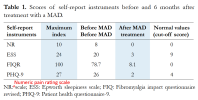
61 y/o female with 21-year history of fibromyalgia (for which she took duloxetine, carbamazepine and cyclobenzaprine that leveled her pain at 6/10 on numeric rating scale), and 10-year history of panic disorder. She also had daily migraines. Her FIQR score of 78.7 was consistent with severe fibromyalgia and her PHQ-9 score of 26 indicated severe depression.
PSG revealed severe OSA (majority hypopnea) with presence of alpha-delta sleep. She did not tolerate CPAP so was referred for treatment with a mandibular advancement device (MAD) with a final setting of 10mm advancement.
With MAD treatment, "her multisite pain resolved completely without further need for either previously described analgesic medication," her mood dramatically improved and migraine headaches decreased from daily to once every 2-3 months. Epworth Sleepiness Scale (ESS) AND PHQ-9 scores went from indicating severe sleepiness and depression to within normal limits.
After initiating treatment with the subjectively titrated MAD, the patient returned for follow - up visits after 3, 6 and 12 months. She continuously used the MAD every night and all night long confirmed by sleep diary including adherence related information. Self-reported control of snoring was confirmed by her husband and the Snorelab® cell phone app. Improvement of excessive daytime sleepiness was observed soon after treatment initiation with the MAD without any negative side- effects. Her multisite pain resolved completely without further need for either previously prescribed analgesic medication and her mood improved much. The alfa-delta pattern was absent at this time.
Additionally, alpha-delta sleep (an objective finding associated with fibromyalgia) was absent from follow-up PSG. As far as I'm aware, there's not much out there on whether alpha-delta sleep is a finding that comes and goes in people who have it, or whether it is relatively stable. However, the
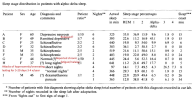
first study that formally described alpha-delta sleep by Hauri and Hawkins (
Sci-Hub link) which reported on 9 patients with various diagnoses with alpha-delta sleep ("the only psychological similarity among most alpha-delta patients was a general feeling of chronic, somatic malaise and fatigue") found that alpha-delta sleep was present during every laboratory night of the 9 patients (number of nights ranged from 2-6). Patient I was a "professional man under no psychiatric care" who had been "over-zealously treated with corticosteroids for the last 12 years"; alpha-delta sleep was seen while he was on dexamethasone feeling "weak, fatigued, with poor appetite and increased need for sleep." 4 weeks after steroid treatment was stopped (and he was started on Parnate) alpha-delta sleep was absent. But overall, the authors concluded "It seems unlikely that alpha-delta sleep is mainly a drug-related phenomenon":
Although some of the patients received drugs during this study (or had recently been withdrawn from them), it seems unlikely that alpha-delta sleep is mainly a drug-related phenomenon. Visual analysis of the data did not reveal any obvious differences in the alpha-delta pattern between drug free patients and those either currently or recently on drugs.