https://www.ncbi.nlm.nih.gov/pmc/articles/PMC2583111/
Abstract
Complement activation resulting in significant increases of C4a split product may be a marker of postexertional malaise in individuals with chronic fatigue syndrome (CFS). This study focused on identification of the transcriptional control that may contribute to the increased C4a in CFS subjects after exercise. We used quantitative reverse-transcription polymerase chain reaction to evaluate differential expression of genes in the classical and lectin pathways in peripheral blood mononuclear cells (PBMCs). Calibrated expression values were normalized to the internal reference gene peptidylpropyl isomerase B (PPIB), the external reference gene ribulose-1,5-bisphosphate carboxylase/oxygenase large subunit (rbcL), or the geometric mean (GM) of the genes ribosomal protein, large, P0 (RPLP0) and phosphoglycerate kinase 1(PGK1).
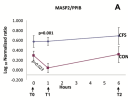
All nine genes tested, except mannose-binding lectin 2 (MBL2), were expressed in PBMCs. At 1 hour postexercise, C4, mannan-binding lectin serine protease 2 (MASP2) and ficolin 1 (FCN1) transcripts were detected at higher levels (≥ 2-fold) in at least 50% (4 of 8) of CFS subjects and were detected in 88% (7 of 8) CFS subjects when subjects with overexpression of either C4 or MASP2 were combined. Only an increase in the MASP2 transcript was statistically significant (PPIB, P = 0.001; GM, P = 0.047; rbcL, P = 0.045). This result may be due to the significant but transient downregulation of MASP2 in control subjects (PPIB, P = 0.023; rbcL, P = 0.027). By 6 hours postexercise, MASP2 expression was similar in both groups.
In conclusion, lectin pathway responded to exercise differentially in CFS than in control subjects. MASP2down-regulation may act as an antiinflammatory acute-phase response in healthy subjects, whereas its elevated level may account for increased C4a and inflammation-mediated postexertional malaise in CFS subjects.
Abstract
Complement activation resulting in significant increases of C4a split product may be a marker of postexertional malaise in individuals with chronic fatigue syndrome (CFS). This study focused on identification of the transcriptional control that may contribute to the increased C4a in CFS subjects after exercise. We used quantitative reverse-transcription polymerase chain reaction to evaluate differential expression of genes in the classical and lectin pathways in peripheral blood mononuclear cells (PBMCs). Calibrated expression values were normalized to the internal reference gene peptidylpropyl isomerase B (PPIB), the external reference gene ribulose-1,5-bisphosphate carboxylase/oxygenase large subunit (rbcL), or the geometric mean (GM) of the genes ribosomal protein, large, P0 (RPLP0) and phosphoglycerate kinase 1(PGK1).
All nine genes tested, except mannose-binding lectin 2 (MBL2), were expressed in PBMCs. At 1 hour postexercise, C4, mannan-binding lectin serine protease 2 (MASP2) and ficolin 1 (FCN1) transcripts were detected at higher levels (≥ 2-fold) in at least 50% (4 of 8) of CFS subjects and were detected in 88% (7 of 8) CFS subjects when subjects with overexpression of either C4 or MASP2 were combined. Only an increase in the MASP2 transcript was statistically significant (PPIB, P = 0.001; GM, P = 0.047; rbcL, P = 0.045). This result may be due to the significant but transient downregulation of MASP2 in control subjects (PPIB, P = 0.023; rbcL, P = 0.027). By 6 hours postexercise, MASP2 expression was similar in both groups.
In conclusion, lectin pathway responded to exercise differentially in CFS than in control subjects. MASP2down-regulation may act as an antiinflammatory acute-phase response in healthy subjects, whereas its elevated level may account for increased C4a and inflammation-mediated postexertional malaise in CFS subjects.