Did they in their world of non dualism give any regard to the fact that aluminium poisoning itself might increase propensity to anxiety whether as part of specific mechanisms or by inducing stress of general dysfunction and the experience thereof.Wessely was unfortunately not mentioned. However a report at the time - the Clayton report, referred to in Hansard below clearly aims to minimise the effect of early issues and raises anxiety as an explanation in below (my bolding)
Hansard https://api.parliament.uk/historic-hansard/written-answers/1989/jul/20/lowermoor-incident-group
"Mr. Freeman
The report of the Lowermoor incident health advisory group is being published today. The group was set up in January 1989 at my request to provide independent expert advice to the Cornwall and Isles of Scilly district health authority on the implications for the health of the population in the Camelford area following the contamination of their drinking water in July 1988. Copies of the report have been sent to the Department of Health and to the Department of the Environment, and I am placing copies in the Library. I am grateful to Dame Barbara Clayton and her colleagues for their very thoughtful and authoritative report.
Hansard: https://api.parliament.uk/historic-hansard/written-answers/1989/jul/20/lowermoor-incident-group
"The Government welcome the group's advice that no long-term effects on health are expected. The group's main findings are that:
(i) early symptoms, which were mostly gastrointestinal disturbances, rashes and mouth ulcers and which appeared to be mostly mild and short-lived, can most probably be attributed to the incident. Other causes such as viral infections cannot be discounted for some of the cases.
(ii) it is not possible to attribute the very real current health complaints to the toxic effects of the incident, except insofar as they are the consequence of the sustained anxiety naturally felt by many people. A number of factors have contributed to this anxiety, particularly in relation to long-term effects, and these are addressed in the report."
Hansard https://api.parliament.uk/historic-hansard/written-answers/1989/jul/20/lowermoor-incident-group"
I cannot find the full report, nor who the other authors were. In the film there is a brief shot of 4 people, including Clayton -but I don't know who the others were.
However I know how brilliant the S4ME sleuths are at finding relevant info.

- Home
- Forums
- ME/CFS and Long Covid news
- ME/CFS and Long Covid news
- Psychosomatic news - ME/CFS and Long Covid
You are using an out of date browser. It may not display this or other websites correctly.
You should upgrade or use an alternative browser.
You should upgrade or use an alternative browser.
Who is Simon Wessely?

Though completely brazen in this and other instances ( Iranian schoolgirls, Heathrow chemical incident ....)Did they in their world of non dualism give any regard to the fact that aluminium poisoning itself might increase propensity to anxiety whether as part of specific mechanisms or by inducing stress of general dysfunction and the experience thereof.
Why spoil a good run ( particularly if you're female)
It's the diagnosis of first resort.
B12 deficiency - anxiety
POTS - anxiety
Sleep issues - anxiety
Thyroid - anxiety
Etc

Nightsong
Senior Member (Voting Rights)
Years ago I obtained copies of the Clayton reports on Camelford (media coverage usually refers to the "Clayton report", but there were actually two) - I wondered if they were of some relevance given the psychobehaviouralists' interest in the event. They were only available in hard-copy at the time I borrowed them - I had them scanned and have PDF copies. It's been a very long time since I looked at them. They're too large to upload as attachments to the forum and I'm uncertain of the copyright status, but if any regular member here has a serious interest, my DMs are open. May take me a few days to respond.Clayton report
(Few seem interested in either the history of ME or of the emergence of psychosomatics, but, in case there's any interest, I also have a number of other scanned/PDFised copies of other things only available in hard copy - off the top of my head: the 1980s Streeten study that we thought was used to inform the 30 bpm criteria for POTS; some texts by Mansel Aylward; a long out of print book written by the founder of ANZMES; a copy of the full writeup of the Showalter-Wessely debate at the RCP in the mid 1990s; the Linbury Trust's guidebook to the 1990s ME research they funded, ...)

@Arvo (who definitely is interested in the history of ME and the emergence of psychosomatics), these resources may be useful?(Few seem interested in either the history of ME or of the emergence of psychosomatics, but, in case there's any interest, I also have a number of other scanned/PDFised copies of other things only available in hard copy - off the top of my head: the 1980s Streeten study that we thought was used to inform the 30 bpm criteria for POTS; some texts by Mansel Aylward; a long out of print book written by the founder of ANZMES; a copy of the full writeup of the Showalter-Wessely debate at the RCP in the mid 1990s; the Linbury Trust's guidebook to the 1990s ME research they funded, ...)

And @ME/CFS Science Blog ?

ME/CFS Science Blog
Senior Member (Voting Rights)
Yes would be interested. Had plans to write blog posts about the history of ME/CFS (there seems to be a lot of myths about it), but never got to it. Perhaps somewhere in the future.

Arvo
Senior Member (Voting Rights)
Yes, please!@Arvo (who definitely is interested in the history of ME and the emergence of psychosomatics), these resources may be useful?
Though the topic of these documents sound somewhat outside those I'm mainly focusing on in my writing, they fall right in my collection period, and will probably shed additional light on events. And I'm interested in collecting, bringing together and preserving any primary sources regarding the first phase of the psychiatric appropriation of ME so they can be used for study by me and others.
I'll DM you @Nightsong


Sly Saint
Senior Member (Voting Rights)

The health secretary, Wes Streeting, has ordered a clinical review of the diagnosis of mental health conditions, according to reports.
Streeting is understood to be concerned about a sharp rise in the number of people making sickness benefits claims because of diagnoses for mental illness, autism and attention deficit hyperactivity disorder (ADHD), the Times reported.
The review, which is expected to be launched on Thursday, is set to be led by Prof Peter Fonagy, a clinical psychologist at University College London specialising in child mental health, with Sir Simon Wessely, a...

Robert 1973
Senior Member (Voting Rights)
From The Cocktail Party by TS Eliot:
“Half the harm that is done in this world is due to people who want to feel important. They don't mean to do harm; but the harm does not interest them. Or they do not see it, or they justify it because they are absorbed in the endless struggle to think well of themselves."

Jonathan Edwards
Senior Member (Voting Rights)
More than half.
Jonathan Edwards
Senior Member (Voting Rights)
Posts moved from: Invisible Illness A History, from Hysteria to Long Covid, 2026, Mendenhall (book)
----------------------------------------------
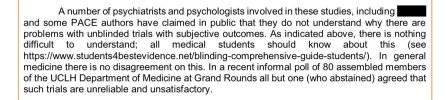
I recently noted that Wessely's name has been repeatedly redacted from my NICE expert witness testimony.
----------------------------------------------
I recently noted that Wessely's name has been repeatedly redacted from my NICE expert witness testimony.
Last edited by a moderator:

V.R.T.
Senior Member (Voting Rights)
That man has entirely too much influence.I recently noted that Wessely's name has been repeatedly redacted from my NICE expert witness testimony.
Sounds a bit unusual - I’m assuming redacting isn’t common in these things?I recently noted that Wessely's name has been repeatedly redacted from my NICE expert witness testimony.
I often wonder whether such things makes people more curious by highlighting it more as being pertinent and want to go and look up why it might end up being done, where a lot outside the bubble might just read through something and only half-note different names given so many people focus on gist/summarise as they read or listen etc.
also is the guideline and docs associated with it still being edited after publishing on other things or just this?
Last edited:
DARVO, par exellence.The phrase 'it's always projection' springs to mind...
Way too many fingers in way too many pies. A stark warning about why power needs to be limited.That man has entirely too much influence.

Do you mean it was deleted recently without you being informed?I recently noted that Wessely's name has been repeatedly redacted from my NICE expert witness testimony.



NelliePledge
Senior Member (Voting Rights)
Pathetic innit.
