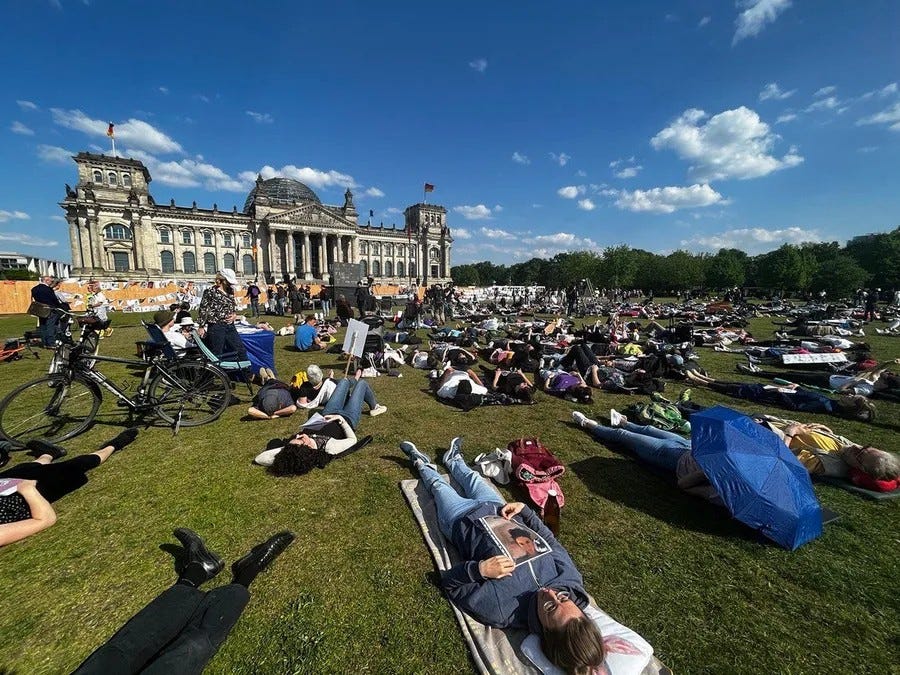
Without protests, IACI patients won't get very far [blog post]

Siebe

Established Member

Patients keep lamenting that we should receive better care and much more research funding. Obviously that would be just. But I argue that the world doesn't work that way. Change happens through pressure. IACI patients need to protest. This is hard, because we're very sick. I discuss a number of obstacles and share some ideas for how we can overcome them.

My main suggestion is that we should have multiple teams that ideally achieve ~3 actions per year (1 per team) to keep pressure high. We should not expect and rely on one team to carry all the burden. That is too heavy.

Some other points:

- we need to get allies to support the operational work, and ideally there's money to compensate someone

- the Millions Missing campaign has run its course. It was a valiant effort during a time where ME/CFS was very neglected. New names are required to achieve positive momentum

- You only have 5 words. Protests should have a single ask and not dilute their message. This makes it harder for policymakers to evade it


You can read the full blog post here:

https://open.substack.com/pub/viral...-protests-iaci-patients-wont?utm_source=share
 
As someone who was the main organiser for a Millions Missing in 2019 I’d just like to flag that while I totally recognise the impact on people with higher severity ME/CFS who get involved in organising the impact on someone with moderate severity (with some better days) like me should be made clear as the risk is definitely there of tipping up a level. The person who had done the previous event had to step back from being involved at all the year I did and I totally understand why because I had to push myself so hard beyond anything I did since stopping work and to some extent further than when working because if you don’t do the essentials the event doesn’t happen. Getting people to volunteer is really hard and as organiser you are putting yourself as the default.
 
One thing that struck me about the writeups of the German protests was how many healthy people were at them standing in for their unwell family and friends. I have no idea how we replicate that anywhere else because it seems to be something unique to Germany since the Covid pandemic started. I tend to think this is all due to the German health minister, its brought some validation and brought families along with sufferers, something that hasn't happened everywhere else. Its a unique change and a critical one for enabling these protests to happen.
 
Last edited:
I commend everyone who has organised or taken part in protests. It is obviously good when they contribute to achieving increased government research funding or to better recognition and treatment for pwME and pwLC.

However, I disagree with the apparent premise of this article that protests are the main way we should direct our energy (if we have any) as advocacy actions. The suggestion seems to be that more countries should do what patients and supporters in Germany have done, and further that we should not just aim for one protest a year, but for three.

I think this is both unrealistic and not necessarily the most productive use of advocates efforts.
 
As someone who was the main organiser for a Millions Missing in 2019 I’d just like to flag that while I totally recognise the impact on people with higher severity ME/CFS who get involved in organising the impact on someone with moderate severity (with some better days) like me should be made clear as the risk is definitely there of tipping up a level. The person who had done the previous event had to step back from being involved at all the year I did and I totally understand why because I had to push myself so hard beyond anything I did since stopping work and to some extent further than when working because if you don’t do the essentials the event doesn’t happen. Getting people to volunteer is really hard and as organiser you are putting yourself as the default.
Thank you so much for your efforts and the risk you took. And I fully agree, it's a point I make in the blog post!

I am not denying it is hard. I'm just making the claim that it is necessary. And sure, maybe Germany has some cultural advantages, but any claim that it cannot be replicated is unjustified pessimism in my opinion.
 
I am not denying it is hard. I'm just making the claim that it is necessary.
I haven't followed the German case. Do you have evidence that it was the demonstrations that led directly to the government funding?

And there are examples in other countries where there has been some fuinding as far as I know unrelated to demonstrations. For example the UK government funding for genetic research, as far as I know, had nothing to do with any demonstrations, but was a result of researchers putting in high quality bids for funding, and other forms of advocacy.
 
I am not denying it is hard. I'm just making the claim that it is necessary.
I haven't followed the German case. Do you have evidence that it was the demonstrations that led directly to the government funding?

And there are examples in other countries where there has been some fuinding as far as I know unrelated to demonstrations. For example the UK government funding for genetic research, as far as I know, had nothing to do with any demonstrations, but was a result of researchers putting in high quality bids for funding, and other forms of advocacy.

I honestly can't see any UK government basing research funding on demonstrations.
 
I think protests can be powerful tools when they have a singular and clearly defined goal. A good example is the Sell Workwell protest of ACT UP.

But one of the problems I see with more general protests is that so few of the advocacy groups appear to have a clear idea of what’s actually needed. Even if they were to gain more influence, I’m not convinced they’d used it wisely. Some might even end up doing long term harm by diverting the focus or «achieving» things of no value that ends up wasting our wish, so to speak.
 
Back
Top Bottom