
Chromosome 1 (1p36.23), RERE

forestglip

Administrator
Staff member
Posts moved from PRIME International Symposium, September 28-29 2026


Here's the Manhhatten plot. Despite the large increase in cases, they found (only) 11 loci (DecodeME's primary analysis found 6 hits with ca 15.000 cases).
1792227557437.webp

From a search of the forum, I found that RERE (the gene at the left-most locus) was one of 35 genome-wide significant hits in an IBS study (Di Lorenzo, 2026: post, thread, paper).

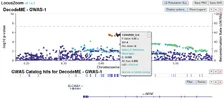
Looking at the DecodeME data, here is the area near RERE, showing that it was nearly significant even before adding the many other cases in the meta-analysis. The variant that is highlighted below is the lead variant from the IBS paper, showing that there is a good chance that the same variant is causal in both traits:
1792963875493.webp

RERE was also one of the candidate genes in PrecisionLife's ME/CFS study (though, like the meta-analysis, this is not an independent replication because it relied partly on DecodeME's data).

Some info about it:
It has been flagged as being involved in neurodevelopmental disorders and some heart defects and more recently in schizophrenia through regulation of synaptic genes (particularly GABAergic neuron). More widely is seems to be involved in transcription of other genes, dialling their expression up or down.

See Spatiotemporal dynamics of RERE in schizophrenia pathogenesis: insights from multi-omics and single-cell sequencing, 2025, Shen et al

And also this description
The RERE gene provides instructions for making a protein that is critical for normal development before birth. This protein interacts with other proteins called transcription factors, which control the activity (transcription) of particular genes. The RERE protein helps these transcription factors turn on (activate) and turn off (repress) a number of genes important for early development, ensuring that the genes are activated (expressed) at the right time and place for proper tissue formation. Research indicates that the RERE protein plays a role in the development of the brain, eyes, inner ear, heart, and kidneys
 
Last edited:
From a search of the forum, I found that RERE (the gene at the left-most locus) was one of 35 genome-wide significant hits in an IBS study (Di Lorenzo, 2026: post, thread, paper).

Looking at the DecodeME data, here is the area near RERE, showing that it was nearly significant even before adding the many other cases in the meta-analysis. The variant that is highlighted below is the lead variant from the IBS paper, showing that there is a good chance that the same variant is causal in both traits:
That sounds like a really interesting gene! Thank you for highlighting it.
 
I believe that identification of RERE gene is important for its relation to retinoid signalling, although GABAergic signalling could be an important one, as @forestglip suggests.

Regarding retinoid signalling :

The arginine-glutamic acid dipeptide repeats gene (RERE; MIM# 605226; HGNC:9965) encodes a nuclear receptor co-regulator that is widely expressed during both embryonic development and adulthood.1,2 RERE plays a key role in positively regulating retinoic acid signaling across multiple cell types and modulating the expression of target genes including FGF8 and RARB through interactions with various transcription factors

The following genes are related to retinoic acid metabolism :

RERE, NCOR2, MED25, ZNF423, RAI14 : All appearing at PrecisionLife study.

Fluge et. al identified CRABP2, RARRES2. All related to retinoic acid as well.

Relevant thread here : https://s4me.info/threads/charting-...026-hoel-fluge-mella.44410/page-3#post-613699

There are alleged reports of patients getting ME/CFS via isotretinoin : https://connectsci.au/hc/article/11/4/295/34426/Chronic-fatigue-syndrome

Whitney Dafoe may have gotten significantly worse after rubbing a retinoid-related substance (Tretinoin) to his nostrils (increased systemic absorption possible)


I finally got some after a long battle with insurance to use to try to get vitamin A into my system better hoping I might feel better and to help with topical infections that I know I have from being bedridden with no sun for over a decade. I put a dab into each nostril (absorbs best in mucosal tissue) and rubbed it all around twice and the next day, that exact area in my nostrils were "chapped" feeling (like when you were a kid and got a cold and rubbed your nose with too many tissues) and I've also felt like I have a cold on top of ME/CFS, I've just been miserable. And it seems to be affecting my whole body system wide, my BM's have even been messed up since


This is another thread , @ME/CFS Science Blog mentioning retinol as being increased at the Beentjes study (no 5 - Retinol-binding protein 5) :

https://s4me.info/threads/openais-new-chatgpt.30712/page-7#post-574862

Using network analysis, I've identified the potential role of accutane for ME/CFS and also of Gulf War Illness since 2017 and I also had the opportunity to discuss this potential connection during my presentation at EUROMENE (2018)

https://algogenomics.blogspot.com/search?q=accutane

In my opinion, all ME/CFS patients should be screened as to whether they have taken RoAccutane prior their sickness. This could be an important data point that has repeatedly been missed. Example below, October 30, 2018, this forum, user Kafka :


https://s4me.info/threads/hello-fro...th-me-and-my-remission-saga.6420/#post-116793

My youngest daughter, now 29, was diagnosed in middle school with CFS after a course of Accutane
 
Last edited:
Back
Top Bottom