PRIME International Symposium, September 28-29 2026

There’s actually a pretty interesting connection to Wirth’s HIF-1α model. He proposes that hypoxia/ROS could activate HIF-1α, leading to increased extracellular matrix/collagen production and thickening of the capillary basement membrane. That could then further impair microcirculation, creating a kind of vicious cycle.

Of course, this is Wirth’s hypothesis and hasn’t been demonstrated by the Wüst study itself.
 
He proposes that hypoxia/ROS could activate HIF-1α, leading to increased extracellular matrix/collagen production and thickening of the capillary basement membrane.

Except that 150 years of histopathology of basement membranes has not shown this happening in any other hypoxic situation, as far as I am aware.

In other branches of medicine one doesn't get this sort of smog of evidence-free theorising.
 
The other problem with the basement membrane theory is that if you improve you have to then explain how the membrane "unthickens".

I also cannot see how these microclot /microcirculation theories can explain intraday fluctuations.

How does it explain alcohol intolerance present in about 75% of sufferers?

ETA if it's constitutional why have no connective tissues genes shown up in GWAS studies?
 
Last edited:
I agree, if they exist at all. However, as I understand it, the microclots enthusiasts believe they are causal for whatever condition they happen to be studying.
Ah. Yeah, that doesn’t seem a convincing conclusion.

I don’t know what it would mean if they exist. It’s not an area I’ve paid much attention to and have little understanding of. I’ve been doing s bit more reading recently but it’s pretty basic stuff.

But some sort of subtle changes caused by other changes is I think what @jnmaciuch is talking about?
 
Does anyone know if, where and when videos of the PRIME workshop will become available? I missed it but it sounds very interesting.
They include decodeME.
I wouldn't see this as a replication then, it's probably just DecodeME driving the signal in the meta-analysis due to its large sample size.

I look forward to reading the results of this GEM meta-analysis but because of the poor selection criteria, I think they might be less reliable than DecodeME itself. Would be very skeptical of any findings of signs that aren't partly present in DecodeME itself.
 
Previous PRIME webinars have been available here some time after the event, I’m assuming/hoping the same for this

Slightly different question, but I expect the response will be the same
 
Does anyone know if, where and when videos of the PRIME workshop will become available? I missed it but it sounds very interesting.

I wouldn't see this as a replication then, it's probably just DecodeME driving the signal in the meta-analysis due to its large sample size.

I think they might require support for a hit from multiple datasets in order for it to be included, but let's see.

I look forward to reading the results of this GEM meta-analysis but because of the poor selection criteria, I think they might be less reliable than DecodeME itself. Would be very skeptical of any findings of signs that aren't partly present in DecodeME itself.

I agree.
 
I watched the presentation by Hanna M. Ollila titled "The Future of MECFS Genetics". She gave a good impression and presented findings from the big meta-analysis. Here's the direct link to the video:
EDIT: I've updated the images to versions with a better resolution.


The meta-analysis has 60,542 cases and 2,766,590 controls. Based on the slides, they included cases based on self-reported chronic fatigue and those with a diagnosis pos-viral fatigue syndrome. So a wider net than just ME/CFS.
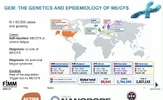
1792227501907.webp

Here's the Manhhatten plot. Despite the large increase in cases, they found (only) 11 loci (DecodeME's primary analysis found 6 hits with ca 15.000 cases).
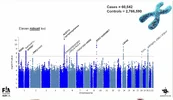
1792227557437.webp

One of the more interesting findings is that the pituitary (green bar below) now stood out in the tissue analysis.
1792227697632.webp


They also found large genetic correlations between Long Covid and ME/CFS and Long Co id and fibromyalgia. ALthough I'm not sure how they end up with values of rg = 0.99 and if these are reliable. The standard errors also look quite large, suggesting there may be an issue with this calculation (perhaps due to the low heritability h^2)?
1792223763593.webp

Lastly, they also report that ME/CFS also had correlations with other post-infectious traits.

1792228007592.webp

I stil have doubts with this wider net approach but it does look interesting and might offer a slightly different perspective. Perhaps it would be worthwhile to do a meta-analysis by combining ME/CFS, LC and fibromyalgia samples.

 

Attachments

  • 1792223441586.webp
    1792223441586.webp
    77.9 KB · Views: 18
  • 1792223681647.webp
    1792223681647.webp
    17.3 KB · Views: 16
  • 1792224217039.webp
    1792224217039.webp
    65.6 KB · Views: 17
Last edited:
Back
Top Bottom