
Cortisol levels in ME/CFS

It may be I've missed it but I haven't seen much discussion of stimulation and suppression studies of the HPA axis in this thread.

Suppression - where glucocorticoids (eg dexamethasone) are given to participants and cortisol levels are subsequently measured. These externally given glucocorticoids mimic cortisol and inhibit ACTH production in a negative feedback loop. In this 2008 suppression study by Papadopolous and Cleare they administered dexmethasone in the evening and the next morning measured cortisol. They saw no difference in suppression of cortisol levels between patients and controls.

Stimulation - where a CRH challenge is given to participants and ACTH/cortisol changes measured. CRH stimulates ACTH and then cortisol production. In this Scott et al 1998 crh stimulation study the authors reported a significant (p<0.005) blunted ACTH response in CFS patients compared to controls:
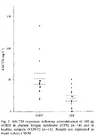
1793355816530.webp

and a less blunted by still significantly blunted cortisol response (p<0.05):
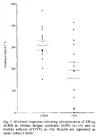
1793355877180.webp
 
It may be I've missed it but I haven't seen much discussion of stimulation and suppression studies of the HPA axis in this thread.

Thanks @chillier for digging those out. That is very useful to me. It makes sense in terms of there being some inhibition of an upstream pathway involving CRH and or maybe TRH thatmight explain the various prolactin response data.

It looks very much as if the peripheral adrenal part of the HPA axis is largely untouched in ME/CFS. I suspect that CRH may modulate ACTH in a short term fashion that does not have too great an influence on basal levels of cortisol. That of course raises a qury about the cortisol levels in CSF reported by Felipe. That might be due to local secondary events of course. I think we should be able to sort this out with some further testing and I am pretty sure that there is a story behind it all of importance.
 
That of course raises a qury about the cortisol levels in CSF reported by Felipe. That might be due to local secondary events of course.

This is the bit that bothers me about the autopsy results. Cortisol is not different at baseline in the blood in other MECFS studies, and as @forestglip has pulled out from the NIH study there's no difference in the CSF there either. Also if the adrenal gland was producing cortisol why would it end up in the CSF anyway, is it produced somewhere else?

I'm guessing the CSF samples were taken post mortem in which case I wonder whether there is a confounder there with cause of death. Is it possible that a more peaceful death eg through euthanasia could result in less cortisol produced than the stress of a death by some other cause in controls? I don't know if anything about causes of death has been mentioned but I'm aware it's important to be respectful around privacy in these things.
 
s it possible that a more peaceful death eg through euthanasia could result in less cortisol produced than the stress of a death by some other cause in controls?
Im not sure we can know that the ME/CFS patients would have had more 'peaceful' deaths than controls without knowing everyones cause of death.

And I'm not sure undergoing euthanasia wouldn't be stressful, even for someone who really wanted it.
 
Im not sure we can know that the ME/CFS patients would have had more 'peaceful' deaths than controls without knowing everyones cause of death.

And I'm not sure undergoing euthanasia wouldn't be stressful, even for someone who really wanted it.

Absolutely.

I think there is a lot of potential for the cause of death to be one of the biggest confounders in these studies in general and it's good to be aware of.
 
Last edited:
I strongly suspect that the core pathology of ME/CFS was identified in Dinan's papers on hypothalamic responses in 1992-2005. They were on CFS. "PEM" was coined as a feature of CFS. The objection to the name seems to have much more to do with public perception and getting financial support.

I am interested in hearing the case for this, sounds like it could be good to do a dive into Dinan's endicrinology work. It's worth pointing out that this 2001 study by Cleare et al appeared to fail to replicate the blunted ACTH response to CRH stimulation seen by Scott and Dinan above - so I'm not so sure this will turn out to be real.

It does seem possible that the system has backups built in by changing expression of receptors on the pituitary and adrenal gland to keep things homeostatic, that could hide things.
 
I am interested in hearing the case for this, sounds like it could be good to do a dive into Dinan's endicrinology work.

I amtrying to pull together Dinan's various CFS studies. They go a lot wider than the CRH response. Dinan emailed me last week and said that he was confident the data were robust. He didn'tneed to say that. The negative Cleare paper is less detailed and there is some suggestion even there of a higher or earlier. ACTH response without a corresponding increased cortisol response. My suspicion is that Cleare wanted to tell a story around hypocortisolaemia, which doesn't seem to fit with the consensus now. I would also be a bit doubtful about the nature of a cohort of patients attending psychiatric clinics at the Maudesley. Some of. Dinan's patients would have been from psychiatric referrals at Barts but he collaborated in studies at various places.

Whoever produced the most reliable data there seems to be a good case for revisiting this. A study on a cohort not referred to psychiatry might be particularly valuable. A study on severe cases at home using a capillary sampling method might be even better.
 
Do you know why Dinan stopped researching what he referred to as CFS?

No. I think he was satisfied that he had shown a shift in serotonin signalling that was different from depression. That seemed to link to impaired HPA axis signalling but oddly not to low cortisol. My suspicion is that at that time nobody could see how to take that further. in terms of a hypothesis.

Dinan moved back to Ireland, and settled in Cork. More recently he has been interested in gut and brain.

Another factor may have been that this sort of of. clinicla study was easy to do in 1990 but even by 2000 was getting more difficult because of bureaucracy and financial straightjackets. By the time he stopped work on this, around 2010, it would have been a different ballgame. This is the thing that worries me most at present. Getting simple clinical studies done without fuss has become much much more difficult.
 
It sounds like Dinan could be a useful person to have thinking about ME/CFS again. Perhaps one of us should send him the PRIME webinar on the Neurology of ME/CFS when it’s available, unless he was there.

I wish there was a sign-up option to get notifications about PRIME webinars and videos. I recall it was discussed on here somewhere but I don’t know if it’s in the pipeline.
 
It sounds like Dinan could be a useful person to have thinking about ME/CFS again. Perhaps one of us should send him the PRIME webinar on the Neurology of ME/CFS when it’s available, unless he was there.

I got a clear message from Dinan that he is hanging up his research boots and is going to enjoy some travelling. He has provided some useful. comments but I don't think he wants to get involved. He. probably has dozens of people pestering him about long ago research.

I think Peter Goadsby might be interested in the migraine angle on this. We haven't had a chance to talk yet though. Goadsby will understand the neuroendocrinology in detail.
 
I got a clear message from Dinan that he is hanging up his research boots and is going to enjoy some travelling. He has provided some useful. comments but I don't think he wants to get involved. He. probably has dozens of people pestering him about long ago research.

I think Peter Goadsby might be interested in the migraine angle on this. We haven't had a chance to talk yet though. Goadsby will understand the neuroendocrinology in detail.
Thank you very much for talking to Dinan. I hope he enjoys traveling. I wish he was still interested in doing research into our disease, but it seems he has provided us a lot. I’m very grateful for the many people on this forum who dig up old papers and find useful things that feel like they have been forgotten about.

I hope you get to talk to Goadsby soon. He is exactly the kind of person we need.
 
Do you know why Dinan stopped researching what he referred to as CFS?

I think there may have been a strong presumption in 1995 that the relevance of hypothalamus to ME/CFS would be through hypocortisolaemia - a problem with "HPA axis". That has hung around even until now. I think they should have focused much more on the effects of hypothalamic signalling on brain not on peripheral tissues.
 
blunted ACTH response in CFS patients
Some more studies here
 
Back
Top Bottom