Dopamine modifying agents

hotblack

Senior Member (Voting Rights)
I’ve been thinking and reading more about dopamine. Partially because of interest in PD but also now in relation to eccentric medium spiny neurons aka eccentric spiny projection neurons (which have both D1 and D2 receptors).

And from what I’ve read D1 generally excites the post-synaptic neuron while D2 generally dampens firing.
The most studied dopamine signaling pathway is the modulation of cyclic AMP production, with D1-like receptors activating cyclic AMP production through Gs/olf, and D2-like receptors inhibiting adenylyl cyclase (AC) activity through Gi/o proteins.

I thought it would be useful to build up a list of dopamine modifying agents, how they modify things and look back at studies which have used them, perhaps with a different perspective or to be able to gain more of an understanding of potential mechanisms.

I’ll start of with some posts but please anyone jump in.
 
I could have been prescribed gabapentin for nerve pain, but because of the possible side effects on my already bad brainfog, I use low dose ropinirol, a dopamine agonist. It only works during the night and I actually sleep.

In the past I'd used it for restless legs, a few years ago I could stop. My feeling is that there is a connection with insuline-resistance, Stopping ropinirol coincided with starting diabetes II medication.
Correletion does not have to be causation, but?
 
Here’s what I”ve got so far. Hopefully mostly accurate. We need a wiki with multiple people able to edit really..

D2 Receptor Antagonists
First generation antipsychotics
Haloperidol, Chlorpromazine, Fluphenazine, Perphenazine, Thioridazine

Second generation antipsychotics (also block 5-HT2A)
Risperidone, Olanzapine, Quetiapine, Ziprasidone, Lurasidone, Paliperidone

D2 & D3 Receptor Partial Agonists
Aripiprazole, Brexpiprazole, Cariprazine

Ergot Derived Dopamine Agonists (strong D2 affinity)
Bromocriptine, Cabergoline

Non-Ergot Dopamine Agonists (Selective D2 & D3)
Pramipexole, Ropinirole, Rotigotine

Broad/non-selective D1 and D2 Family Agonist
Apomorphine

Dopamine Precursor
Levodopa (L-DOPA) (combined with Carbidopa)

Dopamine Reuptake Inhibitors
Methylphenidate, Bupropion

Dopamine Releasing Agents
Amphetamine, Dextroamphetamine, Lisdexamfetamine, Methamphetamine

Dopamine Depleting Agents
Tetrabenazine, Deutetrabenazine, Valbenazine

Dopamine Metabolism Inhibitors (MAO-B inhibitors)
Selegiline, Rasagiline, Safinamide

Adenosine A2A Antagonists (Indirect Dopamine Modulator)
Istradefylline
 
Last edited:
It’s very useful.
Personal experience with methylphenidate: I regained my depth perception and found it easier to coordinate my movements in time (I didn’t try to step out before opening the door – the sort of thing that happens all the time when I’m in brainfog). I found it hard to fall asleep, so I don’t use it. But I found it quite interesting.
 
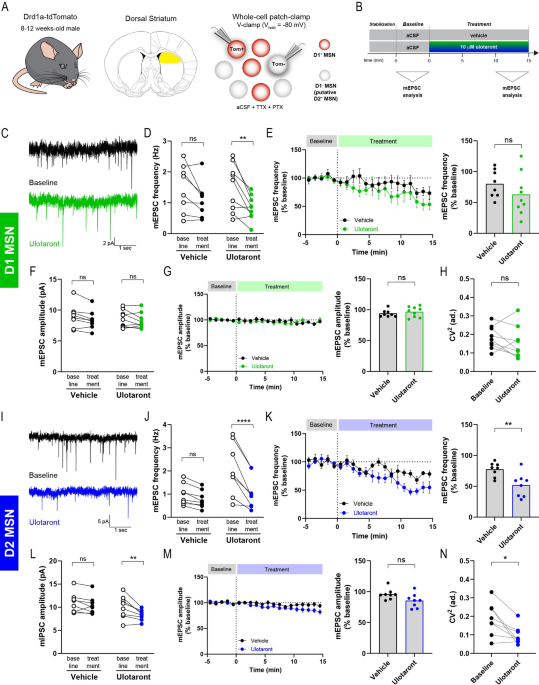
This sounds a bit scary but I was reading about this drug in late stage clinical trials:

Ulotaront -

"While current evidence implicates TAAR1-mediated regulation of dopaminergic tone as the primary circuit mechanism, little is known about the effects of TAAR1 agonists on the glutamatergic system and excitation-inhibition balance. Here we assessed the impact of ulotaront (SEP-363856), a TAAR1 agonist in Phase III clinical development for schizophrenia, on glutamate function in the mouse striatum and hippocampus. Ulotaront reduced spontaneous glutamatergic synaptic transmission and neuronal firing in striatal and hippocampal brain slices, respectively. Interestingly, ulotaront potentiated electrically-evoked excitatory synaptic transmission in both brain regions, suggesting the ability to modulate glutamatergic signaling in a state-dependent manner."

 
I also wonder about non-direct modifiers? Things like Naltrexone could impact dopamine, well, probably does, but I guess if we get into indirect pathways it gets confusing.
Are there also drugs that directly modify dopamine even though they aren't aimed at that?

No idea which drugs could work like that but maybe anti-depressants as well as corticosteroids do? (They are both so commonly prescribed that there could be some useful data? On the other hand their effects are probably too many to conclude anything about specific reactions involving dopamine?)


Edited to add anti-depressants
 
Last edited:
Are there also drugs that directly modify dopamine even though they aren't aimed at that?

No idea which drugs could work like that but maybe anti-depressants as well as corticosteroids do? (They are both so commonly prescribed that there could be some useful data? On the other hand their effects are probably too many to conclude anything about specific reactions involving dopamine?)


Edited to add anti-depressants
I believe Pregabalin indirectly affects dopamine. People with severe anhedonia (which doesn’t respond to antidepressants) take Pregabalin to minimise it and the emotional flatness. If I remember correctly anhedonia implies altered activity in some reward-related systems. Unfortunately, in such cases tolerance to the effect of Pregabalin happens quite often, and discontinuation of the medication is associated with serious withdrawal symptoms.
 
Last edited:
Wouldn't we know if those worked given how often they've been prescribed to ME patients over the last 50 years?
That's why I think it could give (negative) clue -- if it's dopamine-modifying the specific mechanism affected by cortisone it's likely not the place where to look for ME/CFS specific mechanisms. Dito for anti-depressants.

On the other hand, if there were subgroups benefitting from those drugs, that would give a clue too, but most probaby too difficult to find out whther suchs subgroups exist.
 
This is less about ‘can we find a drug that works’ and more ‘can we learn anything about mechanisms’. I also think it may not be entirely black and white, neurotransmitters seem to have different effects in different cells. And the picture would likely get even more confusing to interpret with antidepressants or other drugs which may have secondary or indirect effects. Hence thinking primarily about more direct effects or drugs with more known behaviours. Maybe those others will tell us something if we can interpret the info confidently enough?

But yeah it may not lead anywhere. Some of the LDA discussion got me thinking though and maybe there is something in studies we can learn though.
 
Last edited:
That's why I think it could give (negative) clue -- if it's dopamine-modifying the specific mechanism affected by cortisone it's likely not the place where to look for ME/CFS specific mechanisms. Dito for anti-depressants.

On the other hand, if there were subgroups benefitting from those drugs, that would give a clue too, but most probaby too difficult to find out whther suchs subgroups exist.
I use ropinirol, a dopamine agonist, low dose(4mg) it only works against restless legs and nerve pain (SFN,Raynaud or whatever). No effect on other symptoms. It helps me sleep though.
 
me
It’s very useful.
Personal experience with methylphenidate: I regained my depth perception and found it easier to coordinate my movements in time (I didn’t try to step out before opening the door – the sort of thing that happens all the time when I’m in brainfog). I found it hard to fall asleep, so I don’t use it. But I found it quite interesting.
Advocated by some NHS consultants for sarcoid fatigue, which often does not track organ damage/function directly (if at all) and is phenotypically similar to at least some ME.
 
Here’s all the threads tagged with dopamine

And all threads with aripiprazole or abilify.

I also wonder about non-direct modifiers? Things like Naltrexone could impact dopamine, well, probably does, but I guess if we get into indirect pathways it gets confusing.
I remember from boyhood (several yrs prior to fatigue onset and decades prior to sarcodi diagnosis) getting a nice buzz and weight loss from mefenamic acid (sp??) . Body just seemed to work better. Used to be available as Ponstan. Naltrexone did nothing but caused/correlated with weight gain. Neither long term tolerable due to GI effects so I doubt weight loss on MA was due to GI damage. Still wonder if this was early stage/subclinical autoinflammatory disease.
 
Looks to be an NSAID so more a COX inhibitor and unrelated to dopamine as far as I can tell?
Sorry my mistake I misread naltrexone for naproxen!
In fact anti inflammatories acting on COX can have an effect on depression. Carmine Pariente in London has done quite abit of work on this. Presumably acting on cytokines and affecting neurotransmittters thereby but possibly also in some cases thru pain relief.
I tried naltrexone but had return of former symptoms of cold feeling legs. leg pain, a very unpleasant awakening at night and also the new symptom of facial palsy. This was what convinced me that Lyme and/or sarcoid should have been considered for years and I hit it with minocycline with swift post?/prompter? resolution of acute flare. Since naltrex tends overall to reduce Th1 I think reactivated Lyme was more likely than sarcoid at that time. had the odd foray into naltrex since bu consider it for me best avoided on aprecautionary principle.
 
Sorry my mistake I misread naltrexone for naproxen!
In fact anti inflammatories acting on COX can have an effect on depression.
Ah, thanks, wasn’t sure if I’d missed something. I’m sure there’s all sorts of tangential or unknown effects of things :) It’s probably going to be complicated enough so am trying to stick to more clearly understood dopamine modifiers.
 
Back
Top Bottom