Dopamine modifying agents

hotblack

Senior Member (Voting Rights)
I’ve been thinking and reading more about dopamine. Partially because of interest in PD but also now in relation to eccentric medium spiny neurons aka eccentric spiny projection neurons (which have both D1 and D2 receptors).

And from what I’ve read D1 generally excites the post-synaptic neuron while D2 generally dampens firing.
The most studied dopamine signaling pathway is the modulation of cyclic AMP production, with D1-like receptors activating cyclic AMP production through Gs/olf, and D2-like receptors inhibiting adenylyl cyclase (AC) activity through Gi/o proteins.

I thought it would be useful to build up a list of dopamine modifying agents, how they modify things and look back at studies which have used them, perhaps with a different perspective or to be able to gain more of an understanding of potential mechanisms.

I’ll start of with some posts but please anyone jump in.
 
I could have been prescribed gabapentin for nerve pain, but because of the possible side effects on my already bad brainfog, I use low dose ropinirol, a dopamine agonist. It only works during the night and I actually sleep.

In the past I'd used it for restless legs, a few years ago I could stop. My feeling is that there is a connection with insuline-resistance, Stopping ropinirol coincided with starting diabetes II medication.
Correletion does not have to be causation, but?
 
Here’s what I”ve got so far. Hopefully mostly accurate. We need a wiki with multiple people able to edit really..

D2 Receptor Antagonists
First generation antipsychotics
Haloperidol, Chlorpromazine, Fluphenazine, Perphenazine, Thioridazine

Second generation antipsychotics (also block 5-HT2A)
Risperidone, Olanzapine, Quetiapine, Ziprasidone, Lurasidone, Paliperidone

D2 & D3 Receptor Partial Agonists
Aripiprazole, Brexpiprazole, Cariprazine

Ergot Derived Dopamine Agonists (strong D2 affinity)
Bromocriptine, Cabergoline

Non-Ergot Dopamine Agonists (Selective D2 & D3)
Pramipexole, Ropinirole, Rotigotine

Broad/non-selective D1 and D2 Family Agonist
Apomorphine

Dopamine Precursor
Levodopa (L-DOPA) (combined with Carbidopa)

Dopamine Reuptake Inhibitors
Methylphenidate, Bupropion

Dopamine Releasing Agents
Amphetamine, Dextroamphetamine, Lisdexamfetamine, Methamphetamine

Dopamine Depleting Agents
Tetrabenazine, Deutetrabenazine, Valbenazine

Dopamine Metabolism Inhibitors (MAO-B inhibitors)
Selegiline, Rasagiline, Safinamide

Adenosine A2A Antagonists (Indirect Dopamine Modulator)
Istradefylline
 
Last edited:
It’s very useful.
Personal experience with methylphenidate: I regained my depth perception and found it easier to coordinate my movements in time (I didn’t try to step out before opening the door – the sort of thing that happens all the time when I’m in brainfog). I found it hard to fall asleep, so I don’t use it. But I found it quite interesting.
 
This sounds a bit scary but I was reading about this drug in late stage clinical trials:

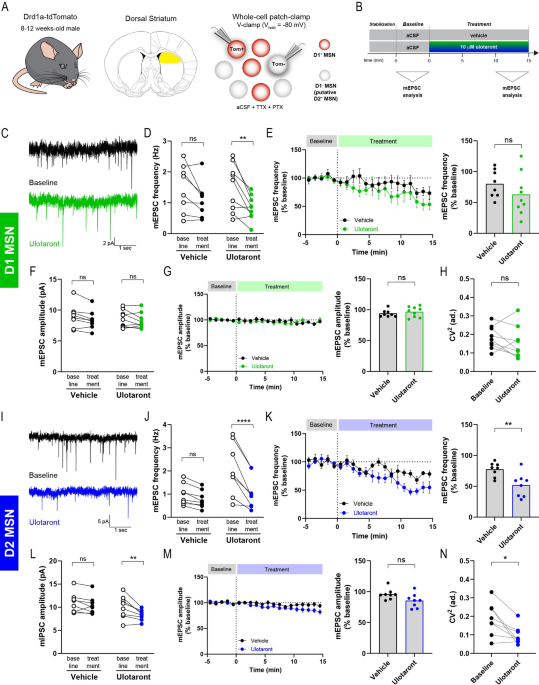
Ulotaront -

"While current evidence implicates TAAR1-mediated regulation of dopaminergic tone as the primary circuit mechanism, little is known about the effects of TAAR1 agonists on the glutamatergic system and excitation-inhibition balance. Here we assessed the impact of ulotaront (SEP-363856), a TAAR1 agonist in Phase III clinical development for schizophrenia, on glutamate function in the mouse striatum and hippocampus. Ulotaront reduced spontaneous glutamatergic synaptic transmission and neuronal firing in striatal and hippocampal brain slices, respectively. Interestingly, ulotaront potentiated electrically-evoked excitatory synaptic transmission in both brain regions, suggesting the ability to modulate glutamatergic signaling in a state-dependent manner."

 
Back
Top Bottom