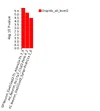
Dropviz: the mouse brain atlas, Saunders et al. 2018.

ME/CFS Science Blog

Senior Member (Voting Rights)
I had a go at matching genetic data on ME/CFS with the gene expression data from Dropviz.

This is the paper that discovered the eccentric medium spiny neuron (discussed here). It's a mouse brain atlas with RNA data from 0.69 million cells. The main publication is Saunders et al. 2018. but there's also a website with visualization and an option to download the data.

Paolo Maccalini already tested this dataset in his paper using the meta-analysis of DecodeME and the Million Veterans Program (MVP) data. Using the level 2 classification of Dropviz he found 6 cell types that passed the bonferonni-correction as shown in Table A1.
1782724204642.webp
https://s4me.info/threads/biologica...encing-of-me-cfs-2026-maccallini-et-al.50225/

This uses the FUMA website approach of grouping the data per dissection and controlling for the average gene expression of that dissection. That's fine but it also means that the results for a cell type are influenced by what else is in the dissection.

As a supplementary to this, I want to do analysis that ignores the dissection groupings and controls for the average of the entire dataset, similar to what we did with the Human Brain Atlas. Luckily the FUMA website provides a dataset that groups all dissections and has the data already in the right format. You can download these here:
 
Level 1
Here's what I got for the level 1 classification which has 88 cell types. The results show again that only the neuron type reaches statistical significance.

1782725028881.webp

It's also clear that the signal isn't confined to one brain region. The signals in the cerebellum and substantia nigra look a bit weaker though.

1782725089464.webp
 
Level 2
Level 2 has 565 cell types. I've tried to deduce some info form the markers they have. For example: Gad1Gad2' = GABAergic, while Slc17a7 or Slc17a6 = Glutamatergic. There were significant hits for both.

1782725634171.webp

Here are the ID's of the 13 cell types that reached bonferonni-significance:
1782725676037.webp

Using the annotation file on the Dropviz website, it seems that the eccentric medium spiny neurons had cluster IDs of 13-1, 13-2, 13-3, 13-4, and 13-5. One of these (STR.Neuron_Gad1Gad2_Drd1-Otof-Sorcs1.13_2) was among the 13 significant cell types but the others didn't really stand out.

1782725777150.webp
 
Last edited:
Here are the ID's of the 13 cell types that reached bonferonni-significance:
Here's some more info on these cell types by matching them to the annotation file:

IDBrain RegionCommon namecell_cluster
GP.Neuron_Gad1Gad2-Th_Adora2a-Th.3_9Globus PallidusStriatum, Th+ SPNGABAergic
STR.Neuron_Gad1Gad2_Drd1-Cxcl14.10_5StriatumdSPN, lateral striatumGABAergic
HC.Neuron_Slc17a7_C1ql2-Penk.4_2HippocampusDentate Principal cellsglutamatergic
HC.Neuron_Slc17a7_Pvrl3-Grm5.6_2HippocampusCA3 Principal cellsglutamatergic
HC.Neuron_Slc17a7_C1ql2-Cck.4_1HippocampusDentate Principal cellsglutamatergic
STR.Neuron_Gad1Gad2_Drd1-Nefm.10_4StriatumdSPNGABAergic
PC.Neuron_Slc17a7_Syt6-Sla.1_4Posterior CortexLayer6aglutamatergic
FC.Neuron_Gad1Gad2_Synpr-Pcdh11x.1_6Frontal CortexNeuron.Gad1Gad2.Synpr-Pcdh11xGABAergic
GP.Neuron_Gad1Gad2_Adora2a.3_3Globus PallidusStriatum, Indirect spiny projection neuron iSPNGABAergic
GP.Neuron_Gad1Gad2_Drd1-Nefm.3_1Globus PallidusStriatum, dSPNs, neurofilament state+GABAergic
STR.Neuron_Gad1Gad2_Drd1-Otof-Sorcs1.13_2Striatumeccentric SPN, dSPN-like markersGABAergic
STR.Neuron_Gad1Gad2_Adora2a-Nefm.11_1StriatumiSPNGABAergic
PC.Neuron_Slc17a7_Syt6-Nefm.1_8Posterior CortexLayer 6aglutamatergic

One thing that stands out is that the cells from the Globus Pallidus actually also point to the striatum. They are all from cluster 3 and the Saunders et al. 2018 paper notes about this:
Resolving Neuron Types within the Basal Ganglia
....
To define GPe neuron types, we screened markers of global clusters and subclusters for expression in the GPe (GP/NB dataset). GPe neurons were present in cluster 2 (n = 11,103 cells), one of three neuron clusters (Figure 6A). Cluster 1 contained cholinergic neurons (n = 437 cells), and cluster 3 contained neurons of the adjacent striatum and basolateral amygdala (n = 9,847 cells).
So much like the Human Brain Atlas I think there's a potential link here to medium spiny neurons (not just the eccentric ones) in the striatum.
 
So much like the Human Brain Atlas I think there's a potential link here to medium spiny neurons (not just the eccentric ones) in the striatum.
Using conditional analysis, three cell types remain as independent:

- the striatal inhibitory medium spiny neurons,
- the dentate principal cells in the hippocampus
- the layer 6a cells in the posterior cortex.

1782744055295.webp

1782744128591.webp
 
If I understand correctly layer 6A form a connection between the cortex and thalamus but perhaps also the claustrum and other inner structures.
Layer 6A Pyramidal Cell Subtypes Form Synaptic Microcircuits with Distinct Functional and Structural Properties - PMC

So one hypothesis for ME/CFS could be a disrupted network of cortico-striatal communication which reminded me of this hypothesis from Peter Behan and Abhijit Chaudhuri from the year 2000:
We have introduced and defined the concept of central fatigue for the latter disorders. We have further proposed, with supportive neuropathological data, that central fatigue may occur due to a failure in the integration of the limbic input and the motor functions within the basal ganglia affecting the striatal–thalamic–frontal cortical system.
Fatigue and basal ganglia - PubMed
 
Last edited:
Back
Top Bottom