Evidence of White Matter Neuroinflammation in [ME/CFS]: A Diffusion-Based Neuroinflammation Imaging Study 2026 Yu et al

Although DTI offers useful markers of microstructural integrity, it lacks biological specificity and cannot demonstrate the contributions of inflammation, edema, or axonal damage. Advanced diffusion models (Oestreich and O'Sullivan 2022) have been developed to address this limitation.

One such validated (Wang et al. 2014; Zhan et al. 2018) approach is the diffusion-based neuroinflammation imaging (NII) model (Wang et al. 2011, 2015, 2019, 2024; Chiang et al. 2014; Samara et al. 2020), which estimates multiple biologically informed indices to quantify inflammation-related processes, including the hindered water ratio (NII-HR, indicating extracellular tissue edema), restricted fraction (NII-RF, indicating inflammation-related cellularity) and fibre fraction (NII-FF, indicating apparent axonal density).

In addition, the model provides fibre-compartment diffusivities, axial (NII-AD), radial (NII-RD), mean (NII-MD) and fractional anisotropy (NII-FA). Unlike conventional DTI metrics, which are biassed by isotropic signals from oedema or cell infiltration, these fibre-specific diffusivities isolate the anisotropic component of diffusion, thereby improving sensitivity and interpretability for axonal injury and demyelination. These indices offer greater specificity in detecting changes related to extracellular fluid accumulation, cellular infiltration and axonal density, which are hallmarks of neuroinflammation.

 
After all the discussion about glymphatics and brain water I do just wonder whether people with ME/CFS might have changes in all these measures as a result of lying flat more. It might be the opposite of normal pressure hydrocephalus where there is too much water outside the brain rather than inside. Lying flat has a siginifcant effect on hydrostatic pressures affecting water flux.
Wouldn’t that effect be controlled for by the sedative controls used?

And afaik glymphatics are mostly active during the night when sleeping and horizontal anyways.
 
Last edited:
After all the discussion about glymphatics and brain water I do just wonder whether people with ME/CFS might have changes in all these measures as a result of lying flat more. It might be the opposite of normal pressure hydrocephalus where there is too much water outside the brain rather than inside. Lying flat has a siginifcant effect on hydrostatic pressures affecting water flux.

When you say flat, do you mean completely flat, head not propped up at all?
 
I'm just starting with reading the abstract, but this directionality is reversed for between-group vs within-ME/CFS, right? If so, I think this would make the finding less compelling.
Compared to HCs, ME/CFS patients exhibited widespread white matter abnormalities, including [...] significantly higher NII-FF [neuroinflammation imaging fibre fraction] [...] across association, commissural and projection fibres. [...] Among ME/CFS patients, higher NII-FF was associated with lower disease severity.
 
Wouldn’t that effect be controlled for by the sedative controls used?

And afaik glymphatics are mostly active during the night when sleeping and horizontal anyways.

I don't think sedatives would affect the hydrodynamics.

The story about glymphatics is clearly very controversial - even among the international experts on brain water flux. I have in the last month corresponded with several and none of them agree with each other but all seem to agree that the original glymphatic story was wrong. The whole thing is very complicated. Movement down perivascular channels may be greater at night but the idea that this means increased clearance (of waste) looks very dubious.

The things you are li'ble....
They ain't necessarily so.
 
When you say flat, do you mean completely flat, head not propped up at all?

Not necessarily. The main thing would be not upright. When upright the venous drainage from the brain goes straight into vessels at subatmospheric pressure. Not if you lie down. One of the most basic signs students learn is the jugular venous pressure. When you lie nearly flat the blood in the jugular vein can be seen to bob up ad down. If you stand up the vein is empty.
 
In the Kéri, S. 2025 paper you linked earlier, they say

Yes. ScoutB explained the isotropic diffusion well:
It sounds like roughly they are breaking the diffusion (of water while it's being pushed around by magnets) down into components going in different directions as well as an "isotropic" component that corresponds to the amount of diffusion going equally in all directions (expanding motion basically).

The water that is confined inside something like a cell can't move much when pulled by a magnet, compared to water that isn't confined inside something. But, I don't think the problem of the seeming reversal in the Yu 2026 paper of what the result for the restricted fraction actually means compared to everyone else has been explained.

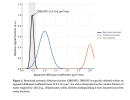
The 2025 Keri paper gives this chart to explain three categories of diffusion; restricted, hindered and free. The numbers along the x axis are the diffusion coefficients e.g. 0.3 um2/ms, a measure of how much the water moves when pulled by the magnet. The diffusion coefficients are not the fraction, which is shown on the y axis, labelled 'Relative signal fraction'.

Screenshot 2026-03-18 at 5.01.21 AM.png


Yu 2026 paper said:
NII-derived hindered fraction of restricted isotropic diffusion (D ≤ 0.3  μm2/ms)
(Also, what the Yu/Shan team have written there with the 'hindered' doesn't make a lot of sense if you want communicate clearly, because there are three categories: Restricted, hindered and Free. And it's not clear why they have used less than 0.3 for the diffusion coefficient range. but, whatever. The big problem is them saying that low RF means more inflammation.)


ScoutB said:
I think their "D" is again supposed to be a coefficient telling you how much of this "isotropic" diffusion there is at a given spot. If I'm right about that, this would explain the discrepancy, as then the thread's paper is defining "NII-RF" to be <0.3 while Kéri, S. 2025 is using 0.3-0.6.

In the discussion, this thread's paper also says:
Lower [NII-RF] reflects more inflammatory cellularity, these positive associations imply that less cellular infiltration is associated with better mental health and better function.
Which I think confirms that their "NII-RF" measure is doing the opposite of what other people's RF measure is.

I do think that it is possible that the authors have confused
1.diffusion coefficients D, where a lower coefficient means there is more 'solid stuff restricting diffusion', more confinement and therefore probably 'increased cellularity' and therefore probably 'cellular infiltration and therefore inflammation', with
2. volumes exhibiting diffusion in that range of diffusion coefficients that indicates confinement i.e. Restricted Fraction, RF.

The Keri 2025 paper suggests that everyone is saying that high volumes of RF is correlated well with histological evidence of inflammation. But these authors are saying the opposite, that the low volumes of RF in people with ME/CFS means inflammation.

I could be wrong about this, it certainly is hard to believe that an error this significant could be made. But this isn't making sense to me yet.
 
Last edited:
The Keri 2025 paper suggests that everyone is saying that high volumes of RF is correlated well with histological evidence of inflammation. But these authors are saying the opposite, that the low volumes of RF in people with ME/CFS means inflammation.

I could be wrong about this, it certainly is hard to believe that an error this significant could be made. But this isn't making sense to me yet.

I haven't got my head round this. I ma impressed by your attempts. I see a lot of potential confusions here. Early transudative inflammation is mostly a matter of increased free water. After that you get cells coming in and free water may go down. I wouldn't expect glial activation per se to alter water much at all. Standard inflammation models may give certain signal patterns but who knows if those signal patterns in a brain mean inflammation? Or what sort?

In general, inflammatory cell infiltration in brain tissue is a disaster. And nobody has reported it in ME/CFS (I am talking of more cells, not just busy microglia that are already there). Inflammatory infiltrates in white matter will almost certainly be accompanied by demyelination, which there isn't.

It seems to me that there are probably much more likely explanations in changes in water movement than inflammatory cell infiltration.
 
There seems to have been good work done by other authors correlating observable inflammatory cell infiltration with high restricted fraction.

Where the correlations between RF and measured inflammation seem to fall down is with what is described as mild inflammation. That Keri paper mentions that. That paper is worth a read. Excerpts:

Across diverse models, from autoimmune demyelination to TBI, DBSI-RF consistently mirrors the magnitude of cellular infiltration measured in tissue (Table 1). Correlation coefficients between the DBSI-RF and quantitative histology range from 0.7 to 0.9 in high- inflammation settings, underscoring a strong concordance. In cases of milder inflammation, DBSI-RF shows only mild or no elevation, corresponding to weaker correlations with histology. This body of evidence supports the validity of the DBSI-RF as a potential biomarker of neuroinflammation, with histopathology serving as the reference standard.Life 2025, 15, 1599 8 of 17 However, further studies are needed to reveal specificity and sensitivity. Additionally, the discrepancy between MRI voxel size and the optical resolution of histopathological imaging may be a limiting factor in making direct and accurate correlations.

While many studies support DBSI-RF as a putative inflammation marker, further studies are warranted. Sample sizes in human studies have been modest, and more val-idation is needed across diverse populations and scanner platforms. Histopathological comparison data in humans are limited, based on case reports or autopsies [11]. Stan-dardizing the threshold that defines “restricted” is also questionable. Some studies used 0.3 µm2/ms for in vivo brain tissue, while others used up to 0.6 µm2/ms in ex vivo or rodent tissue [11,27,30]. Slight differences in threshold or fitting approach could affect the absolute values across studies. Thus, before DBSI-RF can be adopted widely, consensus on protocols and reference values is needed.
 
I don't think the problem of the seeming reversal in the Yu 2026 paper of what the result for the restricted fraction actually means compared to everyone else has been explained.
Yeah, I agree. I should have said "might begin to explain" instead of "explain" in my earlier post, and actually now that I've read more I don't think the <0.3 vs 0.3-0.6 thing could fix this after all. Because, as you mentioned earlier, the Yu/Shan ME/CFS paper (this thread's paper) seems to be contradicting the studies they cite as well, and those papers seem to be using the exact same "NII" model as them, including the same cut off of RF being <0.3.

For example, they cite Wang et al. 2015 (a study on MS) as using the same model. However, Wang et al. definitely seems to be saying "more restricted fraction" means "more cells"
Although the definitive classification of the spectrum of isotropic diffusion components has not yet been reached, previous experimental observations suggested that restricted isotropic (associating with cells) and non-restricted isotropic diffusion (associating with vasogenic oedema and tissue loss) may be distinguished using a threshold of isotropic diffusivity of 0.3 µm2/ms
DBSI restricted isotropic diffusion fraction correlated with the area of [cell nuclei] detected by haematoxylin stain in the first and third specimens…
The patient with early relapsing-remitting multiple sclerosis (Patient 1) had the largest number of voxels with increased restricted isotropic diffusion fraction characteristic of increased cellularity
Our interpretation of DBSI restricted isotropic fraction as a metric of cellularity is supported by its close correlation with 4’,6-diamidino-2-phenylindole (DAPI)-positive nuclear counts in animal models of inflammatory demyelination…

I still don't exactly understand how they are calculating the "NII-RF" value, so perhaps it's somehow getting a sign flip compared to the other papers (for ex. if the other papers were using x and this paper was using 1-x, metaphorically speaking). But if that were the case you'd think they'd mention it.
 
Thanks ScoutB.
I think this study may well have found something interesting in the RF result, but it would have been better if they had not rushed to put a label of inflammation on it. As Jonathan says, it is possible that the lower RF finding does actually say something about a version of inflammation, or something else. .

I've sent off a query to Qiang Yu, the first and corresponding author of the paper, about the relationship of the restricted fraction to inflammation, and also about the use of HADS. Hopefully Qiang will join us here.
 
Thanks Hutan and ScoutB, I was running into the same issues.

Here's how I understand it: hindered water ratio (NII-HR) indicates places were water is very free to diffuse while restricted fraction (NII-RF) are places where water is very restricted to diffuse. In inflammation both measures are increased. NII-HR because of water flowing to the inflamed area, and NII-RF because of cells moving into the tissue and in them water is restricted.

But in this ME/CFS study both NII-HR and NII-RF were reduced? So the key measured are the opposite of what is seen in neuroinflammation?
 
Last edited:
echoing thanks for the analysis in this thread. The NII-RF directionality really puzzles me.

I'll note that this sentence in the discussion:
Reduced NII-RF, linked to cellularity changes, confirm histopathological reports of immune cell infiltration in ME/CFS (Mandarano et al. 2020).
cites this paper

which is a paper on circulating T cells in ME/CFS that doesn't include any histology and doesn't show any infiltration. I have not looked through all the citations. Was there ever a study in ME/CFS showing infiltration via histology? In the brain almost certainly not.

I feel like I have the same complaint in all brain imaging studies where the methods state that a family-wise p-value correction was performed, but the text seems to imply that the correction was across brain regions/voxels, and not across all the different measures assessed. I would really like clarification on that. [Edit: if these are all meant to be various proxy measures for "neuroinflammation" I'm not sure there's a strong argument for treating each measurement as a separate hypothesis]
 
Last edited:
Another thing that confused me:

3.4 Group Comparison of NII- and DTI-Derived Metrics Without Controlling for Confounding Factors​


Without controlling for confounding factors, Figure S23 (Appendix B.3 in Supporting Information) exhibits that the NII-RF in the ME/CFS patient group was significantly lower than those in the HCs in several association, commissural, and projection fibres. There were no other significant group differences in TBSS for NII-derived metrics between ME/CFS and HCs when no confounding factors were controlled for. In addition, there were no significant group differences in any DTI-derived metrics between ME/CFS and HCs that did not control for potential confounding factors.

Per the methods, they state:
Group comparisons in each NII/DTI-derived metrics were performed using general linear models controlling for sex, age, BMI, MET, depression and anxiety scores via FSL's randomise tool (Winkler et al. 2014) with 10,000 permutations at each voxel, and multiple regression analyses were also performed using the randomise tool to examine the associations between NII/DTI-derived metrics and clinical scores.

So I have to assume that the results in Table 2, which seem to be the results referenced in the abstract, are the p-values from the model with the 6 covariates. I have no idea how you end up with most of your associations falling out of significance when you don't correct for confounders.
Anyone see something I might be missing to explain this?
 
Here's how I understand it: hindered water ratio (NII-HR) indicates places were water is very free to diffuse while restricted fraction (NII-RF) are places where water is very restricted to diffuse. In inflammation both measures are increased. NII-HR because of water flowing to the inflamed area, and NII-RF because of cells moving into the tissue and in them water is restricted.

I am not sure that is right but I have not been able to work it out. 'Hindered' and 'restricted' appear to be quite different parameters here. I think restricted may mean anisotropic - which would go with water in and around axons being able to move in ne axis but not so much in others. But I cannot see a clear explanation of this.

The examples of using this technique to identify 'neuroinflammation' are odd. Thy are MS, Alzheimer's and obesity. I doubt there is significant inflammation in obesity but there are probably changes in parameters for other reasons. Demyelinating lesions are very different from the increase in microglia of chronic degenerative changes like Alzheimer's.

I think we deserve a better exposition of what these things really measure. We also need to see better confirmation with specific histological correlation (I am not sure there was any for any of the studies in other diseases quoted).
 
Back
Top Bottom