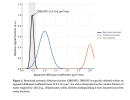
Although DTI offers useful markers of microstructural integrity, it lacks biological specificity and cannot demonstrate the contributions of inflammation, edema, or axonal damage. Advanced diffusion models (Oestreich and O'Sullivan 2022) have been developed to address this limitation.
One such validated (Wang et al. 2014; Zhan et al. 2018) approach is the diffusion-based neuroinflammation imaging (NII) model (Wang et al. 2011, 2015, 2019, 2024; Chiang et al. 2014; Samara et al. 2020), which estimates multiple biologically informed indices to quantify inflammation-related processes, including the hindered water ratio (NII-HR, indicating extracellular tissue edema), restricted fraction (NII-RF, indicating inflammation-related cellularity) and fibre fraction (NII-FF, indicating apparent axonal density).
In addition, the model provides fibre-compartment diffusivities, axial (NII-AD), radial (NII-RD), mean (NII-MD) and fractional anisotropy (NII-FA). Unlike conventional DTI metrics, which are biassed by isotropic signals from oedema or cell infiltration, these fibre-specific diffusivities isolate the anisotropic component of diffusion, thereby improving sensitivity and interpretability for axonal injury and demyelination. These indices offer greater specificity in detecting changes related to extracellular fluid accumulation, cellular infiltration and axonal density, which are hallmarks of neuroinflammation.
Transdiagnostic In Vivo Magnetic Resonance Imaging Markers of Neuroinflammation (2022)
Diffusion basis spectrum imaging detects and distinguishes coexisting subclinical inflammation, demyelination and axonal injury in experimental autoimmune encephalomyelitis mice (2014)
Differentiation and quantification of inflammation, demyelination and axon injury or loss in multiple sclerosis (2015)
Quantification of increased cellularity during inflammatory demyelination (2011)
Quantifying white matter tract diffusion parameters in the presence of increased extra-fiber cellularity and vasogenic edema (2014)
Neuroinflammation and White Matter Alterations in Obesity Assessed by Diffusion Basis Spectrum Imaging (2020)
Diffusion basis spectrum imaging detects and distinguishes coexisting subclinical inflammation, demyelination and axonal injury in experimental autoimmune encephalomyelitis mice (2014)
Differentiation and quantification of inflammation, demyelination and axon injury or loss in multiple sclerosis (2015)
Quantification of increased cellularity during inflammatory demyelination (2011)
Quantifying white matter tract diffusion parameters in the presence of increased extra-fiber cellularity and vasogenic edema (2014)
Neuroinflammation and White Matter Alterations in Obesity Assessed by Diffusion Basis Spectrum Imaging (2020)