Evidence of White Matter Neuroinflammation in [ME/CFS]: A Diffusion-Based Neuroinflammation Imaging Study 2026 Yu et al

I have no idea how you end up with most of your associations falling out of significance when you don't correct for confounders.
Anyone see something I might be missing to explain this?
I don't think it's an issue. Often significance decreases after controlling for a variable because a covariate is correlated to both the exposure and the outcome, so it explains part of the relationship. But significance can increase if controlling for a covariate that is mainly correlated to just the outcome, as it explains some of the variance in the relationship of exposure and outcome, leading to higher precision.

For example, there might be a regression of having ME/CFS (y-axis) on NII-RF (x-axis), but with a lot of variance in the y-axis due to various other things that affect ME/CFS status, which leads to a high standard error/low significance. If age is also associated with having ME/CFS, but not so much with NII-RF, then controlling for it doesn't change the coefficient of NII-RF much, but it decreases the variance, leading to a lower p-value.
 
Was there ever a study in ME/CFS showing infiltration via histology? In the brain almost certainly not.
The Dutch autopsy study found none:


But significance can increase if controlling for a covariate that is mainly correlated to just the outcome, as it explains some of the variance in the relationship of exposure and outcome, leading to higher precision.
Agree, but it does increase the risk of p-hacking because you can introduce several other variables into your model to see whether they lower the p-values.

Same with this decision.
To avoid group-size imbalance and maintain a 1:1 ratio of patients to HCs, nine ME/CFS participants (five PI-ME/CFS and four GO-ME/CFS participants, respectively) from the pooled cohort in Yu et al. (2025) were excluded to match the HCs.
This might be reasonable, but it also creates an opportunity to present the findings as more impressive, depending on the participants that you exclude.
 
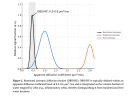
The restricted fraction is the water inside small confined structures such as cells. It is water that is isotropic - it can move in all different directions, just not very far.

The hindered fraction is also isotropic, but I think excludes the restricted fraction and the FF. The NII-HR, the hindered water ratio is the ratio of that to the rest of the signal. I think it might be to the rest of the isotropic signal.

(I'm not yet understanding the FF. If you look at that chart of signals I included up thread there are three signals. On the left with a low coefficient is the restricted fraction, in the middle is the hindered fraction. There is one signal at the far right which seems to be when water is free to diffuse a long way, isotropically. So, I thought the F stood for free, but sometimes it seems to be referred to as fibre. I haven't got to figuring that out. But, for the purposes of the RF(restricted fraction) and HR (hindered ratio) measures, it probably doesn't matter a lot.)
 
Last edited:
Same with this decision.
This might be reasonable, but it also creates an opportunity to present the findings as more impressive, depending on the participants that you exclude.
I also wasn't sure why it would be necessary to match group size.
To avoid group-size imbalance and maintain a 1:1 ratio of patients to HCs, nine ME/CFS participants (five PI-ME/CFS and four GO-ME/CFS participants, respectively) from the pooled cohort in Yu et al. (2025) were excluded to match the HCs. This ensured that there were no significant group differences in age, sex, body mass index (BMI), metabolic equivalents (MET) rate or MRI scan time, which was essential for reducing potential confounding in the imaging analyses.
Are they saying they excluded ME/CFS participants that didn't have similar metrics to a healthy control? Or they just randomly removed ME/CFS participants to match group size?

Either way, I don't really see the reason for doing this. They're already controlling for these variables in the regression, and this reduces the ME/CFS group size by around 11%.
 
What has higher precision? The model?
Yeah, decreased standard error for the coefficient of the main exposure on the outcome since some of the noise is accounted for by the covariate.

Edit: This goes a bit into it, talking about how controlling for covariates increases precision: https://methods.egap.org/guides/analysis-procedures/covariates_en.html
The real gains come in the precision of our estimates. The standard error (the standard deviation of the sampling distribution) of our estimated ATE [average treatment effect] when we ignore covariates is 0.121. When we include covariates in the model, our estimate becomes a bit tighter: the standard error is 0.093. Because our covariates were prognostic of our outcome, including them in the regression explained some noise in our data so that we could tighten our estimate of ATE.
 
For example, there might be a regression of having ME/CFS (y-axis) on NII-RF (x-axis), but with a lot of variance in the y-axis due to various other things that affect ME/CFS status, which leads to a high standard error/low significance. If age is also associated with having ME/CFS, but not so much with NII-RF, then controlling for it doesn't change the coefficient of NII-RF much, but it decreases the variance, leading to a lower p-value.
The way you would want to do the regression is NII-RF ~ ME/CFS label + age + sex + BMI + …..

When you’re reporting the association of the ME/CFS variable accounting for confounders, what you should be assessing is whether a model with that variable performs significantly better than a model including all the variables except for that one (usually done by something like ANOVA between two fitted models). So if the association with NII-RF is largely explained by say age, you’d get no significance for the ME/CFS variable because the model without that variable performed just as well as the model with it. If you were just assessing a model with only the ME/CFS variable and the significance is only due to a confounder, you should get significance of the univariate model (comparing with variable to intercept only) but not when comparing model with variable to model without variable
 
So I have to assume that the results in Table 2, which seem to be the results referenced in the abstract, are the p-values from the model with the 6 covariates. I have no idea how you end up with most of your associations falling out of significance when you don't correct for confounders.
Anyone see something I might be missing to explain this?
Yes, I had the same concern about the addition of controlling for the 'confounders' producing significant results that would not have been there without. I think the age and sex probably are valid, but I thought that the groups were matched on those anyway, in which case there is less reason to do that.

I can't see any good reason to control for anxiety and depression, and so it makes me think that that was done simply because it produced some significant results.

I've talked about how the HADS is probably actually an (imperfect) measure of physical health in people with ME/CFS, rather than a good measure of anxiety and depression, with its questions about not being able to do the things you enjoyed before, and having worries about the future etc. I'm a bit concerned that by controlling for BMI, 'anxiety and depression', they have actually controlled for physical health and activity levels, although in a less than perfect way.

So, yeah, I have felt concerned about the black box of dealing with all those 'confounding factors', which is why I have concentrated on what was found without the confounding factors being taken into account. And that is the Restricted Fraction signal.
 
Last edited:
Then wouldn't the reduced restricted fraction in patients indicated fewer cells rather than more?
When there is a high RF signal, it indicates increased cellularity, hence the idea of inflammatory cell infiltration. But the signal was low in the ME/CFS group, so yes, it could indicate lower cell numbers in the white matter than in the controls, and so potentially less inflammatory infiltration. But that is the opposite of what the authors of the paper seem to be saying. Hence the questions.
 
I would expect water both inside and outside cells in white matter to have a degree of anisotropy to its diffusivity, certainly for outside and for nerve fibres. FF refers to fibres I think.

Is it that the anisotropy measures stratify across the 'hindered' and 'restricted' components?

Hindered seems an odd term for relatively free water outside cells but I guess it may mean slowed but not limited to a tiny domain. Maybe a reduced hindered ratio means more free unhindered water? That at least would fit with low grade cerebral vessel transudation.

I think we can be reasonably sure that there will be no signal from inflammatory cells present in the white matter. If they formed a significant proportion of the water the person would likely be comatose.
 
So if the association with NII-RF is largely explained by say age, you’d get no significance for the ME/CFS variable because the model without that variable performed just as well as the model with it.
Yes, but this is in the case of age being correlated to both ME/CFS status and NII-RF. Age can be correlated to only NII-RF, in which case adding this variable to a model that only had ME/CFS does lead to better predictive ability for NII-RF.
 
Yes, but this is in the case of age being correlated to both ME/CFS status and NII-RF. Age can be correlated to only NII-RF, in which case adding this variable to a model that only had ME/CFS does lead to better predictive ability for NII-RF.
The association they should be reporting is only the one between the ME/CFS variable and NII-RF in a model that also includes the covariates, which you derive by doing a test between a model containing all covariates + ME/CFS vs. a model containing covariates only. The p-value of the initial model with ME/CFS and covariates is not the relevant one
 
For some reason the chart I attached upthread isn't showing (fixed now) - here it is again, from the Keri paper:

Screenshot 2026-03-18 at 5.01.21 AM.png
These are all for isotropic signals. there are other measures for anisotropic movement (movement confined to particular planes). The one on the left is the restricted fraction - around the 0.3 mark. that's the one where water can only move a very short distance e.g. in cells. In the middle is the hindered fraction. and there's a free fraction on the right.
 
Sort of, I think. More free water (maybe more edema, more CSF), relative to the water in the cells (RF) and the water in the hindered fraction is (extracellular spaces, in tissues). Maybe less well hydrated cells and tissues, and/or more water hanging around outside of the cells and tissues

There are no absolutes i.e. definitively 'wetter' than the control brains, because these measures are relative fractions.
 
Last edited:
I'm not sure what exactly you mean by the p-value of the initial model. The p-value of the ME/CFS status coefficient in a model including all covariates? I think this is the same p-value you would get from an F-test comparing the model with and without ME/CFS status.
that's what the link you shared is referring to by precision. It's saying that including the covariate improves the precision of the overall model NII-RF ~ ME/CFS label + age + BMI ....
Which gives it's own p-value if you do an F-test comparing to an intercept only model. That's what I thought you meant, but there might be some confusion using the same terms to mean different things.

If you are just assessing the association between ME/CFS and NII-RF within the model with covariates, the precision of the model NII-RF ~ ME/CFS label + age + BMI .... doesn't actually matter. I'll try to write it out to make it more clear
 
Back
Top Bottom