Fibromyalgia in obstructive sleep apnea-hypopnea syndrome: a systematic review and meta-analysis, 2024, He et al.

nataliezzz

Senior Member (Voting Rights)
Fibromyalgia in obstructive sleep apnea-hypopnea syndrome: a systematic review and meta-analysis
Jie He, Meifeng Chen, Na Huang, and Bo Wang
https://pmc.ncbi.nlm.nih.gov/articles/PMC11144865/

Abstract

Introduction: Fibromyalgia (FM) is a common condition in patients with obstructive sleep apnea-hypopnea syndrome (OSAHS). This meta-analysis aimed to evaluate differences in sleep monitoring indicators between patients with OSAHS and positive FM and patients with OSAHS and negative FM and to determine the incidence of FM in patients with OSAHS.

Methods: An exhaustive literature review was conducted to analyze the incidence of FM in patients with OSAHS, using online databases, including PubMed, EMBASE, Web of Science, CNKI, and Wanfang, both in English and Chinese. The quality of the included studies was assessed by two researchers using the Newcastle−Ottawa Scale scores. The acquired data were analyzed using Stata 11.0 software. Continuous variables were combined and analyzed using the weighted mean difference as the effect size. Conjoint analyses were performed using random-effects (I2 > 50%) or fixed-effect (I2 ≤ 50%) models based on I2 values.

Results: Fourteen studies met the inclusion criteria. This study showed that 21% of patients with OSAHS experienced FM. Subgroup analyses were performed based on race, age, sex, body mass index, and diagnostic criteria for patients with OSAHS. These findings indicate that obese patients with OSAHS have a higher risk of FM, similar to females with OSAHS. Regarding most sleep monitoring indicators, there were no discernible differences between patients with OSAHS with positive FM and those with negative FM. However, patients with positive FM had marginally lower minimum arterial oxygen saturation levels than those with negative FM. The current literature suggests that patients with OSAHS have a high incidence of FM (21%), and FM has little effect on polysomnographic indicators of OSAHS.
 
Last edited by a moderator:
People asked for population-level data supporting a connection between sleep-disordered breathing and "chronic complex illnesses," so here is what I found for fibromyalgia (the only "chronic complex illness" for which this type of data exists). This meta-analysis only looked at obstructive sleep apnea (OSA, i.e. apnea-hypopnea index [AHI] ≥ 5) and not milder sleep-disordered breathing/upper airway resistance syndrome (UARS), but for a discussion of why UARS and OSAS (obstructive sleep apnea syndrome) are not actually separate disorders (at least in most cases) and a general explanation of the UARS theory of "chronic complex illnesses," see the UARS thread and the AI summary.

For context, prevalence of OSA in the adult population based on 11 epidemiological studies was 22% in men and 17% in women, though some studies oversampled suspected OSA patients or habitual snorers (oversampling habitual snorers will obviously skew the results as people with OSA are much more likely to snore - the vast majority of people with OSA snore), so we can probably assume that the prevalence of OSA is actually a bit lower.

Also for context, a meta-analysis of prevalence of fibromyalgia in the general population (Sci-Hub link for those who want to read the full paper) found the prevalence of fibromyalgia in the general population to be 1.78% (3.98% in women and .01% in men). Most of the data in this meta-analysis used American College of Rheumatology (ACR) fibromyalgia criteria or ICD-9/10 as the diagnostic method. For an explanation of the ACR fibromyalgia criteria and how it has changed over time (1990 vs. 2010 vs. 2016 criteria), see here: Diagnostic Criteria for Fibromyalgia: Critical Review and Future Perspectives

In the above meta-analysis by He et al., sex-based subgroup analysis identified prevalence of fibromyalgia in the OSA patients to be: 23% in women and 3% in men. ACR fibromyalgia criteria as the diagnostic method was required (prevalence rates varied from 15-32% depending on which diagnostic criteria was used: 1990: 15%; 2010: 32% 2016: 20%). Of note, the authors say "OSAHS" (i.e. obstructive sleep apnea-hypopnea syndrome, which is typically defined as OSA + daytime sleepiness), but daytime sleepiness was not actually required; AHI ≥ 5 was the only required criteria, although obviously people who are referred for sleep evaluations and ultimately diagnosed with OSA are more likely to be sleepy/fatigued (many people with OSA are asymptomatic but are unlikely to be referred for sleep evaluations unless their snoring is really bothersome to partners/etc.), so we are probably looking more at the prevalence of fibromyalgia in OSAS (rather than OSA in general) here, but technically excessive daytime sleepiness was not required.

I also have a BlueSky thread on sleep-disordered breathing and fibromyalgia with 2 independent case reports of fibromyalgia cures with treatment of OSA, and several smaller studies supporting the OSA - fibromyalgia connection (I'll try to make a new thread/threads here at some point with some of the smaller studies)
 
Last edited:
To make a start on testing that we would need some evidence that there was a striking difference between all people with these illnesses and everyone else, using a blinded study of a cohort that was not selected by attendance at clinics that might have biased samples. Is there any such evidence?
@Jonathan Edwards people who are referred for sleep studies and ultimately diagnosed with OSA tend to be those who are sleepy/fatigued (and primarily those who are sleepy rather than those with fatigue without sleepiness, as sleepiness is the "classic" symptom associated with sleep-disordered breathing/OSA by the medical profession and general population). I don't believe this meta-analysis of prevalence of fibromyalgia in OSA patients should be biased towards people with symptoms of fibromyalgia being referred for sleep studies as the vast majority of rheumatologists, sleep doctors, primary care doctors (and doctors in general) have no reason to suspect that there is any connection between fibromyalgia and sleep-disordered breathing.

And I wouldn't trust a rheumatologist to be able to diagnose 'fibromyalgia' in a meaningful way.
Of course you have said this too, so perhaps none of this will mean anything to you considering you do not seem to think a diagnosis of fibromyalgia based on ACR fibromyalgia criteria made by a rheumatologist means anything; still, even if it is meaningless, why would we find such a drastically higher prevalence of it (21%) in OSA patients vs. the general population (1.78%)?
 
Of course you have said this too, so perhaps none of this will mean anything to you considering you do not seem to think a diagnosis of fibromyalgia based on ACR fibromyalgia criteria made by a rheumatologist means anything;
You might be interested in this recent discussion about diagnostic criteria and guidelines in relation to ME/CFS:
still, even if it is meaningless, why would we find such a drastically higher prevalence of it (21%) in OSA patients vs. the general population (1.78%)?
If the data is meaningless it doesn’t matter what it says.

People that sleep worse experience more pain in general, I certainly do. Considering that the FM criteria are incredibly broad, I’m surprised the numbers are not higher.
 
People that sleep worse experience more pain in general, I certainly do. Considering that the FM criteria are incredibly broad, I’m surprised the numbers are not higher.
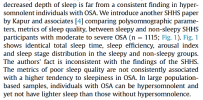
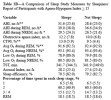
Ah, but you are missing the main point here. The majority of people with OSA do not "sleep worse"; as I have repeatedly pointed out, the majority of people with OSA are asymptomatic. So what do you propose the relationship between OSA and fibromyalgia is, if it is clearly not caused by a general "worse sleep" that all OSA patients have? In fact, even in sleepy OSA patients, metrics of poor sleep quality are far from a consistent finding (see below for a comparison of sleep metrics in sleepy and non-sleepy OSA patients). So again, what is causing the higher rates of fibromyalgia in OSA patients if it cannot be explained by general "poor sleep"/sleep fragmentation?

From: Reply to Punjabi, PRO: Sleep fragmentation causes hypersomnolence in OSA (Sci-Hub link)

1764977415905.png1764977491956.png
 
So again, what is causing the higher rates of fibromyalgia in OSA patients if it cannot be explained by general "poor sleep"/sleep fragmentation?
Lots of things will be randomly correlated with lots of other things without them having to have much to do with each other.

Scrolling this site is fascinating:
 
The majority of people with OSA do not "sleep worse"; as I have repeatedly pointed out, the majority of people with OSA are asymptomatic. So what do you propose the relationship between OSA and fibromyalgia is, if it is clearly not caused by a general "worse sleep" that all OSA patients have?
You did say:
obviously people who are referred for sleep evaluations and ultimately diagnosed with OSA are more likely to be sleepy/fatigued - many people with OSA are asymptomatic but are unlikely to be referred for sleep evaluations.
So it seems like we can't be sure of the prevalence of FM in asymptomatic OSA based on this study, since people in a study are probably mostly symptomatic.
 
Lots of things will be randomly correlated with lots of other things without them having to have much to do with each other.
You literally went from confidently asserting that poor sleep quality is the reason for elevated rates of fibromyalgia in OSA patients (and that you were in fact surprised that the rate of fibro in OSA patients was not higher than 21%), to - when it was pointed out to you that there is poor evidence supporting traditional metrics of poor sleep quality in OSA/S - instead of engaging with the evidence re: an alternative paradigm for the OSA - fibromyalgia connection, pivoting to suggesting that the connection must just be a random/meaningless correlation.

It's definitely not just a random correlation considering the multiple case reports of fibromyalgia cures with treatment of OSA from different authors/countries (one with the objective finding of alpha-delta sleep [the only consistent objective finding associated with fibro] disappearing along with fibro symptoms), Dr. Gold's study showing that fibro patients had a more collapsible upper airway (and one fibro patient who was unemployed due to symptoms returned to full employment after getting on CPAP), other studies showing improvement in fibro symptoms with CPAP treatment over traditional medication therapy, etc... It's not just about one piece of evidence here, it's about all of it together (but apparently some people won't even consider it until there is a large RCT proving it; although at this point I think even if there were, most people might *still* ignore it lol)

But as I've stated before, I don't think you and I will get far in discussion about UARS @Utsikt, so let's just leave it at this.

I'd love to hear from other people who haven't weighed in on UARS yet like @Sean, @Andy @rvallee, @Nightsong @SNT Gatchaman etc. and @ME/CFS Science Blog
 
Last edited:
You did say:

So it seems like we can't be sure of the prevalence of FM in asymptomatic OSA based on this study, since people in a study are probably mostly symptomatic.
Yes, exactly. The prevalence of fibromyalgia in all OSA patients in general is likely lower. We are probably looking more at the prevalence of fibromyalgia in OSA syndrome (OSAS - i.e. OSA + daytime sleepiness) here, as those are the people most likely to be referred for sleep evaluations, although people with fatigue without sleepiness are referred sometimes (often?) too. But I was just pointing out that even though the authors say OSAHS, technically the only required criteria was AHI ≥ 5; excessive daytime sleepiness wasn't required for inclusion.
 
I appreciate your determination to pursue this lead, nataliezzz. I unfortunately don't have the bandwidth to really engage with the topic.

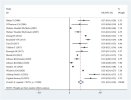
Just from the abstract and a quick skim, ~20% prevalence of FM seems fairly high to me, even given fairly broad criteria, so it seems plausible that there's some connection. Prevalences from the included studies are kind of all over the place, which suggests to me that the criteria aren't super consistent between studies, but they're still mostly above 15-20%.
fphys-15-1394865-g002.jpg

Whether it's OSA causing FM, or something like people with unhealthy lifestyles being more likely to get both, I don't know.
 
I appreciate your determination to pursue this lead, nataliezzz. I unfortunately don't have the bandwidth to really engage with the topic.
No worries, you’ve engaged with me quite a bit on it in the past (appreciate that), and I appreciate your AI summary (which made it onto the desk of Ron Davis btw!). I’m looking for some other people who haven’t weighed in yet to step up and take an interest/a look at the evidence.
 
I'd love to hear from other people who haven't weighed in on UARS yet like @Sean, @Andy @rvallee, @Nightsong @SNT Gatchaman etc. and especially @ME/CFS Science Blog (I don't really buy the whole "I'm too busy to look into UARS" thing anymore from him [I never actually did]... a meta-analysis pertaining to fibromyalgia is exactly the kind of thing he would normally be all over social media posting about...except if it has to do with sleep-disordered breathing, I guess. *sigh* - I know he’s already seen it on Twitter, btw)
I'm too busy and have no interest in looking into UARS.
 
For those tagged above who may be interested in it (I'm guessing it's going to be no one, but you never know lol), the below seems kind of important coming from a sleep doctor who is not Dr. Gold! (considering people with ME/CFS, fibromyalgia, Gulf War illness, etc. pretty much universally complain of sleep dysfunction/disturbance):
In addition, this from Dr. Denise Dewald (another sleep doctor not affiliated with Dr. Gold):

"I think of flow limitation as a really important thing to look at when you're looking at a PSG [polysomnogram] and deciding is this a normal study, or is it not? Spoiler alert: just about everyone who's referred for a sleep complaint does not have a normal study. After thousands of sleep studies, I have yet to see an actual normal study* in someone who was symptomatic. The only normal studies I've seen have been in people who are referred because they needed a sleep study for bariatric surgery or because they work in transportation. Oh, and there was one guy who was sent by his cardiologist because he developed atrial fibrillation, and so of course he needed a sleep study, but he had rheumatic valvular disease."

*i.e. no flow limitation during non-REM sleep; most people have some flow limitation during REM due to loss of muscle tone

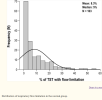
While inspiratory flow limitation (IFL) is a common finding in asymptomatic individuals, not everyone has it during non-REM sleep (well, clearly, since some of the people Dr. Dewald mentioned who were referred for sleep studies for bariatric surgery/because they work in transportation did not).

Inspiratory Flow Limitation in a Normal Population of Adults in São Paulo, Brazil This study found that a significant % of asymptomatic individuals had 0% IFL:

1765011663765.png

And while Dr. Gold has stated that he feels that research group has a "primitive view" of IFL (i.e. he would identify IFL in instances where they wouldn't), even in Dr. Gold's Gulf War illness study, 2/11 controls (asymptomatic age/BMI-matched Gulf War vets) had 0% IFL during the sampled breaths of stage N2 (non-REM) sleep:

1765011499348.png
 
You literally went from confidently asserting that poor sleep quality is the reason for elevated rates of fibromyalgia in OSA patients (and that you were in fact surprised that the rate of fibro in OSA patients was not higher than 21%), to - when it was pointed out to you that there is poor evidence supporting traditional metrics of poor sleep quality in OSA/S - instead of engaging with the evidence re: an alternative paradigm for the OSA - fibromyalgia connection, pivoting to suggesting that the connection must just be a random/meaningless correlation.
Forestglip explained why I made that connection.

I think I’m going to step away. We clearly don’t agree on how robust and interpretable this data is.
 
I was initially diagnosed with Fibromyalgia. Some decade later I started to decline with my undiagnosed Mild ME. I put on weight and a year later, became overweight, started megasnoring, reporting to the GP that it was loud enough to hear outside the building and I was observed stopping breathing for over 30 seconds repeatedly. I was told that doesn’t mean it’s sleep apnoea.

It took 6 years to be diagnosed with OSA during which time I’d gone from overweight to morbidly obese.

Correlation is not causation.

Incidentally, recently losing weight has meant I can no longer tolerate the CPAP which does not come with a mask small enough for a petite female face.
 
Forestglip explained why I made that connection.
No, they didn't? They pointed out that we are not looking at the prevalence of fibromyalgia in all OSA patients here, the sample is more skewed towards OSA syndrome (OSAS - OSA + daytime sleepiness) patients (as they are more likely to be referred for sleep evaluations because they are sleepy), which I agreed with.

I pointed out that most OSAS patients are not sleepy because of traditional metrics of "poor sleep," (and provided evidence that sleepy and non-sleepy OSA patients do not differ on these metrics); thus "poor sleep" does not explain the elevated rates of fibromyalgia in OSA/S patients. The reason OSAS patients are sleepy/fatigued is very likely to share a common underlying cause with the reason many of them have fibromyalgia.
 
Last edited:
Correlation is not causation.

Incidentally, recently losing weight has meant I can no longer tolerate the CPAP which does not come with a mask small enough for a petite female face.
Hi, see below (and the UARS thread) for why it's not just correlation.

There definitely should be a CPAP mask out there for you (even if it's a pediatric one)! Not sure if you are able to go into your durable medical equipment provider's local office and try some different ones out.

It's definitely not just a random correlation considering the multiple case reports of fibromyalgia cures with treatment of OSA from different authors/countries (one with the objective finding of alpha-delta sleep [the only consistent objective finding associated with fibro] disappearing along with fibro symptoms), Dr. Gold's study showing that fibro patients had a more collapsible upper airway (and one fibro patient who was unemployed due to symptoms returned to full employment after getting on CPAP), other studies showing improvement in fibro symptoms with CPAP treatment over traditional medication therapy, etc... It's not just about one piece of evidence here, it's about all of it together (but apparently some people won't even consider it until there is a large RCT proving it; although at this point I think even if there were, most people might *still* ignore it lol)
 
Back
Top Bottom