Genetic similarities between ME/CFS and other diseases

Is it possible that glutamate synapses showing up in your results could be the result of Sars-cov-2 affecting mGlur2?

The details of GPCR–iGlu receptor cross-talk should inform a better understanding of how synaptic transmission is regulated and lead to new therapeutic strategies for neuropsychiatric disorders.
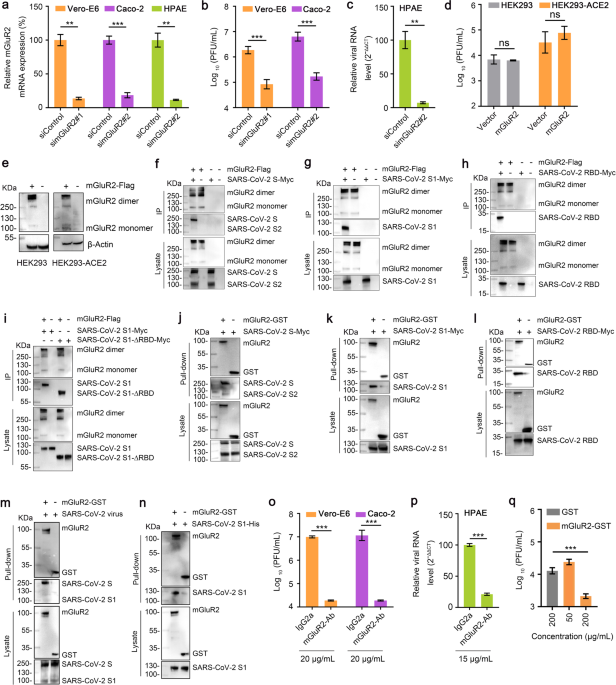
Do viruses cause permanent damage to receptors, though?
I can't find the answer.

"Virus–receptor interactions play a key regulatory role in viral host range, tissue tropism, and viral pathogenesis. Viruses utilize elegant strategies to attach to one or multiple receptors, overcome the plasma membrane barrier, enter, and access the necessary host cell machinery.

The viral attachment protein can be viewed as the “key” that unlocks host cells by interacting with the “lock”—the receptor—on the cell surface, and these lock-and-key interactions are critical for viruses to successfully invade host cells.

Many common themes have emerged in virus–receptor utilization within and across virus families demonstrating that viruses often target particular classes of molecules in order to mediate these events.

Common viral receptors include sialylated glycans, cell adhesion molecules such as immunoglobulin superfamily members and integrins, and phosphatidylserine receptors."

Something about viral entry, at least by enveloped viruses:
"Enveloped viruses can directly bind to and bypass the lipid bilayer of a host cell. Viral membrane fusion proteins (fusogens) facilitate this process by lowering the kinetic barrier of the bilayer – the fusogens bind to the host cell bilayer, undergo a conformational change and fuse the two bi-layers together."

This study maps the morphological changes in the plasma membranes of macrophages infected by human cytomegalovirus or human immunodeficiency virus and find novel differentially expressed receptors.

 
Do viruses cause permanent damage to receptors, though?
I can't find the answer.
Viruses do not damage receptors. They often bind to host receptors to get in to cells. Most receptor molecules are quite short-lived, maybe hours, days or perhaps weeks. If a receptor is used for internalisation it is likely to be replaced by a fresh receptor within hours at least.
 
Do they change the cell membrane?

This study says that some viruses do, so it doesn't appear to be univeral.


"The effect of viruses on plasma membrane function has been studied in two types of situation: (i) during the toxin-like action of paramyxoviruses when fusing with susceptible cells, and (ii) during an infectious cycle initiated by different viruses in various cell types.The nature of the permeability changes induced during the toxin-like action of viruses, and its modulation by extra-cellular Ca2+, are described: membrane potential collapses, intracellular ions and metabolites leak out of, and extracellular ions leak into cells, but lysis does not take place. The biological significance of such changes, and their relation to changes induced by other pore-forming agents, are discussed."

Oh, this is interesting:
"Yet there is no more reason for assuming that cell death is necessarily responsible for the symptoms of viral infection, than there is in the case of diseases such as juvenile diabetes or the haemoglobinopathies: in these cases the symptoms of the disease are due to an alteration in the function of muscle or blood cells respectively, not to their destruction. Such considerations have led the author to pose the question that forms the basis of this article: to what extent do virally-mediated alterations of plasma membrane function underlie changes in cell behaviour?"
 
This study says that some viruses do, so it doesn't appear to be univeral.
You seem to be quoting a speculative article from 40 years ago. If you search the lierature you will find papers saying pretty much anything. The effects of viruses on cell membranes occur over a period of seconds, minutes or hours. I cannot see how they can be of much relevance to ME/CFS.
 
Which part of the article is merely speculative?

Altered membrane potential, phospholipids, antiphospholipid syndrome, reversible skeletal muscle membrane depolarization during severe episodes of PEM....

These are a few of my favorite things to read about. I am wondering how SaRS,CoV-2 could affect glutamate synapses, which are on the cell membrane, which is made of phospholipids.
 
You seem to be quoting a speculative article from 40 years ago. If you search the lierature you will find papers saying pretty much anything. The effects of viruses on cell membranes occur over a period of seconds, minutes or hours. I cannot see how they can be of much relevance to ME/CFS.

About the author​

Dr. Charles A. Pasternak is renowned for his pioneering work relating to cancer and infectious disease. He was the Founder-Chairman of the Department of Cellular and Molecular Sciences and the Department of Biochemistry at St. George's Medical School at the University of London. He currently is Director of the Oxford International Biomedical Centre which he founded in 1992. Dr. Pasternak won an Eleanor Roosevelt Fellowship of the International Union Against Cancer in the Department of San Diego. He is the Founder-Editor of the prestigious international journal Bioscience Reports and is the author of over 250 original papers and two professional books. A member of numerous national and international committees including UNESCO and the International Union of Biochemistry and Molecular Biology, he has received awards and honors from several foreign governments for his work. He currently resides in London.
 
Which part of the article is merely speculative?

The whole thing seems to be a musing opinion piece framing things a certain way.
Altered membrane potential, phospholipids, antiphospholipid syndrome, reversible skeletal muscle membrane depolarization during severe episodes of PEM....

These things need to be put in to some sort of time course framework. We have no evidence that there are any viruses around when someone gets PEM.
These are a few of my favorite things to read about.

Favourite things do not necessarily point to the right biological answer!
 
Is the damage done to orexin not part of a receptor in Narcolepsy? And is it not likely from an overly strong immune response to a virus? Sorry I am coming at this from a low scientific level.

I don't think we know the exact mechanosm but it seems that the whole orexin cell just dies in narcolepsy. In AIDS the whole CD4 T cell dies. In polio the whole motor neuron cell dies. Yes, viruses kill cells and they use receptors to get into the cell and damage it but they do not damage receptors as such. The Greeks in their Trojan horse did not damage the gateway to Troy. They were invited in.
 
The question remains, how does SARS-CoV-2 affect glutamatergic synapses?

Does it?
There may be a question about whether it binds to them during infection but that does not translate to affecting receptor function in general. I don't really understand the proposal.
 
but it seems that the whole orexin cell just dies in narcolepsy.
The T1N autopsy study we’ve discussed multiple times on the forum is the main piece of reliable evidence and doesn’t support this. Epigenetic repression is more likely, with the study showing preserved expression of another gene also highly specific to orexin neurons and increased methylation at the promoter region for orexin (and CRH, which was also depleted)


[Edit: also makes more sense logistically. In AIDS the whole T cell dies because the virus specifically targets T cell specific surface receptors for entry. But we don’t know of a receptor that differentiates orexin and CRH neurons from other populations in the region that have preserved function. It makes more sense for an immune signal to target those loci epigenetically than for a virus to target those specific cells]
 
Last edited:
The T1N autopsy study we’ve discussed multiple times on the forum is the main piece of reliable evidence and doesn’t support this.

I think I must have missed that. If the cells are just silenced that makes a bit of a puzzle of the idea that the problem is an MHC restricted autoimmune response to orexin cells. It would not surprise me if that story was wrong though.

I am not sure it alters the present discussion, though.
 
I think I must have missed that. If the cells are just silenced that makes a bit of a puzzle of the idea that the problem is an MHC restricted autoimmune response to orexin cells.
It is tricky to reconcile, but it might have something to do with how the immune signals ended up localized to that region of the hypothalamus in the first place.

I am not sure it alters the present discussion, though.
perhaps not. Though it does suggest T1N is not an example of a virus directly causing permanent structural damage in a cell or death of a cell population
 
Back
Top Bottom