Genetics: Chromosome 6 BTN2A2 and BTN3A3 (BTN2A1)

Per the AZ analysis, all but one of the mutations in BTN2A1 occur in the cytosolic portion of the protein, indicating that it’s signaling within innate immune cells (or other cells with surface BTN2A1) that would matter more for ME/CFS.

But doesn't the BTN heterodimer signal outside the cell when it has formed in response to recognition events within the cell?
 
But doesn't the BTN heterodimer signal outside the cell when it has formed in response to recognition events within the cell?
Yes, another paper found that but only with a very specific phosphoantigen that binds in a pocket in BTN3A1. I think this paper was shared previously in the thread:

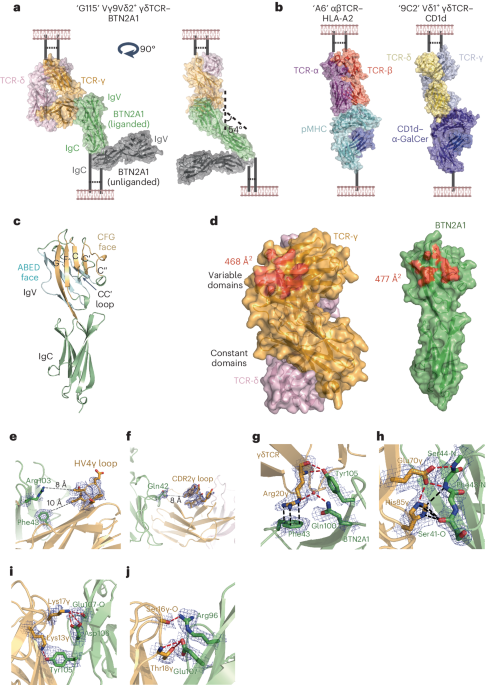
Main idea: BTN2A1 can bind Vγ9Vδ2+ γδTCR all the time, but this alone does not seem to be enough to cause T cell activation. Phosphoantigen-bound BTN3A1 complexes with BTN2A1, and that activates the gdT cell.

A second paper, the macrophage one I shared upthread, found that extracellular engagment of BTN2A1 on macrophages with a mAb stimulates a signaling cascade within the macrophage. There's some hints of multiple extracellular binding partners of BTN2A1 besides the γδTCR.

Looking back at the macrophage paper, it also screened 9 different mAbs--only one of which altered cytokine production from macrophages. They did an additional screen on that one mAb and found it did not have an effect on γδT-cell mediated killing of cancer cells. Which indicates that the domain that binds the γδTCR and the domain that affects macrophage signaling are two different parts of the protein. In which case I have to take back my earlier comment:

What might be relevant here is if the regulatory effect of BTN2A1 on an innate immune cell occurs via T cells brushing up against them (or other cells that can travel in out and around tissue). In which case it would tell us to focus on either 1) innate immune cells that are in constant contact with T cells or 2) a specific point in time where T cells infiltrate a tissue during an initial triggering event, like an infection.
We have no indication from current studies that T cells are regulating macrophages through BTN2A1.
 
found that extracellular engagment of BTN2A1 on macrophages with a mAb stimulates a signaling cascade within the macrophage.
And I should clarify: the parts of the protein with ME/CFS-associated mutations are on the intracellular side (circled in green in the diagram). We don't know the exact place where the mAb binds on the extracellular side, just that once it binds it triggers something in the circled part of the protein.

BTN2A1.webp
 
Interesting. Coeliac is DQ related and initially there seemed to be a DQ signal in DecodeME.
BTN2A1 and BTN3A1 as Novel Coeliac Disease Risk Loci: An In Silico Analysis

Abstract​

Coeliac disease (CeD) is a gastrointestinal enteropathy triggered by the consumption of gluten in predisposed individuals. A recent study showed that individuals were at more than 10% risk of having CeD if a first-degree relative also had the disease. However, only around 50% of CeD genetic heritability is attributable to specific loci, with the majority of this heritable risk attributed to the HLA loci, while the remaining 50% of disease risk is currently unidentified. We investigated the butyrophilin family of immunomodulators as novel CeD risk loci. We sequenced the butyrophilin loci of 48 CeD and 46 control patients and carried out gene-based burden testing on the captured single-nucleotide polymorphisms (SNPs). We found a significantly increased BTN2A1 gene burden in CeD patients. To validate these results, the SNP data of 3094 CeD patients and 29,762 control participants from the UK Biobank database were subjected to single-variant analyses. Fourteen BTN2A1, ten BTN3A1, and thirteen BTN3A2 SNPs were significantly associated with CeD status. These results are interesting, as BTN2A1 and BTN3A2 have not been associated with CeD risk previously but are known to modulate the activation of Vγ9+ γδ T cells and NK cells. Twenty of the 37 SNPs above were associated with CeD status independent of the risk-associated HLA genotypes. All twenty of these SNPs, alongside a novel SNP not included in the above SNPs, were associated with CeD in HLA-DQ2.5-matched case-control groups. We reaffirm the association of the BTN3A2 locus with CeD risk and identify BTN2A1 and BTN3A1 as putative novel CeD risk loci.

Open access
 
BTN2A1 and BTN3A1 as Novel Coeliac Disease Risk Loci: An In Silico Analysis
I was looking at the authors of this paper, specifically Kim Ngan Luu Hoang's other publications and found this of interest(not directly BTN but more γδ T cells):

TGF-β1 potentiates Vγ9Vδ2 T cell adoptive immunotherapy of cancer

Summary​

Despite its role in cancer surveillance, adoptive immunotherapy using γδ T cells has achieved limited efficacy. To enhance trafficking to bone marrow, circulating Vγ9Vδ2 T cells are expanded in serum-free medium containing TGF-β1 and IL-2 (γδ[T2] cells) or medium containing IL-2 alone (γδ[2] cells, as the control). Unexpectedly, the yield and viability of γδ[T2] cells are also increased by TGF-β1, when compared to γδ[2] controls. γδ[T2] cells are less differentiated and yet display increased cytolytic activity, cytokine release, and antitumor activity in several leukemic and solid tumor models. Efficacy is further enhanced by cancer cell sensitization using aminobisphosphonates or Ara-C. A number of contributory effects of TGF-β are described, including prostaglandin E2 receptor downmodulation, TGF-β insensitivity, and upregulated integrin activity. Biological relevance is supported by the identification of a favorable γδ[T2] signature in acute myeloid leukemia (AML). Given their enhanced therapeutic activity and compatibility with allogeneic use, γδ[T2] cells warrant evaluation in cancer immunotherapy.


Results​

Expansion of Vγ9Vδ2 T cells in serum-free medium containing TGF-β1 elicits a distinct immunophenotype with enhanced bone marrow migratory capacity


I happened to be reading @ME/CFS Science Blog on the ME/CFS immune system to give myself a little refresher before coming back to this thread but this stuck out:

The immune system in ME/CFS

"The most consistent findings in the ME/CFS literature on the immune system over the past 40 years are reduced natural killer cell cytotoxicity and increased levels of the signaling molecule TGF-beta."

 
Reading through this thread and reading up on CD45 while traversing rabbit holes…

Protein tyrosine phosphatase, receptor type, C also known as PTPRC is an enzyme that, in humans, is encoded by the PTPRC gene. PTPRC is also known as CD45 antigen (CD stands for cluster of differentiation), which was originally called leukocyte common antigen (LCA).

Of note here is nothing significant around PTPRC itself on the DecodeMe LocusZoom.

But of the proteins it’s said to interact with here was a little blip on the LocusZoom around the LCK gene

The Lck is a member of Src kinase family (SKF) and is important for the activation of T-cell receptor (TCR) signaling in both naive T cells and effector T cells. The role of Lck is less prominent in the activation or in the maintenance of memory CD8 T cells in comparison to CD4 T cells.

So hardly conclusive but perhaps pointing towards which cell group(s) or signalling pathways we should be looking at?
 
Reading more about CD45 and wondering if we need a dedicated thread or if this helps add to what people have been discussing here. Others may be familiar but this is all new to me.

CD45 is heavily involved in the activation threshold for these immune cells.

So from what I can tell a change in CD45 behaviour could change how CD4+ Helper T cells and CD8+ Cytotoxic T cells and gamma delta T cells and Natural Killer T cells behave and the thresholds for which they respond to some or all antigens, regardless of changes to MHC?

So not what a cell binds to but how much of it is needed to trigger a response.
 
I checked if the DecodeME signal around BTN2A1 colocalizes with that in this GWAS on anxiety
Genome-wide association study of major anxiety disorders in 122,341 European-ancestry cases identifies 58 loci and highlights GABAergic signaling - PMC

My (amateur) analysis suggests there's a real association signal for both traits but driven by two separate causal variants, not one shared variant. The results was pretty clear: PP.H3 = 99.9% while PP.H4 = 0.0076%

Plotting the two GWAS results on the same graph, looks like this. The DecodeME top SNPs are slightly to the left of BTN genes which start at 26,365 (just below the top anxiety SNPs).
1787000834709.webp

Code:
anx_gz <- "ANX_2026_daner.gz"
if (!file.exists(anx_gz)) {
  download.file("https://ndownloader.figshare.com/files/62089324", destfile = anx_gz, mode = "wb")
}

dme <- fread("../GRCH37_conversion/gwas_GRCh37.csv",
              select = c("CHROM_GRCh37","GENPOS_GRCh37","ALLELE0","ALLELE1","BETA","SE","P","N"))
setnames(dme, c("CHROM_GRCh37","GENPOS_GRCh37","ALLELE0","ALLELE1","BETA","SE", "P"),
              c("chrom","pos","dme_a0","dme_a1","dme_beta","dme_se", 'dme_p'))

anx <- fread(anx_gz, select = c("CHR","SNP","BP","A1","A2","OR","SE","P","Nca","Nco"))
setnames(anx, c("CHR","BP","A1","A2","OR","SE", "P"),
              c("chrom","pos","anx_a1","anx_a0","anx_or","anx_se", "anx_p"))

anx[, anx_beta := log(anx_or)]
anx <- anx[, .(chrom, pos, anx_a0, anx_a1, anx_beta, anx_se, anx_p, Nca, Nco)]

# The txt file gives this info and says they filtered for minimum 70% of cases
anx_total_n <- 122083 + 729602
anx <- anx[(Nca + Nco) >= 0.7 * anx_total_n]

# The top hit for DME on chromosome 6
chrom_i = 6
pos_i = 26239404
window = 5e5
lower_limit = pos_i - window
upper_limit = pos_i + window

d1 <- dme[chrom == chrom_i & pos > lower_limit & pos < upper_limit]
d2 <- anx[chrom == chrom_i & pos > lower_limit & pos < upper_limit]

# Only keep SNPs that are in both GWAS
m <- merge(d1, d2, by = c("chrom", "pos"))

# Leave out palindromic allelles (AT, TA, CG, GC)
is_palindromic <- (m$dme_a0 == "A" & m$dme_a1 == "T") | (m$dme_a0 == "T" & m$dme_a1 == "A") |
                    (m$dme_a0 == "C" & m$dme_a1 == "G") | (m$dme_a0 == "G" & m$dme_a1 == "C")
m <- m[!is_palindromic]

# Align both GWAS
same_direction     <- m$dme_a1 == m$anx_a1 & m$dme_a0 == m$anx_a0
opposite_direction <- m$dme_a1 == m$anx_a0 & m$dme_a0 == m$anx_a1
m <- m[same_direction | opposite_direction]    
m[dme_a1 == anx_a0, anx_beta := -anx_beta]      

# Give our SNPs a name for coloc
snp <- paste(m$chrom, m$pos, sep = ":")

d1 <- list(
  snp = snp,
  beta = m$dme_beta,
  varbeta = m$dme_se^2,
  type = "cc"
)

d2 <- list(
  snp = snp,
  beta = m$anx_beta,
  varbeta = m$anx_se^2,
  type = "cc"
)    

res <- coloc.abf(d1, d2)
res$summary
 
Last edited:
The level of thought, research and discussion gone into this thread must surely be a gift to some research team?

What would a bare bones study design look like if the goal was just to learn enough to know whether this line of research is worth pursuing further? And if it's a yes, what would an ideal study look like, one that could give solid answers to all the questions raised in this thread?

[side note: I've been reading offline in bits and pieces so couldn't 'like' as I went along but consider yourselves 'liked', everyone who contributed]
 
Prognostic and Therapeutic Significance of BTN3A Proteins in Tumors
That 2021 paper is a readable description of the three BTN3A proteins.

Some interesting bits and pieces, bearing in mind that we thought upthread that ME/CFS risk is increased by SNPs that increase BTN3A3 expression:

Compared with healthy controls, the expression of BTN3A3 in patients with ulcerative colitis is significantly up-regulated 66. If ulcerative colitis is not treated as soon as possible, it is likely to develop into colon cancer..... There is a negative correlation between the expression of BTN3A3 and IFN-γ in colonic tissue of patients with ulcerative colitis 68.
Have we looked at any GWAS for ulcerative colitis?

It sounds as though all three BTN3A proteins are of interest in cancer research, and so there may well be recent and forthcoming advances in the understanding of how they work.
 
Last edited:
My (amateur) analysis suggests there's a real association signal for both traits but driven by two separate causal variants, not one shared variant. The results was pretty clear: PP.H3 = 99.9% while PP.H4 = 0.0076%

Yes, I like that, I think it is clear.
Maybe BTNs are involved in danger signals and we are looking at two quite different aberrations of a danger response in the brain. What still seems open is whether we should see BTNs as 'immune' or whether we just bundle them in with the other neuronal hits. The one thing that seems likely to be true to me is that they probably point to an innate danger aspect of immunity rather than adaptive antibody or T cell responses.
 
Yes, I like that, I think it is clear.
Maybe BTNs are involved in danger signals and we are looking at two quite different aberrations of a danger response in the brain. What still seems open is whether we should see BTNs as 'immune' or whether we just bundle them in with the other neuronal hits. The one thing that seems likely to be true to me is that they probably point to an innate danger aspect of immunity rather than adaptive antibody or T cell responses.
Something I've been wondering- is it possible for a gene to be doing two roles - almost acting as a 'bridge' between aspects of a disease?

E.g. could BTN2A1 be both affecting T like cells signalling in tissue and be doing something with eMSNs in MECFS, or is it the case that it would only be doing one of these things in a given disease?
 
The other thing to bear in mind is that, for example, schizophrenia is now thought to have an immune element in some patients, with significant improvements reported after iirc rituximab is given. So gene overlaps with psychatric illness cannot be categorically be used as evidence that ME/CFS genes affect the brain only.
 
E.g. could BTN2A1 be both affecting T like cells signalling in tissue and be doing something with eMSNs in MECFS, or is it the case that it would only be doing one of these things in a given disease?

Absolutely both. The only question is whether in ME/CFS it isn't actually doing anything 'immune' as we usually understand it after all. In other words it does not link in to virus infections particularly. The bridge idea seems to me much more plausible.

But note the big difference from things like PANDAS with strep or even Reiter's with chlamydia and salmonella - ME/CFS seems to be triggered by such a wide range of things that it makes sense for it not to involve specific adaptive immunity. One of the recent posts about PANDAS looks to me like old fashioned Sydenham's chorea, which together with rheumatic fever and nephritis is pretty unique to Strep A. That suggests a specific adaptive response, probably involving immune complexes rather than autoantibodies. ME/CFS looks to be quite different. Another pointer to that is that there is no stereotyped time relation for infection to ME/CFS.

And BTNs, being more on the innate side and multifunctional would fit well within that story.
 
Back
Top Bottom