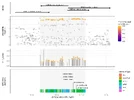
Genetics: locus 12:123,924,955 - genes CCDC92, ZNF664, etc.

I find these plots fascinating but bewildering. Does anybody have any idea why one might get a group of SNPs all with the same score of 6 in a strip and then another group with a score of 5 all in a strip - in exactly the same domain? My thought is that there must be some inutitively understandable basis for this and that it might tell us something about what this domain signifies.
 
Both the eqtl and phewas show that multiple studies that share the same signal. I've attached my results in Excel files.

This region comes up a lot in metabolic traits such as BMI, HDL cholesterol, waist-to-hip ratio, etc. The ME/CFS risk version goes with a lower waist-to-hip ratio for a given BMI, higher HDL cholesterol and lower triglycerides.

But there are many other traits here as well with high a colocalization (PP.H4 > 0.9) such as Schizophrenia and 'Getting up in morning'.
 

Attachments

Does anybody have any idea why one might get a group of SNPs all with the same score of 6 in a strip and then another group with a score of 5 all in a strip - in exactly the same domain?
Probably due to linkage disequilibrium, the correlation with the one causal SNP that is driving the signal. The colours indicate that the strips are SNPs that have the same correlation with the causal SNP.
 
Probably due to linkage disequilibrium,

Sure, but why two SNP strips in the same domain at different levels? Maybe one lot make that domain form an S bend to the left and another lot an s bend to the right, instead of a single arc and the different bends lead to different level of risk to different diseases because they influence expression of some gene or genes further along, or something of that sort? It makes me think that rather than just noting a locus it would be good to have identification tags for SNP strips, to see if the top one and bottom one are reversed in another condition for instance. My guess is that you are doing something a bit like that already but it is hard to keep track of.
 
Here's a bit more about some of the candidate genes:

CCDC92
CCDC92 encodes a coiled-coil domain-containing protein with identical protein binding activity and is positioned in the centriole, centrosome, cytoplasm, and nucleoplasm. It is linked to innate immune response and regulation of defense response to virus, placing it in a cellular context that connects structural compartments with immune-related biology. Brain expression is prominent at both the protein and RNA levels, with additional RNA expression in the male reproductive system and cardiovascular system.

At the molecular level, CCDC92 is characterized by a coiled-coil domain family and a protein rich in phosphorylation sites, features that are consistent with regulated protein interactions and post-translational control. Its known activity is identical protein binding, indicating a role in homomeric or closely related protein association rather than a specialized catalytic function. Together with its centriolar, centrosomal, and nucleoplasmic localization, this supports a role in cellular organization linked to immune-response-associated processes.

Clinical associations for CCDC92 are limited in the provided information, but the gene is annotated in relation to innate immune response and defense response to virus. Its strongest stated relevance is therefore biological rather than disease-specific, with expression and localization patterns that place it in tissues and compartments relevant to both structural and immune functions.
CCDC92 Gene - GeneCards

ZNF664
ZNF664 encodes a Krüppel C2H2-type zinc-finger transcription factor that binds DNA and regulates RNA polymerase II transcription. It is a nuclear protein, with localization reported in the nucleoplasm, and its core biological theme is control of DNA-templated gene expression.

ZNF664 is predicted to enable DNA-binding transcription factor activity and RNA polymerase II cis-regulatory region sequence-specific DNA binding activity, placing it in the transcriptional regulatory machinery. The available expression profile shows RNA expression in brain, endocrine system, and peripheral nervous system, with protein detection in the eye, linking the gene to tissues with active regulatory programs.

No specific disease associations or pathogenic variants are reported for ZNF664 in the provided information. Its biological significance is therefore centered on transcriptional regulation rather than a defined clinical syndrome, and no gene-specific therapeutic agents are named.
ZNF664 Gene - GeneCards

DNAH10
DNAH10 encodes dynein axonemal heavy chain 10, an axonemal motor protein that functions in cilia and flagella. It is an inner arm dynein heavy chain and belongs to the dynein heavy chain family, with roles tied to microtubule-based movement and cilium movement involved in cell motility.

DNAH10 localizes to the axoneme, the 9+2 motile cilium, the sperm principal piece, and cell projections. Its activity is associated with ATP-dependent, binding, and catalytic functions, consistent with a motor role in ciliary and flagellar movement. Expression is high in the male reproductive system, with lower expression measurements reported in brain and female reproductive system.

Pathogenic variants in DNAH10 are reported in spermatogenic failure, male infertility with azoospermia or oligozoospermia due to single-gene mutation, and alacrima, achalasia, and impaired intellectual development syndrome. Variant findings also include oligospermia, linking DNAH10 to reproductive dysfunction and broader developmental disease.

DNAH10 Gene - GeneCards
 
Perhaps it is also the locus for volunteering for research projects.
Yeah, the locus is not so clear or informative. Posting the analyses anyway, perhaps something clicks when in the future more info is available.

My guess is that you are doing something a bit like that already but it is hard to keep track of.
Yes the colocalization analyses tries to find out if the two signals are driven by the same causal variant(s) based on these correlation patterns among SNPs.
 
The ME/CFS risk version goes with a lower waist-to-hip ratio for a given BMI, higher HDL cholesterol and lower triglycerides.

But there are many other traits here as well with high a colocalization (PP.H4 > 0.9) such as Schizophrenia and 'Getting up in morning
Hmm interesting. I meet most of this traits: High HDL, Low Triglycerides, Schizophrenia running heavily in the family and.. "Getting up in morning" ..well I have been always an early bird (if its this what the trait means). Unfortunately no sexy pear shape (lower waist-to-hip ratio).
 
Back
Top Bottom