Preprint Low Dose Naltrexone for Post-COVID Fatigue Syndrome: A Randomized Controlled Trial, 2026, Naik, Nacul+

It’s true that you can’t define subgroups, but, am I completely mistaken, or shouldn’t we expect – in the event of any anticipated subgroups, say if, for example, 20–30 per cent of all pwME were true responders – that their would still be a clear positive trend towards the treatment, even if it might not be statistically significant?

I mean, how likely is it – or how minuscule would the positive effect have to be, even in genuine responders, for the difference to placebo being almost exactly zero in most categories?
Seems to me that trials like this answer the question about sub-groups. If there were any, they would be identifiable in the results, making the whole premise about identifying sub-groups pointless. That is, if the treatment worked, of course, which is the most likely explanation for why no sub-groups were identified.

But no such sub-groups have been identified at all yet, so the argument looks mostly like an attempt at rationalizing that is similar to what the psychosomatic cabal did over decades.

When something works, we'll know. There will be no need to squint hard and look at it at just the right angle with the right lighting.
 
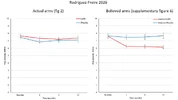
Regarding the blinding point discussed above by @EndME, @Utsikt and others, I noticed that the Spanish fibromyalgia study did assess blinding at 12 months. Participants' guesses were no better than chance. But when participants believed they were receiving LDN, they reported more improvement. See my post here.

When you put the two relevant graphs side by side, you see why there is a disconnect between trial results and what people experience in routine practice when they know they are being given LDN:

1793878817045.webp
 
Very much worth it. I think every study should have that question to assess blinding, and then making graph like that. It makes the placebo effect really easy to see in a study with a null result. Please rest now!
I agree. There would be less confusion among both clinicians and patients.

To be clear, I did not make the two graphs, the authors did. I just fished them out of the two documents and put them side by side. But that reading/thinking/copying/pasting/formatting is exhausting with severe ME/CFS.

All credit to Rodríguez-Freire and colleagues for collecting and presenting the data that helps us understand the psychology of the trial. Three of the authors are from psychology departments.
 
For anyone interested, I just posted a similar graph to the one above for functional impairment on the thread for the Spanish FM study by Rodríguez-Freire et al. that looked at blinding. See here.

My conclusion is that the subgroup people say exists for each treatment may well be the subgroup that believes they are receiving an effective treatment.
 
There's literally a cult around this drug. I've never seen that before.
I've seen it before. Back in 2009 to 2013, Vitamins and supplements were really popular for ME & Fibromyalgia. Tons of patients were swearing that vitamin B12, Glutathione, Co Enzyme Q10, etc made a noticeable different to their health.

If it didn't work there was always some excuse. You didn't take the right dose. You didn't take it for long enough. It has to be MethylB12 not Hydroxy. It has to be sublingual. It has to be injected because your digestive system can't absorb it.
 
Back
Top Bottom