Preprint Low Dose Naltrexone for Post-COVID Fatigue Syndrome: A Randomized Controlled Trial, 2026, Naik, Nacul+

This article doesn't have the best timing:
Low-Dose Naltrexone Linked to Some Long COVID Improvements
— But study's observational design and lack of a control group limit the findings' impact

WASHINGTON -- People with long COVID reported significantly better functioning and symptom improvements after taking low-dose naltrexone, according to a small retrospective cohort study.

Symptom burdens declined among 230 adults with long COVID from baseline to more than 3 months after receiving a low-dose naltrexone prescription off-label for the condition. The average seven-symptom composite score dropped by an estimated annual change of 5.1 points (95% CI -7.69 to -2.52, P<0.001) from a baseline average of 20 after adjustment for other factors. Number of symptoms declined by a mean annual change of -2.4 (95% CI -3.94 to -0.94, P=0.001).

As self-reported symptoms slid, self-reported functional status rose. The adjusted mean annual change to patients' functional stage scores was -0.32 (95% CI -0.57 to -0.07, P=0.011) on a scale from 1-5, reported Brandon Aflak, JD, CNA, a fellow at Stanford University in California.

"Although these findings are encouraging, this observational study design does limit causal inference," Aflak said in a presentation at the IDWeek annual meeting. "Randomized, placebo-controlled trials are needed to establish the safety and efficacy of low-dose naltrexone for long COVID, and to determine its potential role in clinical management."
Low-Dose Naltrexone Linked to Some Long COVID Improvements | MedPage Today
 
LDN also seems to be popular with people with Hashimoto's thyroiditis. I discovered this when I told my sister about LDN. She is in some Hashi online groups and knew immediately what I was talking about. It does indeed float around in various disease communities.

My sister also has Hashi and told me a while back that she has "PEM" based on her symptoms she read online. I'm not asking her if he knows about LDN.
 
My sister also has Hashi and told me a while back that she has "PEM" based on her symptoms she read online. I'm not asking her if he knows about LDN.

I have a mate with hashimotos and while she does have a terrible time of it and gets bad fatigue sometimes, I can't see how she could possibly have PEM with the amount of activity, work and exercise she does.
 
I saw Jack’s tweet from Amatica Health, and I have to say I was pretty disappointed.

A bit off-topic, but I paid quite a lot of money for a really comprehensive RNA analysis wirh Amatica, with tens of thousands of values grouped into different categories. But how meaningful are these results, really? Can the medications we take significantly affect them? I have quite a few questions about all this.

What struck me was that when we compared our results with other patients on Twitter, those with mild or moderate ME/CFS seemed to have much better results. Mine were honestly terrible, with a huge number of values way below the median. But it's hard to know what conclusions we can actually draw from that.

Anyway, back to Jack. I'm obviously in favour of identifying subgroups, but his tweet leaves me puzzled. Claiming he can guarantee it wasn't a placebo effect simply because LDN worked so well for him, when we're talking about a negative randomised trial, is pretty strange coming from someone who presents himself as a scientist.
As you yourself write, Jack is selling tests with 'Amatica-Health'.
He does this with the promise that people can use them to gain insights into their condition and assess which ‘subgroup’ they belong to. All this talk of subgroups and the ‘n=1’ approach is, in effect, part of his business model.

What I’m saying isn’t meant to pass judgement on his motives or on whether what their doing at Amatica is of any use for patients and/or reseachers (I think there is a separate thread for that), but in my opinion, everything he posts on social media, including his recent posts about LDN, has to be read with keeping that aspect in mind.
 
I apologize if this has been discussed elsewhere, but I don’t quite understand how this sub typing argument works.

If a drug did work for a subtype of people, wouldn’t a signal show up in this trial, assuming that the proportions of people in that subgroup are the same in the placebo and drug arms of the study?

Long discussion here, but overall its impossible with the current ME/CFS knowledge and criteria we have


It’s true that you can’t define subgroups, but, am I completely mistaken, or shouldn’t we expect – in the event of any anticipated subgroups, say if, for example, 20–30 per cent of all pwME were true responders – that their would still be a clear positive trend towards the treatment, even if it might not be statistically significant?

I mean, how likely is it – or how minuscule would the positive effect have to be, even in genuine responders, for the difference to placebo being almost exactly zero in most categories?
 
I mean, how likely is it – or how minuscule would the positive effect have to be, even in genuine responders, for the difference to placebo being almost exactly zero in most categories?
We had a bit of a discussion about that in the contexr of the Ritux-trial.

It really depends on your sample size, the inherent variability (which is high vor ME/CFS), the effect size (and by extension, your outcome measure), and possibly also the assumption that the treatment does not make one subgroup worse and another better. It also depends on the statistical test that is used (some could for example handle that later assumption, others can't).

For the context of Ritux, there was some consensus that a potential responder subgroup would have to be very small to be missed. But in the Ritux trial, the treatment group actually got a bit worse than the placebo group, which affects these things.

In this trial, the CI's appear relatively wide, e.g., (LDN, 4.2; placebo, 4.4; adjusted mean difference (AMD) -0.76, 95% confidence interval (CI) -4.18 to 2.67). Note that the CI [-4.18, 2.67] is on the difference not on the baseline values. So just eyeballing, this study may not have adequate power to detect subgroups or very small effect sizes. But to know for sure, one would have to do the math.

 
One thing that I think may be worth considering is the possibility that naltrexone can indeed produce some relief though relevant pathway in ME/CFS, but that subsequent fluctuation, adaptation or tachyphylaxis cancel this out over an extended period. The drug is of no useful benefit but people may have a sense that it works - a bit like the theophylline in tea.
 
One thing that I think may be worth considering is the possibility that naltrexone can indeed produce some relief though relevant pathway in ME/CFS, but that subsequent fluctuation, adaptation or tachyphylaxis cancel this out over an extended period. The drug is of no useful benefit but people may have a sense that it works - a bit like the theophylline in tea.
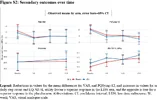
In that scenario, wouldn't the graphs look different than they do? You'd expect the fatigue/pain/etc to drop more in the LDN group than the placebo group initially, but then come back up. So a V- or U-shape, with an initial between-groups difference. (Or an n-shape for sometihng that would ideally increase, like steps.) But that's not what's in the graphs. Let me know if I'm misunderstanding something.

They're all in supplementary file 2, but here's one:

1793267386541.webp
 
That wasn't my experience when taking it. Nothing like the transient good sensation that I get from, eg, a nice cup of tea.
Nor mine, though I was having an adverse reaction! It was more like my reaction to coffee (bad) than my reaction to tea (good, though cannot drink either any more). I was just trying to understand what Jonathan was proprosing.

I don't think it fits with what the people who report benefit say, but I do get the general point that if something useless were to give a transient pleasant sensation, it could muddy self-reports but not be captured by the measures used. Though I'm not quite convinced about the latter - I think that positivity would come out somewhere, if not in the fatigue or pain measures, then in quality of life or something like that.
 
Back
Top Bottom