Mapping the Complexity of ME/CFS: Evidence for Abnormal Energy Metabolism, Altered Immune Profile and Vascular Dysfunction, 2025, Heng

Dolphin

Senior Member (Voting Rights)
https://papers.ssrn.com/sol3/papers.cfm?abstract_id=5131664

Mapping the Complexity of ME/CFS: Evidence for Abnormal Energy Metabolism, Altered Immune Profile and Vascular Dysfunction
Cell Reports Medicine
53 Pages Posted: 12 Feb 2025 Publication Status: Under Review

Ruiwen Benjamin Heng
Macquarie University

Bavani Gunasegaran
Macquarie University

Shivani Krishnamurthy
Macquarie University

Sonia Bustamante
University of New South Wales (UNSW)

Ananda Staats
Macquarie University

Sharron Chow
Macquarie University

Seong Beom Ahn
Macquarie University

Moumita Paul-Heng
The University of Sydney

Yolande Maciver
The Grove Health Pymble

Kirsten Smith
The Grove Health Pymble

Denise Phuong Tran
The University of Sydney

Peter P. Howley
Macquarie University

Ayse Aysin Bilgin
Macquarie University

Alexandra Sharland
The University of Sydney

Richard Schloeffel
Macquarie University

Gilles J. Guillemin
Macquarie University

Abstract

Myalgic encephalomyelitis/chronic fatigue syndrome (ME/CFS) is a complex disorder with no known underlying mechanisms, diagnostic tools, or treatments.

Multiple areas of dysfunction have been extensively studied, but rarely examined together.

We recruited age- and sex-matched ME/CFS patients and healthy controls for a multi-modal study examining energy metabolism, immune profiles and plasma protein levels.

Elevated levels of adenosine monophosphate (AMP) were detected in both plasma and immune cells.

Additionally, immune cells showed higher levels of adenosine diphosphate (ADP) and a reduced adenosine triphosphate/adenosine diphosphate (ATP/ADP) ratio.

These findings imply decreased ATP generation and the presence of energy stress within the immune cell population.

Adaptive immune cell populations were skewed towards less mature effector subsets of CD4+, CD8+ and gd T cells, and proportions of CD1c+CD141-conventional DC type 2 (cDC2) and CD56lowCD16+ terminal natural killer (NK) cells were also reduced.

Elevated levels of plasma proteins associated with thrombus formation and vascular reactivity may contribute to the endothelial dysfunction observed in ME/CFS patients.

Using Classification and Regression Tree (CART) modelling, we identified variables from each mode of investigation with strong predictive potential for ME/CFS.

Together, this study provides new insights into the somatic symptoms and underlying biology of ME/CFS.

Note:
Funding Information: BG is supported by the Susie Myers Glioblastoma Scholarship (PANDIS) and Macquarie University Research Training Program Domestic Scholarship; SK is supported by International PhD scholarships from Macquarie University; MPH is supported by Sydney University Research Training Program Domestic Scholarship; SBA is supported by Cancer Council NSW funding RG23-06 and Targeted Call Research-National Health and Medical Research Council (NHMRC) funding GNT2015197; GJG was supported by the NHMRC funding APP1176660.

Declaration of Interests: The authors declare no competing interests

 
Last edited by a moderator:
Published as —

Mapping the complexity of ME/CFS: Evidence for abnormal energy metabolism, altered immune profile, and vascular dysfunction
Heng; Gunasegaran; Krishnamurthy; Bustamante; Pires; Chow; Ahn; Paul-Heng; Maciver; Smith; Tran; Howley; Bilgin; Sharland; Schloeffel; Guillemin

Myalgic encephalomyelitis/chronic fatigue syndrome (ME/CFS) is a complex disorder with undefined mechanisms, no diagnostic tools and treatments.

To investigate concurrent system dysfunctions, we recruited age- and sex-matched ME/CFS patients and healthy controls for a multimodal analysis of energy metabolism, immune profiles, and plasma proteomics.

Immune cells from ME/CFS patients show elevated adenosine monophosphate (AMP) and adenosine diphosphate (ADP) with a reduced ATP/ADP ratio, indicating decreased ATP generation and cellular energy stress. Immune profiling reveals skewing toward less mature effector subsets of CD4+, CD8+, and γδT cells, with reduced CD1c+CD141− conventional DC type 2 and CD56lowCD16+ terminal natural killer cells.

Elevated levels of plasma proteins associated with thrombus formation and vascular reactivity may contribute to the endothelial dysfunction observed in ME/CFS patients. Classification and regression tree modeling identifies variables with strong predictive potential for ME/CFS. Together, this study provides insights into the somatic symptoms and underlying biology of ME/CFS.

HIGHLIGHTS
• This study involves age- and sex-matched 61 healthy controls and 61 ME/CFS patients

• Abundance of AMP and ADP, with reduced ATP/ADP ratio in immune cells

• Lower proportion of terminal effector memory T cell, NK, and DC subpopulations

• Elevated plasma proteins associated with vascular and anti-inflammation activity

Web | DOI | Cell Reports Medicine | Open Access
 
Last edited:
Prior papers from this group came in for criticism, esp the 2022 one. This paper looks to be of better quality and reads pretty clearly.

Could the kynurenine pathway be the key missing piece of Myalgic Encephalomyelitis/Chronic Fatigue Syndrome ME/CFS complex puzzle? (2022)

Dysregulation of the Kynurenine Pathway, Cytokine Expression Pattern, and Proteomics Profile Link to Symptomology in Myalgic Encephalomyelitis/Chronic Fatigue Syndrome ME/CFS (2023)

It is also clear when it comes to the idea of psychological factors. The conclusion overplays things if anything. Obviously the ivory tower anti-dualists would argue about the framing of psychological disorders not being medical conditions, but we all know how that plays out in the real world. (And we should be long past the point where this even needs to be written.)

In conclusion, this study provides compelling evidence that ME/CFS is associated with dysfunction across multiple biological systems, challenging its dismissal as a psychological disorder. Notably, we identified variables from three distinct biological systems with strong predictive potential for ME/CFS, highlighting the crosstalk between immune, vascular, and energy production dysfunction. These findings reinforce the legitimacy of ME/CFS as a medical condition and should pave the way for promoting broader acceptance of the condition within the medical community and society at large, thus improving patient management and outcomes.

It doesn't look like the preprint had much of an analysis or commentary. I'll put some summary findings and discussion quotes up in case of interest.
 
Canadian Consensus Criteria vs healthy (not sedentary) controls.

We observed a deviation at the first node of this pathway at which kynurenine (KYN) can be converted to 3-hydroxykynurenine (3HK), kynurenic acid (KYNA), or anthranilic acid (AA). […] Furthermore, we observed lower levels of p linic acid (PIC) and quinolinic acid (QUIN) in ME/CFS. […] No differences were evident in the median levels of tryptophan (TRP), KYN, AA, and 3-hydroxyanthranilic acid (3HAA) between the two cohorts. The net effect of these changes reduces systemic availability of QUIN, the substrate for NAD + generation.

we observed higher median levels of AMP in ME/CFS [plasma] […] this difference did not achieve statistical significance. There was no difference in the levels of ADP or ATP between the cohorts.

Elevated levels of NAD+ and higher NADP+/NADPH ratio were measured in patients [PBMCs] […] Moreover, in contrast to the findings in plasma, the levels of AMP were significantly higher in ME/CFS

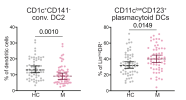
there was a significantly lower proportion of CD1c+ CD141− conventional DC type 2 (cDC2; p = 0.001) but not CD1c− CD141+ conventional DC type 1 (cDC1) and higher proportion of CD11c− CD123+ plasmacytoid DC (pDC; p = 0.0149) in patient PBMCs

The CD45RA −CCR7 −CD4 +effector memory T cell population was dominated by cells expressing the CD27+ CD28+ early effector memory phenotype (p = 0.0037), while the CD27− CD28− terminal effector memory subset was significantly reduced in patient PBMCs when compared to those from healthy controls (p = 0.0056).

We observed a smaller fraction of total CD56 + NK cells in patients compared to healthy controls, and this was primarily attributable to the reduction of CD56low CD16 + terminal NK cells in these patients (p = 0.0187).

Multiple plasma cytokines (interleukins [IL]-1β, IL-2, IL-4, IL-6, IL-8, IL-10, IL-12p70, IL-13, IL-17A, IL-18, IL-23, IL-33, monocyte chemoattractant protein 1[MCP-1], tumor necrosis factor [TNF], interferon alpha [IFN-α], and IFN-γ) were detected and found to be similar in abundance in both cohorts.
 
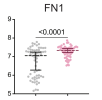
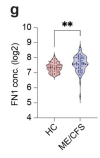
Most of the upregulated proteins were secreted proteins, including fibronectin 1 (FN1), sex-hormone-binding globulin (SHBG), protein C (PROC), proteoglycan 4 (PRG4), thrombospondin 1 (THBS1), von Willebrand factor (VWF), epidermal growth factor (EGF) containing fibulin extracellular matrix protein 1 (EFEMP1), and fetuin B (FETUB).

Together, these pathways suggest endothelial activation and vascular remodeling, supported by the upregulation of FN1, VASN, THBS1, and VWF. In contrast, the most significantly downregulated pathways included Fcγ-receptormediated phagocytosis, B cell receptor signaling, and FcεRI signaling, driven by reduced levels of immunoglobulin-related proteins.

[…] soluble THBS1, VWF, and VASN are implicated in vascular reactivity, potentially contributing to the endothelial dysfunction observed in ME/CFS patients. Soluble THBS1 promotes platelet aggregation at the site of vascular injury in the presence of VWF, which was also elevated in our study. This interaction facilitates thrombus formation. Furthermore, THBS1 can bind to two receptors, CD36 and CD47, to antagonize the nitric oxide signaling pathway. Binding to these receptors on vascular smooth muscle cells impairs vasodilation and restricts blood flow,[…] could collectively reduce overall blood flow […] corroborates an earlier study suggesting that this antiangiogenic glycoprotein restricts brain-blood flow in a subset of ME/CFS patients, possibly contributing to brain fog and post-exertional malaise. This has prompted the initiation of the STOP-ME study funded by Open Medicine Foundation Canada,
 
In conclusion, this study provides compelling evidence that ME/CFS is associated with dysfunction across multiple biological systems, challenging its dismissal as a psychological disorder.

I find this sort of statement unhelpful and annoying. It fuels the sort of negative comments there have been in response to the factsheet for professionals. The evidence for ME/CFS not being psychological does not rest on a rag bag of random test findings that may well not be significant if p values are appropriately corrected (if they were in the first place), do not replicate dozens of previous similar studies and that do not add up to any coherent explanation. It would be troublesome if it did.

The main evidence is that if you listen to people with ME/CFS a psychological account makes no sense. To that we can now add meaningful genetic evidence that has to be causal.

I have no idea what the findings on blood cells here mean. They might well reflect shifts in populations due to different patterns of physical activity, taking painkiller, or confounders in cohort selection.
 
Back
Top Bottom