News from Scandinavia

Article: Time to leave the ME/CFS diagnosis

OPINION: The ME/CFS diagnosis causes more harm than good. In today’s debate, ME/CFS is portrayed as a distinct, clearly defined disease. It is not.

by Live Landmark


I haven't read it yet, but I think the title and the author's name tell you basically everything about it.
Haven't similar articles by Landmark been published recently? It's dated today and I seem to remember her managing to publish two articles arguing the same nonsense. Or maybe it's just re-published? Science Norway not living up to its name, arguing weird ideology like this.

It would be far better to drop all the psychosomatic nonsense. Now those are harmful diagnoses based on no real disease processes. What a total waste to have experts be so misguided, even worse to have institutions that enable it.
 
Haven't similar articles by Landmark been published recently? It's dated today and I seem to remember her managing to publish two articles arguing the same nonsense. Or maybe it's just re-published? Science Norway not living up to its name, arguing weird ideology like this.

It would be far better to drop all the psychosomatic nonsense. Now those are harmful diagnoses based on no real disease processes. What a total waste to have experts be so misguided, even worse to have institutions that enable it.
It’s the same one, just translated to English.
 
Saw this on Mastodon
@hellebelle@mastodon.social said:
Great News!

The Danish short Best Practice has been selected for the OFF-Odense Film Festival and the Friss Hús Budapest International Short Film Festival.

According to director Martin Strange-Hansen it’s “a short film touching on M.E. #MyalgicEncephalomyelitis and the grey line between being a professional or a human on your job.”
---
The actor playing the brother, Hjalte Ilsøe Gustavussen, is the real life brother of servere ME-patient Marie Louise Ilsøe Gustavussen. So I guess he didn’t have to dig too deep to find the emotions needed. But also a good way to express what his family has been through the past years.

There's a trailer on Vimeo with English subtitles:


There's a brief description on imdb, no mention of ME/CFS:

 
Long article in Swedish about the state of LC “care” in Finland. Can be summarised as dominated by ignorance (how about: eat vegetables?!) and functional rehabbers. Sadly unsurprising. Autotranslation

Doctors are torn about how to care for post-COVID patients while patients like Sara suffer: "Unbelievable that you don't get help"
Thank you for posting. Good to see Akiko Iwasaki towards the end talking a bit about medical research into post infectious illness.

In the article there is a Finnish senior doctor Hélène Rotkirch Virrantaus who says Long Covid symptoms appear in the "psychophysical" whole we humans are. That a virus infection has led to defence mechanisms in the central nervous system which continue to falsely alarm. If you can gain the patient's trust, the patient will feel safe and can return to his or her everyday life with confidence. The patient can trust that nothing is wrong or broken in the body, but it's just the alarm system being a bit too active.

This doctor is co author of a paper titled "Persistent physical symptoms not explained by structural abnormalities or disease processes: a primary care approach to promote recovery". Some other authors are Trudie Chalder, Signe Flottorp, Paul Garner, Live Landmark.
 
Last edited:
«According to Rotkirch Virrantaus, criticism of the clinic is often due to the fact that the message of the operation is misunderstood»

because the BPS message is designed so it can’t be understood, just a constantly moving target of nothingness.

I dont understand why they believe thoughts and behaviour must be the cure, if they believe the cause is a virus triggering the central nervous system. She says «it’s the same mechanism that makes you feel butterflies in your stomach when you’re nervous or feel uncomfortable when standing at a high altitude.»

If someone has a fear of public speaking, assuring them that it’s not dangerous doesn’t stop the butterflies in their stomach. People can try to change their thoughts and behaviours all they like but they will still feel uncomfortable with heights. So if it’s the same, why should it be as simplistic as just telling the patient to feel safe?
 

Members of the Swedish advocacy group Svenska Covidföreningen (Swedish Covid Forum) recently published a resource, “Designing Studies for Patients with PEM,” or post-exertional malaise, to improve research methods into ME and Long COVID. “We have compiled best practices and recommendations for study design in this guide, specifically aimed at researchers,” the authors wrote. They state that patients must be involved in studies from early stages and that the risks associated with PEM must be described in the ethics application, among other recommendations.

 
Members of the Swedish advocacy group Svenska Covidföreningen (Swedish Covid Forum)
FYI: this is the Swedish Covid Association, i.e. the patient organisation. The auto translate might have made a mistake.

It’s a shame they start off by saying that 50 % of LC patients have PEM. Anyone that bothers to check the sources will see that the design of the studies does not allow us to make general statements about the rate of PEM in the entire LC population.

Using «PEM/PESE» throughout the text is just confusing.

The have a section about the causes of PEM, even though we have no clue about it. There’s also lots of talk about «energy thresholds».

They list DSQ as a suitable way to identify PEM.

There’s some kind of myth-busting at the end about wrong assumptions that can be made about PEM.

I think it’s well intended, but my overall impression is that this won’t really help researchers that don’t already understand what PEM can look like and how to deal with it in a study setting.

It also doesn’t feel like they’ve prioritised well enough, and very important information (like using long term tracking with objective activity measurements) is hidden away.
 
Dagens Medisin/Daily Medicine has a paywalled article about an "Explosion" in disability payments being provided to people with an ME diagnose between 2008-2015. They've interviewed a professor in health sociology that did his PhD on medically unexplained symptoms and he explains various facets of how doctors set a diagnosis when there is no clear cut answer about what is wrong with the patients. For example they may take into consideration how easy it is to get help with such and such diagnose versus another.

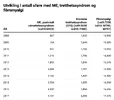
Copying the table(s) here as they are made from data from the Norwegian Labor and Welfare office. Title: "Change in the number of people disabled by ME, CFS or fibromyalgia. The first column is the year and the rest are the diagnoses.
1783399581750.webp
Link to table in the Datawrapper service used by Dagens Medisin


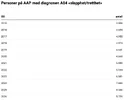
The next table is titled "People on work assessment allowance with the diagnosis A04/Fatigue", with year on the left and the number of people on the right.
1783399778435.webp
Link to table in Datawrapper

Work assessment allowance is given in Norway if you lose 50% of your ability to work/provide an income for yourself. We only have the A04 diagnosis for work assessment allowance as this is the code used by GPs, while for disability you must also have been assessed by specialist that use the coding system with G93.3.
 
Thanks @Midnattsol. Is there a reason why the disabled figures are only up to 2017? Does the Norwegian Labor and Welfare Office potentially have data 2018 to the present (and covering Long Covid and FND labels too)?

That Work Assessment Allowance with diagnosis of Fatigue data line looks to steeply increase after the pandemic onset.
 
Thanks @Midnattsol. Is there a reason why the disabled figures are only up to 2017? Does the Norwegian Labor and Welfare Office potentially have data 2018 to the present (and covering Long Covid and FND labels too)?

That Work Assessment Allowance with diagnosis of Fatigue data line looks to steeply increase after the pandemic onset.
They write in the article that for 2017-2025 it's only possible to get aggregated numbers for the age group 18-29, where there was a change from 426 to 826. I'm not sure why that would be so, if it is about how NAV now stores the data or about the data application process and what they would be able to get for the purpose of an article/within a timeframe.

Edit to add:
We have two threads on registry studies following changes in diagnosis and sick leave pre and post covid in Norway:
Excess primary healthcare consultations in Norway in 2024 compared to pre-COVID-19-pandemic baseline trends, White et al, 2026
Aberrations in medically certified sick leave and primary healthcare consultations in Norway in 2023.... - R. White et al, 2024

Edit to add again:
We don't really have a Long Covid diagnose in Norway, at least nothing that is in use so those patients are most likely found within different categories such as A04 for fatigue, or P29 for burnout, and various other codes depending on what the patients present with. There is a steep increase in consultations for several diagnostic codes following covid becoming part of our environment. FND/MUPS would also be found all over the chart as we can't be sure how the doctors use the codes.
 
Last edited:
63 BPS proponents have written an opinion piece in the journal of the Norwegian medical association:

A few highlights, machine translated:

Give patients their lives back​

We know enough to be able to help far more patients with long-term symptoms. Yet we hold back hope, for fear of disappointing them. It can cost patients large parts of their lives.

This article is a professional appeal from 63 clinicians, researchers and professionals from across the country. We have clinical and research experience with persistent physical symptoms, such as pain, fatigue, "brain fog", dizziness and stomach problems and have come together with a common message: New knowledge about how such symptoms arise and are maintained gives reason for far greater hope for improvement than many patients are given today.

Predictive processing: what the brain really does​

The theoretical foundation is found in predictive processing (5–7) , an established neuroscientific model of how symptoms arise and are maintained through the brain's interpretations, expectations, and learning.
This understanding is relevant to patients with a range of long-term symptoms that the healthcare system has struggled to help. Treatments based on this knowledge show good results in symptom-based diagnoses such as long covid (19) and CFS/ME (20)

Can symptoms disappear?​

For many years, the goal of treatment has been to help patients function better, to learn to live with the symptoms. That has been important and right for many.
The new neurobiological understanding opens up something more. If symptoms are maintained by learned and expectation-based processes in the brain, not only is significant improvement possible. Some patients may recover completely.
It is therefore not good enough, or in line with current knowledge, to simply help patients live with their symptoms. We must also ask how more people can recover.

Fear to give hope, but not to give hopelessness​

Therapists will provide realistic expectations and protect patients from disappointment.

However, we must ask an uncomfortable question:

How good are we really at predicting who will recover?

The answer is: Surprisingly bad.

A joint project​

The new understanding of symptoms has major implications far beyond pain management. It is relevant to the entire spectrum of long-term physical symptoms – conditions that have different diagnoses but appear to share common mechanisms.

This is not a project for one method or one environment, but for the entire professional field: doctors, psychologists, physiotherapists, nurses and others who encounter patients with long-term symptoms. We must give patients hope back. Not because one method solves everything, but because we understand increasingly better what symptoms are and how overprotective symptom alarms can be dimmed – or turned off.

This way, more people can return to work, school, family and everyday life. And this way, more patients can say: "I am healthy."
 

The article (Google Translate):

"We have been constantly surprised by people we thought had little chance, but who nevertheless returned to work, school and life (24)."

The citation:

Holmås TH, Monstad K, Reme SE. Regular employment for people with mental illness - An evaluation of the individual placement and support programme. Soc Sci Med. 2021 Feb;270:113691. doi: 10.1016/j.socscimed.2021.113691. Epub 2021 Jan 7. PMID: 33465601. https://www.sciencedirect.com/science/article/pii/S027795362100023X

"Through a multicentre RCT design, IPS was compared to high-quality treatment as usual offered to people with moderate to severe mental illness. Severe mental illness mainly refers to psychotic or bipolar disorder with or without comorbid substance abuse/dependency, while participants categorized as having moderate mental illness primarily suffered from affective disorders, mainly depression and anxiety disorders."
 
63 BPS proponents have written an opinion piece in the journal of the Norwegian medical association:

A few highlights, machine translated:
Reply by Hanne Thürmer, a cardiologist, who has recently been employed by the Norwegian ME Association:

Google translated excerpts:
One understanding and one model is rarely able to help all patients with all types of chronic ailments. Patients who are told to hope more and harder to get better do not always get better. Then the disappointment and the height of the fall are great.
Yes – doctors and patients must maintain hope and not bury themselves in symptoms and suffering.
No – doctors and patients must not believe that effective treatment is in place.
If patients are blamed for not getting well, it is an abuse that affects vulnerable patients.
 
Brain retraining for ME/CFS in DN, the largest newspaper in Sweden (paywalled):

Jenny gick in i väggen – blev sängliggande i flera år, 2026-08-11

The title actually says "went into the wall" which is a Swedish expression for burnout. So I don't know why they think this was ME/CFS. I have not really read the article.
 
Last edited:
Good article from Må Bra, a Swedish health magazine. They have interviewed Jennie Carlsson who developed ME after an infection 8 years ago. She talks about life with ME and her meeting with the health care system. There is also an interview with professor Niklas Arneberg on post infectious illnesses.

 
Back
Top Bottom