Psychophysiologic symptom relief therapy for chronic back pain: a pilot randomized controlled trial, 2021, Donnino et al

forestglip

Moderator
Staff member
Psychophysiologic symptom relief therapy for chronic back pain: a pilot randomized controlled trial

Donnino, Michael W.; Thompson, Garrett S.; Mehta, Shivani; Paschali, Myrella; Howard, Patricia; Antonsen, Sofie B.; Balaji, Lakshman; Bertisch, Suzanne M.; Edwards, Robert; Ngo, Long H.; Grossestreuer, Anne V.

Introduction:
Chronic back pain is the leading cause of disability in the United States. Based on the hypothesis that nonspecific back pain may be rooted in a psychophysiologic etiology, we propose a new approach to chronic back pain.

Objectives:
A pilot study was conducted to assess whether psychophysiologic symptom relief therapy (PSRT) can reduce disability and back pain bothersomeness for patients with chronic back pain.

Methods:
This was a three-armed, randomized trial for adults with nonspecific chronic back pain that compared PSRT with usual care and an active comparator (mindfulness-based stress reduction [MBSR]). Psychophysiologic symptom relief therapy–randomized participants received a 12-week (36 hours) course based on the psychophysiological model of pain.

All groups were administered validated questionnaires at baseline and at 4, 8, 13, and 26 weeks. The primary outcome was the reduction in pain disability measured by the Roland–Morris Disability Questionnaire.

Results:
The mean Roland–Morris Disability Questionnaire score for the PSRT group (n = 11) decreased from 9.5 (±4.3 SDs) to 3.3 (±5.1) after 26 weeks which was statistically significant compared with both MBSR (n = 12) (P = 0.04) and usual care (n = 12) (P = 0.03).

Pain bothersomeness scores and pain-related anxiety decreased significantly over 26 weeks in PSRT compared with MBSR and usual care (data in manuscript). At 26 weeks, 63.6% of the PSRT arm reported being pain free (0/10 pain) compared with 25.0% and 16.7% in MBSR and usual care arms, respectively.

Psychophysiologic symptom relief therapy attendance was 76%, and there was 100% follow-up of all groups.

Conclusion:
Psychophysiologic symptom relief therapy is a feasible and potentially highly beneficial treatment for patients with nonspecific back pain.

Web | DOI | PMC | PDF | PAIN Reports | Open Access
 
Last edited:
This study was testing psychophysiologic symptom relief therapy (PSRT) to see if it is superior to mindfulness-based stress reduction (MBSR) or usual care in reducing disability and symptoms related to chronic back pain that lacked a clear organic etiology.
Chronic back pain was defined as occurring at least 3 days a week for the 3 months before enrollment.

There was randomization into the three groups. Participants were aware of the intervention they were doing, but they didn't know that MBSR was control arm.
On enrollment into the trial, participants were randomized in a 1:1:1 ratio to the usual care arm, the active comparator arm, or the intervention arm in blocks with random sizes of 3 or 6. [...] The trial was partially blinded; patients in the active comparator group (ie, MBSR) were not aware that they were in a comparator arm.

Brief description of the PSRT intervention, with line breaks added:
Participants randomized to the PSRT arm had a brief one-on-one overview of the course explained to them by an investigator and then participated in a 12-week (38 hours) course.

During the first 4 weeks, participants participated in a PSRT program based on Sarno's psychophysiologic model of chronic back pain23 and included use of the books Healing Back Pain,23 Unlearn Your Pain,25 and Worry Less, Live More: The Mindful Way Through Anxiety Workbook.20 These sessions were held twice a week, 2 hours per session, for 4 weeks (total 16 hours, 8 sessions).

The intervention was delivered through a combination of physician (author M.W.D.) and mind–body expert with 20 years of experience in patient support or counselling, supported by consultation or training from experts in the field of chronic pain.

An in-depth description of this portion of the intervention is described in detail in the Appendix (available at http://links.lww.com/PR9/A129) and briefly as follows:

The overall program was constructed around 4 components: psychophysiologic pain education, returning to physical activity/desensitization, emotional expression, and stress reduction. The psychophysiologic pain education allowed participants to explore their pain history and learn about the clinical presentation of psychophysiological syndromes with the goal of achieving acceptance of the psychological origins of their pain (full details provided in the Appendix, available at http://links.lww.com/PR9/A129). After completing the educational component, desensitization techniques were used with the goal of reversing the conditioned response to a physical stimulus that was not the primary cause of the pain. Desensitization techniques included imagining doing a physical activity with visual motor imagery (eg, bending to pick up heavy books) that would typically elicit pain. The experience that visualization alone can elicit pain allows for the two-fold therapeutic approach of reinforcing that their pain was psychophysiologic but also serves as a means of then desensitizing from this pain by repeated visualization with the knowledge that they were safe. After pain could no longer be elicited by visualization, participants were encouraged to gradually resume physical activity similar to levels undertaken before pain onset (see Appendix, available at http://links.lww.com/PR9/A129 for full details). Finally, participants established techniques for appropriate emotional expression while discouraging emotional repression.

After the first 4 weeks, the course introduced the concept of mindfulness with a cognitive component incorporated into the classic MBSR program, with 2-hour sessions once a week for the remaining 8 weeks including one full day session of 6 hours and an hour long orientation (22 hours, 9 sessions). The component of stress reduction was achieved through the MBSR course, now performed in the context of subjects understanding the origins of their pain and having already achieved improvements in functional activity and reductions in pain.

The primary outcome was reduction in functional limitations or disability based on Roland–Morris Low Back Pain and Disability Questionnaire (RDQ). Here's the questionnaire text, downloaded from the RDQ website:
When your back hurts, you may find it difficult to do some of the things you normally do.

This list contains sentences that people have used to describe themselves when they have back pain. When you read them, you may find that some stand out because they describe you today.

As you read the list, think of yourself today. When you read a sentence that describes you today, put a tick against it. If the sentence does not describe you, then leave the space blank and go on to the next one. Remember, only tick the sentence if you are sure it describes you today.

1. I stay at home most of the time because of my back.

2. I change position frequently to try and get my back comfortable.

3. I walk more slowly than usual because of my back.

4. Because of my back I am not doing any of the jobs that I usually do around the house.

5. Because of my back, I use a handrail to get upstairs.

6. Because of my back, I lie down to rest more often.

7. Because of my back, I have to hold on to something to get out of an easy chair.

8. Because of my back, I try to get other people to do things for me.

9. I get dressed more slowly then usual because of my back.

10. I only stand for short periods of time because of my back.

11. Because of my back, I try not to bend or kneel down.

12. I find it difficult to get out of a chair because of my back.

13. My back is painful almost all the time.

14. I find it difficult to turn over in bed because of my back.

15. My appetite is not very good because of my back pain.

16. I have trouble putting on my socks (or stockings) because of the pain in my back.

17. I only walk short distances because of my back.

18. I sleep less well because of my back.

19. Because of my back pain, I get dressed with help from someone else.

20. I sit down for most of the day because of my back.

21. I avoid heavy jobs around the house because of my back.

22. Because of my back pain, I am more irritable and bad tempered with people than usual.

23. Because of my back, I go upstairs more slowly than usual.

24. I stay in bed most of the time because of my back.


Note to users:

This questionnaire is taken from: Roland MO, Morris RW. A study of the natural history of back pain. Part 1: Development of a reliable and sensitive measure of disability in low back pain. Spine 1983; 8: 141-144

The score of the RDQ is the total number of items checked – i.e. from a minimum of 0 to a maximum of 24.

It is acceptable to add boxes to indicate where patients should tick each item.

The questionnaire may be adapted for use on-line or by telephone.

There were several secondary outcomes:
  • Back pain bothersomeness
  • Pain-related anxiety based on Pain Anxiety Symptom Scale (PASS)
  • Pain relief (percentage of participants with a score of 0 for back pain bothersomeness)
  • Functional recovery (percentage of participants with a score of 0 for RDQ)
  • Feasibility (based on attendance and completion of the program)

Edit: Added more of the quote about details of PSRT intervention.
 
Last edited:
Table 3 shows the between group differences at each time point for the first three outcomes.

Here are the results for just the primary outcome, RDQ/functional disability, in each group at each timepoint.
Time point (wk)PSRT mean ± SDMBSR mean ± SDUsual care mean ± SDComparison (PSRT and MBSR)*Comparison (PSRT and UC)*
09.5 ± 4.312.6 ± 5.88.7 ± 6.4PSRT = MBSR, t(84) = 1.35, P = 0.18, d = −0.57PSRT = UC, t(84) = −0.32, P = 0.75, d = 0.15
41.7 ± 2.99.9 ± 6.07.5 ± 5.4PSRT < MBSR, t(84) = 3.54, P < 0.01, d = −1.09PSRT < UC, t(84) = 2.38, P = 0.02, d = −0.96
80.9 ± 2.18.1 ± 7.49.8 ± 7.9PSRT < MBSR, t(84) = 3.10, P < 0.01, d = −0.96PSRT < UC, t(84) = 3.64, P < 0.01, d = −1.03
131.9 ± 4.07.5 ± 7.18.5 ± 6.6PSRT < MBSR, t(84) = 2.42, P = 0.02, d = −0.80PSRT < UC, t(84) = 2.71, P < 0.01, d = −0.92
263.3 ± 5.18.2 ± 6.78.5 ± 7.6PSRT < MBSR, t(84) = 2.12, P = 0.04, d = −0.71PSRT < UC, t(84) = 2.15, P = 0.03, d = −0.70
* For both comparisons (PSRT vs MBSR and PSRT vs UC), the “<” and the “>” indicate lower and higher RDQ/back pain bothersomeness scores or PASS scores for PSRT compared with the other groups. The “=” indicates a nonstatistically significant difference from the mixed model comparing PSRT with the other groups at each time point.

† d indicates value of Cohen d (standardized mean difference) between the 2 groups.

MBSR, mindfulness-based stress reduction; PSRT, psychophysiologic symptom relief therapy.

Significant p-values are bolded. The PSRT group had significantly lower scores at all timepoints except baseline.

The interaction test, which I think takes into account all the timepoints at once, was significant:
There was a statistically significant interaction of treatment group and time (P = 0.02) when the PSRT arm was compared with the MBSR group, with a greater reduction in RDQ scores in the PSRT arm.

The between group results at each timepoint were fairly similar for the secondary questionnaire outcomes, though not every single timepoint passed p<.05. The interaction was significant for pain-related anxiety. For back pain bothersomeness, the interaction was only significant compared to usual care but not MBSR.

Proportion with functional recovery in each group (score of 0 on RDQ):
There were statistically significant differences between PSRT and MBSR or usual care at all time points except at the 26-week time point, when 5 of the patients (45.5%) in the PSRT arm were classified as functionally recovered, compared with 1 patient (8.3%) in the MBSR group (P = 0.07). Of note, no patients (0%) in the usual care group obtained functional recovery at any time point during the 26-week period.
1781362559571.webp

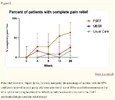
Proportion who were pain free in each group (score of 0 on pain bothersomeness questionnaire)
At the 26-week time point, 7 patients (63.6%) in the PSRT group were classified as being pain free, compared with 3 patients (25.0%) in the MBSR arm and 2 patients (16.7%) in the usual care group. The difference in the proportion of patients who were pain free was not significant between the PSRT and the MBSR arms (P = 0.10) but was significant between the PSRT and the usual care groups (P = 0.04).
1781362543655.webp
 
Of course the people that are instructed to think and behave differently, and were recruited based on their beliefs that doing so will make them better, will report and behave differently after the intervention.

All of the measurement are measuring the adherence to the protocol, not the effect of the protocol.
 
The differences of PSRT to MBSR and usual care seem fairly consistent across outcomes. In the table above for RDQ, the drop in score from week 0 to 4 seems fairly large compared to the other groups.

It looks like the difference between PSRT and the other groups becomes smaller with time. In the table above, the difference from MBSR only barely passes the significance threshold at 26 weeks (p=.04). In figure 2 above, the proportion with total functional recovery peaks and then starts decreasing over time.

Maybe that's evidence that the participants were temporarily running on hope due to how promising the trial is, with the effect slowly diminishing. Or it could be because the PSRT intervention went for 12 weeks, and the last timepoint was at 26 weeks, so maybe there was a real effect of the intervention, but it was wearing off afterwards.

The RDQ primary outcome (in post #3) appears to mostly be questions about changes to daily activities, instead of how the pain feels, so while not immune to bias, maybe it's a little less susceptible.

So just from my quick reading of it, I think it's possible that the participants really felt less pain and were able to improve in their day to day functioning because of the PSRT program, with the effects maybe persisting after the program finished. It doesn't sound extremely unrealistic for a thinking strategy to improve pain in some people.

I think there's also a possibility that if there is an effect, it's not sustainable, and is more like the temporary "adrenaline-rush" feeling in ME/CFS. Or maybe the program somehow led to bias in responses on the questions. For example, maybe the PSRT group felt a bit more pressure to improve from the counselors doing the sessions, even if it was totally subconsciously, as the counselors surely would have liked to see a positive finding.
 
Last edited:
Back
Top Bottom