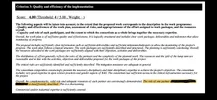
From LinkedIn:
I find it increasingly difficult to understand, and therefore trust, the logic of the European Horizon grant evaluation system.
When an evaluation states repeatedly that the work plan is logical, sufficiently structured, convincing, appropriately resourced, supported by adequate milestones and deliverables, backed by suitable risk-mitigation measures, and implemented by a consortium with the necessary interdisciplinary expertise, infrastructure, open-science competence, and gender expertise, one naturally expects the score to reflect that assessment.
Yet the evaluation receives 4 out of 5. (Similar evaluation for all 3 categories)
Why?
The only concrete shortcoming identified is that “the role of one partner is insufficiently described.” There is no explanation of why this single, relatively specific weakness warrants the loss of an entire point, nor any indication of how it materially compromises the quality or feasibility of the project.
This is precisely where the Horizon evaluation system needs greater transparency and accountability. A numerical score should be traceable to clearly articulated deficiencies. If a proposal loses 20% of the available score for a criterion, applicants deserve to understand exactly what was missing, how serious the deficiency was, and why it justified that deduction. Otherwise, the scoring becomes impossible to learn from, impossible to challenge scientifically, and difficult to distinguish from subjective reviewer preference.
After investing enormous scientific, administrative, and institutional effort into these applications, researchers deserve more than a collection of largely positive statements followed by a score that does not logically follow from them.
There is also a growing perception among researchers that professionally packaged proposals, particularly those prepared with substantial involvement from specialized Horizon consultancy agencies, may have an advantage over proposals written primarily by scientists themselves. Whether or not this perception reflects reality, the fact that it exists should concern the European Commission. Horizon funding should reward the best science, strongest consortium and greatest potential societal impact, not mastery of a specialized grant-writing industry.
I am not arguing that every good proposal must be funded. Competition is extraordinarily high, and difficult choices have to be made. But those choices must be intellectually defensible. When scores determine the fate of years of scientific work and multimillion-euro research programs, “sufficiently convincing” everywhere and one narrowly defined shortcoming cannot simply become 4/5 without a transparent explanation.
Researchers can accept rejection. What is much harder to accept is an evaluation in which the written reasoning and the numerical score appear not to speak the same language.