Single-cell analysis reveals immune remodeling of monocytes, NK cells, T cell exhaustion in Long COVID with ME/CFS, 2026, Elahi et al

John Mac

Senior Member (Voting Rights)
Full title: Single-cell analysis reveals immune remodeling of monocytes, NK cells, T cell exhaustion, and Galectin-9–associated depletion of gamma delta and mucosal-associated invariant T cells in Long COVID with ME/CFS

The cellular mechanisms underlying Long COVID (LC) associated with myalgic encephalomyelitis/chronic fatigue syndrome (ME/CFS) remain poorly understood.

We performed single-cell RNA sequencing (scRNA-seq) on peripheral blood mononuclear cells collected 12 months after acute COVID-19 infection from female individuals with LC-ME/CFS and recovered (R) individuals.

Comparative analysis was also performed using publicly available scRNA-seq datasets from idiopathic ME/CFS patients.

Based on transcriptional signatures, LC-ME/CFS patients exhibited a marked reduction in naïve CD4⁺ and CD8⁺ T cells, regulatory T cells, MAIT cells, and γδ T cells, accompanied by an expansion of effector T cells.

NK cells displayed reduced frequency and altered activation-associated transcriptional factors, consistent with impaired cytotoxic potentials.

B cells in LC patients exhibited gene expression profiles indicative of heightened activation, while plasma cells revealed a distinct transcriptional subset expressing NK-associated genes.

Platelets and low-density neutrophils were expanded and exhibited enrichment of activated-related transcripts.

Monocyte subsets demonstrated transcriptional skewing characterized by reduced expression of phagocytosis-associated genes and increased expression of pro-inflammatory cytokine-related genes/pathways.

In contrast, idiopathic ME/CFS patients exhibited less pronounced immune alterations at the transcriptional level: while T cell activation was evident, there was no reduction in MAIT or NK cells, nor signs of T cell exhaustion.

Notably, FOXP3 expression was upregulated, and B cells and platelets demonstrated dysregulated signatures in idiopathic ME/CFS.

Mechanistically, we identify Galectin-9–TIM-3 interaction as a potential pathway driving γδ and MAIT cell depletion in LC.

Our results reveal extensive peripheral immune remodeling in LC-ME/CFS, distinct from idiopathic ME/CFS, and support a model of chronic immune activation and dysregulation.

Our findings offer a cellular framework for understanding LC pathogenesis and point to potential biomarkers and therapeutic targets for intervention.

 
So there's no mention of how many patients they studied in this abstract.
We performed single-cell RNA sequencing (scRNA-seq) on peripheral blood mononuclear cells collected 12 months after acute COVID-19 infection from female individuals with LC-ME/CFS and recovered (R) individuals.

Comparative analysis was also performed using publicly available scRNA-seq datasets from idiopathic ME/CFS patients.
Is this a valid method of comparison? Comparing fresh blood against a database in this way?

Edit: I really dislike how they use 'idiopathic MECFS' here. Reminds me too much of the BPS 'idiopathic chronic fatigue' grouping/diagnostic dustbin


Based on transcriptional signatures, LC-ME/CFS patients exhibited a marked reduction in naïve CD4⁺ and CD8⁺ T cells, regulatory T cells, MAIT cells, and γδ T cells, accompanied by an expansion of effector T cells.

NK cells displayed reduced frequency and altered activation-associated transcriptional factors, consistent with impaired cytotoxic potentials.

B cells in LC patients exhibited gene expression profiles indicative of heightened activation, while plasma cells revealed a distinct transcriptional subset expressing NK-associated genes.

Platelets and low-density neutrophils were expanded and exhibited enrichment of activated-related transcripts.

Monocyte subsets demonstrated transcriptional skewing characterized by reduced expression of phagocytosis-associated genes and increased expression of pro-inflammatory cytokine-related genes/pathways.

In contrast, idiopathic ME/CFS patients exhibited less pronounced immune alterations at the transcriptional level: while T cell activation was evident, there was no reduction in MAIT or NK cells, nor signs of T cell exhaustion.

Notably, FOXP3 expression was upregulated, and B cells and platelets demonstrated dysregulated signatures in idiopathic ME/CFS.

Mechanistically, we identify Galectin-9–TIM-3 interaction as a potential pathway driving γδ and MAIT cell depletion in LC.
Interesting that they claim to have found these differences. They don't speculate about potential pathways in non LC MECFS, but that probably was outside the scope of their research. I have no idea who this group are and it's hard to judge their findings from this abstract.
 
I knew I'd seen galectin-9 somewhere before!

This lot seem like pretty serious researchers. Interesting that they found dysregulated B cell and platelet signatures and FOXP3 upregulation in vanilla MECFS.
while T cell activation was evident, there was no reduction in MAIT or NK cells, nor signs of T cell exhaustion
What does this actually mean though? the parts about activation and exhaustion are vague.

Also what do they mean by dysregulated B cell signatures, thinking about it? Do they just mean abnormal gene expression or behaviour? That's what the duckduckgo search AI thing tells me but that might be nonsense. Either way vague.

I would be interested to hear others opinions on this abstract (although I guess maybe we need to wait for the paper) and the work of this team in general.
 
@Jonathan Edwards

PS the Andrew German/Maureen Hanson single cell RNA sequencing study also highlighted monocytes, I believe.
Im very interested in the differences they claim to have found between LC and ME/CFS, especially as the LC group seem to have differences in T cells that seemingly go in the opposite direction to what we have speculated about might be happening in MECFS.

Also, what could a role for monocytes in the pathology of MECFS mean?
 
It's hard to tell which parts of this are based on significance testing and which are just saying the direction of effect. For example:
Next, we examined the expression of the top 10 downregulated genes in bulk RNAseq in scRNAseq dataset. Among these, PTPRU, GMPR, WDR62, MUC12, TMEM191B, PLEKHN1, PCDHGC5, and AIRE were detected and found to be broadly distributed across all cell clusters (Figures 4A–H).
We found the downregulation of TMEM191B, PLEKHN1, and PCDHGC5 in LC patients, which is consistent with our bulk RNAseq data. In contrast, the expression of PTPRU, GMPR, WDR62, MUC12, and AIRE were paradoxically upregulated in LC individuals (Figure 4I).

They looked at 10 genes that were significant in a previous study. Of the 8 genes that were also detected here, they reported downregulation and upregulation in all of them. I think it's unlikely that all 8 would again be significant (with 5 out of 8 in the opposite direction), so it seems that this is just saying which group had the higher level. Considering that about half were upregulated and half were downregulated in this study, it seems like it could just be randomness.
 
Is this a valid method of comparison? Comparing fresh blood against a database in this way?
Yeah it’s done sometimes, they just need to be careful about dataset integration and batch correction.

Also what do they mean by dysregulated B cell signatures, thinking about it? Do they just mean abnormal gene expression or behaviour? That's what the duckduckgo search AI thing tells me but that might be nonsense. Either way vague.
It looks like it’s all RNA-seq based. So all results based on only gene expression differences. [Edit: looks like there was one “mechanistic” assay following up on just one of their findings in NK cells.] Groups will sometimes get some samples and churn out several papers using a couple different tools on the same data.

I’d need to know the sample size and all the methodology details before putting any stock in the reported results. I’ve analyzed similar datasets for small LC cohorts before—there was a lot of intra-group variability, and if I used the wrong method for differential gene expression analysis I could’ve gotten significant results just driven by two outliers. The typical methods for plotting RNA-seq results can sometimes hide something like that.
 
Okay, they did batch correction. They claimed to use both DESeq2 and edgeR for differential gene expression, I am not sure why. Either way they didn’t use the default wilcoxon test, which is good.

But the red flag is that I don’t see individual features or scores plotted separately by participant, which is crucial in a small study like this to show that it’s not just a few outliers driving things.
 
Something is really weird with their cell type labeling. They did de-novo clusters, and then manually assigned labels based on marker genes, but looking at the supplemental figures the expression of marker genes was not remotely exclusive to their annotated genes for many of these subsets. According to supplemental figure 1, 25% of their whole dataset should be called a gamma delta T cell. The cluster that ultimately gets called gamma delta T cells is likely a clustering artifact.

They had an antibody for doing flow cytometry to confirm gamma delta T cells, which would have been more trustworthy, but interestingly did not report those results unless I’m missing something
 
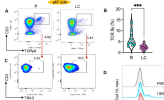
Nope I see it now, all the way down in figure 12. Sorry for the bait and switch @V.R.T.

View attachment 30810

The flow cytometry results seem more robust to me than any of the scRNA-seq analysis
Thanks for digging this up- could you possibly explain these charts like I'm brain foggy? (Because i am!)

I can understand the plot in the top right but thats about it.
 
Thanks for digging this up- could you possibly explain these charts like I'm brain foggy? (Because i am!)

I can understand the plot in the top right but thats about it.
Yep, so flow cytometry is a method where you use fluorescently labeled antibodies that recognize specific surface proteins. The more of a protein a cell has on its surface, the more that antibody will bind. These antibodies are mixed with a sample containing cells, and then the cells shoot through a machine where a “snapshot” is taken that measures the fluorescent intensity for each cell flying past.

Once you have that data for a bunch of different surface proteins, you can use that to determine the identity of the cells in your sample by plotting your fluroscent intensity data in a series of density plots—the plots on the left are basically scatter plots for thousands of cells using two markers at a time that discriminate your cell type of interest.

In the top left plots, they are plotting CD3 (a general marker on all T cells) and TCRgd (a specific marker for gamma delta T cells). Gamma delta T cells would be the clump of cells with high levels of CD3 (relative to other cell types like monocytes) plus high levels of TCRgd. Draw a box around the CD3+TCRgd+ positive clump, and the software will tell you what proportion of all your cells fall into that box (which is whats being shown in the violin plot).

Drawing the box is subjective, which is why it’s best practice to plot the data for all your samples together and draw the box only once, then separate numbers by sample after labels have already been applied. From what I can tell it looks like it was done right here. The Dara pilot did something similar with CD16 and CD56 to measure NK cells, but a concern was that the boxes weren’t drawn all together.
 
Papers will include representative density plots like 12A as proof that they’ve reasonably drawn their boxes. I should also clarify that multiple antibodies are added at the same time, each with a different color, so you can measure everything at the same time for one cell. People have made entire careers becoming a master in this method
 
Back
Top Bottom