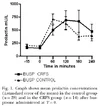
Serotonergic responsivity in obsessive-compulsive disorder. Comparison of patients and healthy controls (Zohar et al., 1987)
[Based on quick skim] OCD patients and healthy controls did not have significantly different prolactin responses to m-CPP (0.5 mg/kg, orally).
Serotonin Function in Obsessive-Compulsive Disorder: A Comparison of the Effects of Tryptophan and m-Chlorophenylpiperazine in Patients and Healthy Subjects (Charney et al., 1988)
[Based on quick skim]
Baseline prolactin significantly reduced in female OCD patients compared to female healthy controls, but no difference for male participants.
Prolactin response to m-CPP (0.1 mg/kg, i.v.) was significantly smaller in OCD patients for females, but not males.
Prolactin response to tryptophan (7 g, orally) was slightly greater in OCD patients.
Serotonergic Responsivity in Obsessive-Compulsive Disorder: Effects of Chronic Clomipramine Treatment (Zohar et al., 1988)
[Based on quick skim] In OCD patients, several months (mean: 4.5 months) of clompiramine treatment did not significantly alter prolactin response to m-CPP (0.5 mg/kg).
Prolactin and Cortisol Responses to MK-212, a Serotonin Agonist, in Obsessive-Compulsive Disorder (Bastani, 1990)
[Based on quick skim] OCD patients had significantly smaller increase of prolactin than healthy controls following administration of MK-212 (20 mg, orally), a 5-HT agonist.
Effects of chronic fluoxetine treatment on behavioral and neuroendocrine responses to meta-chloro-phenylpiperazine in obsessive-compulsive disorder (Hollander et al., 1991)
[Based on quick skim] In OCD patients, prolactin response to m-CPP (0.5 mg/kg, orally), when tested before 12 weeks of fluoxetine treatment, may have been slightly blunted when compared to healthy controls. The prolactin response to m-CPP may have been slightly exaggerated after fluoxetine treatment.
Metergoline blocks the behavioral and neuroendocrine effects of orally administered m-chlorophenylpiperazine in patients with obsessive-compulsive disorder (Pigott et al., 1991)
[Based on quick skim] This study did not include healthy controls. In OCD patients, the m-CPP-induced rise in prolactin and anxiety was blocked by pre-treatment with metergoline.
Fenfluramine stimulation of prolactin in obsessive-compulsive disorder (Hewlett et al., 1992)
[Based on quick skim] OCD patients had significantly smaller prolactin response to DL-fenfluramine (60 mg, orally) when compared to healthy controls. The difference was primarily present in female participants.
Serotonergic Function in Obsessive-Compulsive Disorder: Behavioral and Neuroendocrine Responses to Oral m-Chlorophenylpiperazine and Fenfluramine in Patients and Healthy Volunteers (Hollander et al., 1992)
[Based on quick skim] Compared to healthy controls, OCD patients had blunted prolactin response to m-CPP (0.5 mg/kg, orally), primarily driven by male participants (very few female participants in study).
Prolactin response to DL-fenfluramine (60 mg, orally) did not significantly differ between groups.
Multiple Endocrine Responses to Clonidine in Obsessive Compulsive Dissorder (Khanna et al., 1992)
[Based on quick skim] Prolactin response to clonidine hydrochloride (2 mcg/kg, i.v.) did not significantly differ between OCD and healthy controls.
Buspirone induced prolactin responses in obsessive-compulsive disorder (OCD): Is OCD a 5-HT2 receptor disorder? (Lucey et al., 1992)
[Based on quick skim] OCD patients and healthy controls did not have significantly different prolactin responses to buspirone (30 mg, orally).
[Obsessive-compulsive disorder and depression] (López-Ibor Aliño et al., 1995)
[Based only on abstract]
OCD patients without comorbid depression had larger prolactin, growth hormone, and cortisol responses to clomipramine than controls.
Patients with both OCD and depression had blunted response to clomipramine (the abstract does not specify whether all three hormones were blunted)
Neuroendocrine responses to single doses of buspirone in obsessive-compulsive disorder (Norman et al., 1994)
[Based on quick skim] Prolactin response to buspirone (30 mg, orally) did not significantly differ when comparing OCD and healthy controls.
Brain 5-HT function in obsessive-compulsive disorder: Prolactin responses to d-fenfluramine (Fineberg et al., 1997)
[Based on quick skim] OCD patients had a significantly larger increase of prolactin than healthy controls after administration of d-fenfluramine (30 mg, orally).
Fenfluramine challenge test in obsessive-compulsive disorder—First results (Pidrman & Tůma, 1997)
[Based only on abstract] Comparing prolactin response to fenfluramine in OCD patients before and after 6 weeks of serotonergic antidepressant therapy (no healthy controls), OCD patients had decrease of prolactin 1 hour after fenfluramine before therapy, but not after therapy.
Neuroendocrine and behavioral responses to mCPP in Obsessive–Compulsive Disorder (Khanna, 2001)
[Based on quick skim] OCD patients had significantly blunted prolactin response to m-CPP (0.5 mg/kg, orally) when compared to healthy controls.
Neuroendocrine predictors of response to intravenous clomipramine therapy for refractory obsessive-compulsive disorder (Mathew et al., 2001)
[Based on quick skim]
This study tested prolactin response to clomipramine in OCD patients both before and after 14 days of clomipramine treatment. Responders and non-responders to the treatment were compared.
Before treatment, those who would go on to respond had a blunted prolactin response to clompiramine (25 mg, i.v.).
After treatment, using a larger dose of clomipramine (250 mg, i.v.), the responders still had a blunted prolactin response compared to non-responders.
Acute hormonal changes after IV citalopram and treatment response in OCD (Corregiari et al., 2007)
[Based on quick skim] OCD patients had blunted prolactin response to citalopram (20 mg, i.v.) when compared to healthy controls.
Hypersensitivity of 5-HT2 receptors in OCD patients (De Leeuw & Westenberg, 2008)
[Based on quick skim] OCD patients had increased prolactin response to m-CPP when compared to healthy controls.