Protocol Trial registration: Low-dose Naltrexone for Post-COVID Fatigue Syndrome, 2022, Luis Nacul, British Columbia Women's Hospital & Health Centre

Our local off-label doc recommends the following schedule:

1.5 mg for 2 weeks
3.0 mg for 6 weeks
4.5 mg from then
Try 6.0 mg if you want

Evaluate after 2-3 months, but ideally after 6 months.

Side effects are claimed to be minimal and temporary. No lasting negative effects.
 
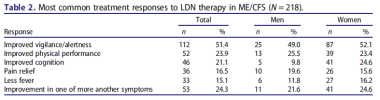
This is from Polo et al. 2019 - a retrospective analysis of ME/CFS patients attending a private clinic in Finland who took LDN and were followed up after an average 1.7 years. Thread here.

Based on Polo's results, fatigue* is the measure you would expect to improve in an RCT, and you would not expect pain to show improvement. To be honest, the change in pain looks to me like less than you might expect from placebo.

*Taking fatigue as the closest to "improved vigilance/alertness".

Of those able to continue with LDN:

1778318745886.png

The results section of Polo et al. divided into sentences for easier reading:
About half of the patients experienced a response with respect to at least two different ME/CFS symptoms. In responders, the extent of the response averaged 2.06 symptoms (men 2.19, women 2.03 symptoms).

18.3% of the sample did not report any response to LDN. 13.8% discontinued LDN for lack of effectiveness after an average of 5.9 months of use.

4.6% were unable to gain benefit because adverse symptoms forced them to discontinue the treatment during the introductory phase before the treatment response could be assessed (after an average of 1 month [1–57 days] of use).

Nearly half of the group (45.8%) did not experience any adverse symptoms from LDN treatment. The other 54.2% reported adverse symptoms, which weremostly mild and temporary. The adverse symptoms occurred only at the beginning of the therapy, or after dose increases. Typically, adverse symptoms were present for only a few days or a few weeks. In the worst cases, the adverse symptoms did not disappear until 1–2 months on treatment. Only one patient reported adverse symptoms during long-term treatment but preferred to stay on LDN in spite of mild nausea.

Serious adverse effects (SAEs) were not reported, although 7.3% of the patients discontinued treatment because of adverse symptoms. The most common reason for discontinuation was nausea (5 patients, 2.5%). Increased anxiety was the reason for early termination in two patients (1.0%).
 
There was some titration of dose, albeit rapid, and then, for most of the study period, people were free to choose the dosage that suited them in the range that most people taking LDN use:

I think this suggests that people were able to take the dose they were able for throughout:
Participants will be able to adjust treatment doses by reverting to the previous well-tolerated dose if they experience persistent but minor side effects following any increase in dose. If a participant has reverted to a previous dose, that dosage will be maintained for the remainder of the study period.

It will be interesting to see what doses people were actually able for.
 
Back
Top Bottom