Capture of the greens was a win for the biopsychosocial lotAction for ME state it wasn't them who briefed Sian Berry on this Commons Question:
Sian Berry MP: ...... ''To ask the Secretary of State for Health and Social Care, if he will hold discussions with the British Association of Clinicians in ME/CFS [BACME] on the geographical availability of regional specialist services for ME/CFS; and if he will undertake a mapping exercise to list the areas that (a) are and (b) are not covered."
20th October 2025.
Action for ME (AFME) on their Facebook, 4/5 December:
"due to taking on her role as Patron of the Sussex ME/CFS Society, Sian unfortunately had to step away from our Parliamentary Champions network and as such, no, we were not involved in briefing Sian for this question. Thanks,"
.

You are using an out of date browser. It may not display this or other websites correctly.
You should upgrade or use an alternative browser.
You should upgrade or use an alternative browser.
UK House of Lords/ House of Commons - relevant people and questions
- Thread starter Sly Saint
- Start date

Tao Fogger
Senior Member (Voting Rights)
There was a debate in the Senedd (Welsh parliament) yesterday.
The full debate can be seen here : https://www.theyworkforyou.com/senedd/?id=2025-12-10.6.733123.h
(Translated)
Elin Jones Plaid Cymru
Item 5 is next, the Member debate. Today's debate is to be led by Adam Price, on ME. Adam Price to move the motion.
(Translated)
- Link to this speechIn context Individually
- Tweet Share
- Record source
Motion NDM8884 Adam Price
Supported by Altaf Hussain, Cefin Campbell, Heledd Fychan, Jane Dodds, Joel James, John Griffiths, Julie Morgan, Llyr Gruffydd, Luke Fletcher, Mabon ap Gwynfor, Mark Isherwood, Mike Hedges, Rhun ap Iorwerth, Rhys ab Owen, Siân Gwenllian, Sioned Williams
To propose that the Senedd:
1. Notes that myalgic encephalomyelitis (ME) is a chronic and disabling illness at all levels of severity.
2. Notes that, of those suffering from ME, 25 per cent are categorised by NICE as 'severe: mainly bed bound or housebound', and 'very severe: fully bedbound', requiring full-time care and, in the severest cases, palliative care and tube feeding.
3. Regrets that it is often those with the greatest severity levels of ME who are provided with the least amount of appropriate care and treatment.
4. Calls on the Welsh Government to:
a) respond to the concerns raised in the Coroner in England’s Prevention of Future Deaths Report, and explain what practical steps they will take to ensure that no patient in Wales will ever be placed in such tragic circumstances as those described in the report;
b) ensure that the Adferiad-funded ME services are making provision appropriate to the needs of patients with severe and very severe ME;
c) bring together an expert group of health professionals and people with lived experience, at a national level, to develop all-Wales guidance and quality standards on ME, including for the most severely affected;
d) make the appointment of an all-Wales specialist consultant for post-infectious chronic conditions—including ME and long COVID—a priority;
e) improve the training on ME for professionals, firstly in the NHS, but also in social services and schools: in particular, raising awareness of the care needs of adults and children with severe and very severe ME; and
f) ensure that health boards truly co-produce their ME and long COVID Adferiad services, taking into account the lived experiences of those suffering at the severest levels and of those caring for them.
The full debate can be seen here : https://www.theyworkforyou.com/senedd/?id=2025-12-10.6.733123.h
Tao Fogger
Senior Member (Voting Rights)
 Martin Wrigley Liberal Democrat, Newton Abbot
To ask the Secretary of State for Health and Social Care, what steps he is taking to support patients with overlapping conditions such as Myalgic Encephalomyelitis (ME), Long Covid, Ehlers-Danlos Syndrome (EDS) and Hypermobility Spectrum Disorder, Postural Tachycardia Syndrome (PoTS), and Mast Cell Activation Syndrome (MCAS).- Tweet Share
- Hansard source(Citation: HC Deb, 11 December 2025, cW)
 Ashley Dalton The Parliamentary Under-Secretary for Health and Social Care
The Department recognises the complex needs of people living with overlapping conditions such as myalgic encephalomyelitis/chronic fatigue syndrome (ME/CFS), long COVID, Ehlers-Danlos syndrome, hypermobility spectrum disorders, postural tachycardia syndrome, and mast cell activation syndrome. Our approach focuses on improving care coordination and access to appropriate services.For ME/CFS, we have published a cross-government final delivery plan, which sets out actions to boost research, improve professional education, and enhance support for daily living, including community-based services and better benefit assessments. While the plan is specific to ME/CFS, it acknowledges overlaps with other complex, multi-system disorders and commits to exploring synergies during implementation.
Additionally, the 10-Year Health Plan aims to transform services and outcomes for people living with complex conditions by prioritising integrated, personalised care. The plan focuses on earlier diagnosis and promotes multidisciplinary teams and community-based services to deliver coordinated support closer to home, reducing reliance on hospital care. Digital innovations, including remote monitoring and personalised care planning, will help manage long-term conditions more effectively. The Plan also commits to 95% of people with complex needs to have a personalised care plan by 2027. Personalised care plans will improve support for people with complex needs by ensuring that care is tailored to the individual and coordinated across services.
In addition, research funded by the National Institute for Health and Care Research into post-viral syndromes and autonomic disorders will help improve understanding autonomic dysfunction and overlapping conditions, accelerate innovation and deliver evidence-based care for patients with complex, multi-system health needs.
The Plan also commits to 95% of people with complex needs to have a personalised care plan by 2027.
In the next 12 months then? Tick tock! It would take longer than that to identify all the people with complex needs, let alone write each them of a 'personalised care plan', even if they started now.
Robert 1973
Senior Member (Voting Rights)
Is there anyone on here who is in Sian Berry’s Brighton constituency who could contact her and maybe ask to meet her to explain the issues?Action for ME state it wasn't them who briefed Sian Berry for this Commons Question:
Sian Berry MP: ...... ''To ask the Secretary of State for Health and Social Care, if he will hold discussions with the British Association of Clinicians in ME/CFS [BACME] on the geographical availability of regional specialist services for ME/CFS; and if he will undertake a mapping exercise to list the areas that (a) are and (b) are not covered."
20th October 2025.
Action for ME (AFME) on their Facebook, 4/5 December:
"due to taking on her role as Patron of the Sussex ME/CFS Society, Sian unfortunately had to step away from our Parliamentary Champions network and as such, no, we were not involved in briefing Sian for this question. Thanks,"
.
To ask the Secretary of State for Health and Social Care, what steps his Department is taking to improve access to ME/CFS support in Ashfield.
Lee Anderson Reform UK, Ashfield
- Tweet Share
- Hansard source(Citation: HC Deb, 2 December 2025, cW)
Residents of Ashfield with myalgic encephalomyelitis, also known as chronic fatigue syndrome (ME/CFS), are supported primarily through the Community Pain Management Service (CPMS), commissioned by the NHS Nottingham and Nottinghamshire Integrated Care Board for the mid Nottinghamshire area, which covers Mansfield and Ashfield and Newark and Sherwood.
The CPMS delivers a multi-disciplinary, community-based service for adults, those aged 16 years old and over, with chronic pain and/or ME/CFS. The service is designed to be accessible, equitable, and holistic, supporting both physical and psychological needs.
Ashfield residents can access the service at several local clinics, including Ashfield Health and Wellbeing Centre in Sutton-in-Ashfield, as well as other sites across mid Nottinghamshire, including Mansfield Community Hospital and Oak Tree Health Centre.
Referrals are accepted from general practitioners, musculoskeletal services, and hospital consultants. The service acts as a single point of access, ensuring streamlined and timely triage and assessment.
So, residents of Ashfield, (wherever that is), who have ME will be directed to the pain management team.
We know how useful the NICE guideline on chronic pain was: exercise, acupuncture and cutting down on pain meds.

While the responses in the UK parliament (and some of the questions too) indicate a lack of understanding of the issue, the motion posed in the Welsh Senedd looked spot on. I think those words, with the addition of a research funding ask, would be a good start when people are defining what they want from government.There was a debate in the Senedd (Welsh parliament) yesterday.
Well done to the advocates behind that and the parliamentary representatives who supported it.
If anyone can comment on how the motion was received, I'd be interested to hear about it.
Tao Fogger
Senior Member (Voting Rights)
 Dan Carden Labour, Liverpool Walton
To ask the Secretary of State for Health and Social Care, whether his Department plans to increase funding for research into Myalgic Encephalomyelitis/Chronic Fatigue Syndrome.- Tweet Share
- Hansard source(Citation: HC Deb, 17 December 2025, cW)
 Zubir Ahmed The Parliamentary Under-Secretary for Health and Social Care
As set out in the final delivery plan, the Department has taken actions to strengthen research capacity and capability in relation to myalgic encephalomyelitis, also known as chronic fatigue syndrome (ME/CFS). The level of research funding is determined by the quantity and quality of proposals that are recommended for support through the competitive process through the National Institute for Health and Care Research (NIHR) funding committees.The actions announced in the final delivery plan include a research showcase event, a new funding opportunity for a development award focussed on evaluating repurposed pharmaceutical interventions, and the announcement of new funded studies in health and care services, research infrastructure, and capacity-building.
We are determined to accelerate progress in the treatment and management of ME/CFS and will continue working with the ME/CFS community to identify and address barriers to research. The NIHR welcomes funding applications for research into any aspect of human health and care, including ME/CFS. Research funding is available, and applications are subject to peer review and judged in open competition, with awards made on the basis of the importance of the topic to patients and health and care services, value for money, and scientific quality.
Tao Fogger
Senior Member (Voting Rights)
 Wendy Chamberlain Liberal Democrat Chief Whip
To ask the Secretary of State for Science, Innovation and Technology, what steps she is taking to support collaboration between Government-funded bodies and private-sector researchers following the identification on 4 December 2025 of multiple biological pathways implicated in ME by the LOCOME study.- Tweet Share
- Hansard source(Citation: HC Deb, 17 December 2025, cW)
 Kanishka Narayan Parliamentary Under Secretary of State (Department for Science, Innovation and Technology)
The LOCOME study, led by Precision life, was funded by Innovate UK through the Advancing Precision Medicine programme. Reporting more than 250 core genes associated with ME, including 76 shared with long COVID, and dozens of drug repurposing opportunities, these findings have important implications for future ME and long COVID research, diagnosis and treatment development. UK Research and Innovation (UKRI) actively fosters collaboration with the private sector by combining the expertise of Innovate UK, which is fully business-focused, with the knowledge exchange expertise of Research England, and disciplinary expertise of their research councils. Innovate UK is well-positioned to collaborate with private-sector researchers on the findings of the LOCOME study.
Tao Fogger
Senior Member (Voting Rights)
 Alison Hume Labour, Scarborough and Whitby
To ask the Secretary of State for Health and Social Care, what steps his Department is taking to ensure that public research investment into health conditions like Myalgic Encephalomyelitis keep pace with recent private sector advances, including the publication on 4 December 2025 by Precision Life of their identification of core genes and 7,555 associated genetic variants linked to the disease.- Tweet Share
- Hansard source(Citation: HC Deb, 5 January 2026, cW)
Alison Hume Labour, Scarborough and Whitby
To ask the Secretary of State for Health and Social Care, whether his Department intends to incorporate recent developments on ME genetics and biological mechanisms, such as the findings of the LOCOME project, into NIHR research priorities.- Tweet Share
- Hansard source(Citation: HC Deb, 5 January 2026, cW)
Zubir Ahmed The Parliamentary Under-Secretary for Health and Social Care
The Department funds research on health and social care through the National Institute for Health and Care Research (NIHR). The NIHR and the Medical Research Council (MRC), part of UK Research and Innovation, are committed to funding high-quality research to understand the causes, consequences, and treatment for post-acute infection conditions such as myalgic encephalomyelitis, also known as chronic fatigue syndrome (ME/CFS), and long COVID.On 6 November, the NIHR and the MRC hosted a showcase event for post-acute infection conditions. This brought together people with lived experience, researchers, clinicians, and funders to help stimulate further research in this field. This included representatives from Precision Life and the LOCOME study, as well as the DecodeME study, which is co-funded by the NIHR and the MRC. Emerging evidence from projects such as LOCOME and DecodeME will be reviewed to ensure future research reflects both scientific progress and patient needs.
The NIHR welcomes funding applications for research into any aspect of human health and care, including ME/CFS and long COVID. Research funding is available, and applications are subject to peer review and judged in open competition, with awards made on the basis of the importance of the topic to patients and health and care services, value for money and scientific quality.
Tao Fogger
Senior Member (Voting Rights)
 Max Wilkinson Liberal Democrat Spokesperson (Home Affairs)
To ask the Secretary of State for Health and Social Care, whether his Department has considered guarantees on specialist care provision for Myalgic Encephalomyelitis (ME), Chronic Fatigue Syndrome (CFS) and very severe ME.- Tweet Share
- Hansard source(Citation: HC Deb, 5 January 2026, cW)
Ashley Dalton The Parliamentary Under-Secretary for Health and Social Care
The commissioning of myalgic encephalomyelitis, also known as chronic fatigue syndrome (ME/CFS), services is the responsibility of local integrated care boards, based on the needs of their local population.The final delivery plan on ME/CFS, which we published in July, includes an action for the Department and NHS England to explore whether a specialised service should be prescribed by my Rt Hon. Friend, the Secretary of State for Health and Social Care, for very severe ME/CFS. Officials from the Department have commenced discussions with NHS England on how best to take forward this action.
Tao Fogger
Senior Member (Voting Rights)
 Jo Platt Labour/Co-operative, Leigh and Atherton
To ask the Secretary of State for Health and Social Care, what plans his Department has to ensure that the needs of patients with severe and very severe Myalgic Encephalomyelitis are fully addressed within future NHS service provision.- Tweet Share
- Hansard source(Citation: HC Deb, 5 January 2026, cW)
Ashley Dalton The Parliamentary Under-Secretary for Health and Social Care
Most of the actions included in the final delivery plan on myalgic encephalomyelitis, also known as chronic fatigue syndrome (ME/CFS), which we published in July, will benefit all patients with ME/CFS, irrespective of condition severity. However, we are taking specific steps to ensure that patients with severe and very severe ME/CFS are not overlooked. For instance, the ME/CFS final delivery plan includes an action for the Department and NHS England to explore whether a specialised service should be prescribed by my Rt Hon. Friend, the Secretary of State for Health and Social Care, for very severe ME/CFS. Officials from the Department have commenced discussions with NHS England on how best to take forward this action.To support healthcare professionals in the diagnosis and management of ME/CFS, the Department has worked with NHS England to develop an e-learning programme on ME/CFS for healthcare professionals, with the aim of supporting staff to be able to provide better care and improve patient outcomes. All three sessions of the e-learning programme are now available at the following link:
https://learninghub.nhs.uk/catalogue/mecfselearning?nodeId=7288
The 10-Year Health Plan for the National Health Service also sets out a plan to shift healthcare from hospitals to the community, enabling people to feel supported managing their long-term conditions, including ME/CFS, closer to home. The Neighbourhood Health Service, delivered by new multidisciplinary teams of professionals, will support more services being delivered in the community, helping to create capacity within secondary services for those patients that need it. This will aim to help ensure that those who suffer from ME/CFS are able to live as independently as possible.
The 10-Year Health Plan for the National Health Service also sets out a plan to shift healthcare from hospitals to the community, enabling people to feel supported managing their long-term conditions, including ME/CFS, closer to home.
Talk of 'feelings' where there should be facts is always such a big red flag.

Binkie4
Senior Member (Voting Rights)
I'm not sure of Parliamentary protocols but it seems that questions about ME, both severe and non severe, are being placed almost weekly. I am glad of the exposure this brings and that members of the Government are being required to deliver an answer, mostly out of nothing actually being done, to satisfy the process. Surely it must become obvious to even the most ardent supporters of the status quo that this is a totally unsatisfactory state of affairs.
The MRC/ NIHR meeting of 6th Nov was referred to in an answer in post #990. I look forward to hearing what this " showcase event " actually achieved in terms of " stimulating further research". It's all hot air but please MPs, keep the questions coming.
The MRC/ NIHR meeting of 6th Nov was referred to in an answer in post #990. I look forward to hearing what this " showcase event " actually achieved in terms of " stimulating further research". It's all hot air but please MPs, keep the questions coming.

NelliePledge
Senior Member (Voting Rights)
Likely quite a bit of this is down to the APPGI'm not sure of Parliamentary protocols but it seems that questions about ME, both severe and non severe, are being placed almost weekly. I am glad of the exposure this brings and that members of the Government are being required to deliver an answer, mostly out of nothing actually being done, to satisfy the process. Surely it must become obvious to even the most ardent supporters of the status quo that this is a totally unsatisfactory state of affairs.
The MRC/ NIHR meeting of 6th Nov was referred to in an answer in post #990. I look forward to hearing what this " showcase event " actually achieved in terms of " stimulating further research". It's all hot air but please MPs, keep the questions coming.

Yep. Just psych-washing.Talk of 'feelings' where there should be facts is always such a big red flag.

hotblack
Senior Member (Voting Rights)
It certainly feels like there are more mentions, which seems good for awareness. How much understanding there is behind that and how much impact it will have we can’t be sure of course. But it feels positive to me. This is how politics and lobbying works.I'm not sure of Parliamentary protocols but it seems that questions about ME, both severe and non severe, are being placed almost weekly.
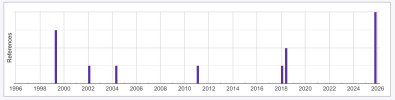
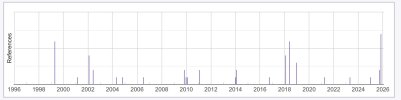
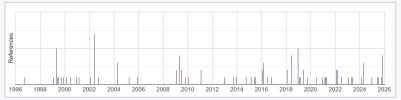
I tried to look for data on Hansard (there’s search tools which show how often terms come up) but it’s difficult given in the changing terms used and searching for ‘me’ isn’t going to get you very far but…. the data doesn’t show a significant increase over the last 30 years although there are some peaks recently. That said there have been previous peaks too, presumably around specific debates or lobbying efforts.
Severe ME/CFS (13 mentions)
ME/CFS (51 mentions) (CFS alone turned up the same results)
Chronic Fatigue Syndrome (96 results)
Myalgic Encephalomyelitis (95 results)
I searched Commons dats not Lords mentions. Also note “Hansard content from 2004 to 2006 is currently unavailable on this website”.
I have doubts that raising parliamentary questions and getting copy and paste answers is sufficient to drive any reasonable progress? Essentially we have had the door shut in our face and adopted the counter policy of asking nicely can we be let it as they repeatedly shout no.
There’s no change of tactics or progression of wider actions from the charities to apply pressure, the new year has started in an uninspiring way. It’s cruising and let time slip through the hourglass mode, as ever.
Afme stated they were in implementation mode vs challenging & the APPG, led by Action for ME, didn’t back the The Liberal Democrat’s DHSC delivery plan challenge. Sonya Chowdhury putting out an opinion piece to LBC , marking 2025 out as the starting point with enough “proof“ & saying that (at last) they were calling for a strategy, doesn’t bring us any closer to actually getting one or excuse the 20 years gap, from the 2002 chief medical officers report, they Let the Medical research council hand out small gestures instead.
If there’s additional activity behind the scenes, the communication of them is absent.
There’s no change of tactics or progression of wider actions from the charities to apply pressure, the new year has started in an uninspiring way. It’s cruising and let time slip through the hourglass mode, as ever.
Afme stated they were in implementation mode vs challenging & the APPG, led by Action for ME, didn’t back the The Liberal Democrat’s DHSC delivery plan challenge. Sonya Chowdhury putting out an opinion piece to LBC , marking 2025 out as the starting point with enough “proof“ & saying that (at last) they were calling for a strategy, doesn’t bring us any closer to actually getting one or excuse the 20 years gap, from the 2002 chief medical officers report, they Let the Medical research council hand out small gestures instead.
If there’s additional activity behind the scenes, the communication of them is absent.
BrightCandle
Senior Member (Voting Rights)
There doesn't seem to be any accountability that the answers are basically waffle repetition of the same position and they have done nothing to actually fix the problems that ME/CFS patients face. Its simply not enough to just pass the buck back to the NHS, it will do what it always does and do CBT + physiotherapy rehab or nothing because it can't find any consultants with the skills.
I don't think anyone is getting anywhere with everyone playing naive like this isn't a giant scandal of patient abuse stretching back decades.
I don't think anyone is getting anywhere with everyone playing naive like this isn't a giant scandal of patient abuse stretching back decades.
It would be slightly better if MPs asked specific questions based on facts instead of these open-ended questions about "what is the government doing to support...", which invite and enable the ministers to give meaningless waffle answers.
For example, the meaningless waffle of "The commissioning of myalgic encephalomyelitis, also known as chronic fatigue syndrome (ME/CFS), services is the responsibility of local integrated care boards, based on the needs of their local population" wouldn't be trotted out so easily if the question was posed as "What is the government doing to ensure the provision of services in areas where local integrated care boards have refused to provide them?"
For example, the meaningless waffle of "The commissioning of myalgic encephalomyelitis, also known as chronic fatigue syndrome (ME/CFS), services is the responsibility of local integrated care boards, based on the needs of their local population" wouldn't be trotted out so easily if the question was posed as "What is the government doing to ensure the provision of services in areas where local integrated care boards have refused to provide them?"