USA: News from the Bateman Horne Center

"Coffee" with a Clinician, from Bateman Horne Center:

Topic: Orthostatic Intolerance & Dysautonomia, Part 1

Wednesday, September 9th at 10 am MDT (9 am PT / 11 am CT / 12 pm ET)

The goals of this session are to share:

- An understanding of the signs and symptoms of orthostatic intolerance (OI) and dysautonomia.
- An overview of how OI and dysautonomia are assessed and diagnosed, including common in-office testing methods.
Coffee with a Clinician is free to attend, with an optional $5 donation to support BHC’s education and outreach programs.

Advance registration required - Registration link
(registration link shows time in your time zone)
 
From Facebook

Over the past year, Bateman Horne Center has been quietly doing a great deal of work to strengthen our clinical team, deepen our research partnerships, and build toward reaching more people who need this kind of care.

Today, we get to share one of the most meaningful parts of that work. We are delighted to welcome Douglas Jones, MD, as our new Medical Director. Dr. Jones is a board-certified allergist and immunologist who has spent more than fifteen years treating patients with complex, often underdiagnosed chronic conditions, and his expertise adds real depth to the clinical leadership shaping BHC's future.

The people living with ME/CFS, Long COVID, fibromyalgia, and other complex chronic conditions, along with the caregivers and clinicians who walk alongside them, remain at the heart of why this work exists, today and as we grow.

Read the full story on our blog, including the official press release: https://batemanhornecenter.org/introducing_bhcs_new_medical_director/
 
Last edited by a moderator:
"Coffee" with a Clinician, from Bateman Horne Center:

Topic: Chapter 6 – Cognitive Impairment
[Note: Updated with the correct topic]

Wednesday, October 14th at 10 am MDT (9 am PT / 11 am CT / 12 pm ET)
The goals of this session are to share:

- How cognitive impairment is assessed: This includes identifying common symptoms and cognitive fluctuations, using assessment tools, and understanding factors that may contribute to cognitive difficulties.
- How cognitive impairment can be managed: This includes implementing pacing and energy conservation, working with environmental adaptations, and developing strategies to address underlying physiological factors and support daily cognitive function.
Coffee with a Clinician is free to attend, with an optional $5 donation to support BHC’s education and outreach programs.
Advance registration required - Registration link
(registration link shows time in your time zone)
 
Last edited:
New blog post from Bateman Horne Center:

When the Seasons Change: Seasonal Transition as an Exertional Stressor

For people living with ME/CFS, and for those with Long COVID or other conditions who experience post-exertional malaise (PEM), a change in seasons may bring more than a change in the weather.

As the seasons shift, some people notice changes in their symptoms including increased fatigue, heaviness, pain, orthostatic symptoms, headaches, sensory sensitivity, sleep disruption, cognitive difficulty, or a decrease in their overall functional capacity.

The term “October Slide” is used by many people with chronic conditions to describe a worsening of symptoms during the autumn season. But rather than focusing on one month, I find it helpful to consider the broader concept of seasonal transitions as potential exertional stressors.

Seasonal transitions happen throughout the year, and depending on where someone lives, each transition may bring a different combination of environmental and daily-life changes.​
The Sick Times recently did an article talking about seasonal changes. The forum post with that article can be found here:

https://s4me.info/threads/the-sick-...he-long-covid-crisis.36159/page-6#post-731745
 
"When the Seasons Change: Seasonal Transition as an Exertional Stressor"

The Sick Times recently did an article talking about seasonal changes.

There was a theory that bodily pH levels take time to adjust upon weather changes in spring and autumn, and in that time the altered acid/alkaline balance gives infections more leeway. This was also a selling point for apple cider vinegar.
 
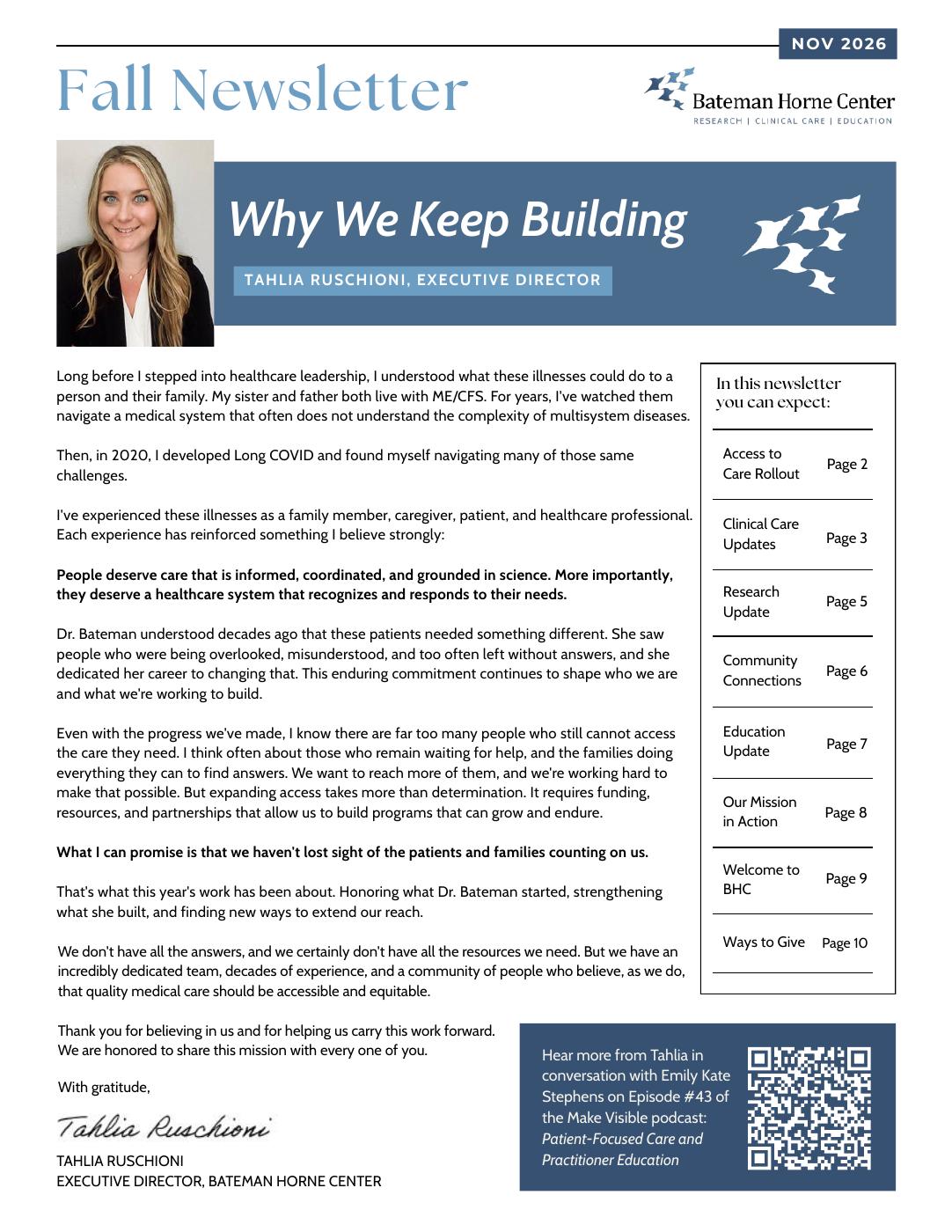
Bateman Horne Center has published a Fall 2026 Newsletter.

PDF format:


Flip-book format:


Text from their email:
At Bateman Horne Center, the people living with complex chronic illness are why we keep building.

Our Fall Newsletter takes you inside that work, from the first steps of our Access to Care pilot to upcoming research that centers people living with severe ME/CFS. We’re also sharing how clinical guidance and lived experiences are reaching the next generation of medical providers.

Inside, you’ll find personal reflections from our leadership, introductions to new team members, and a special honor recognizing Dr. Bateman’s decades of dedication.

Thank you for being part of this community and helping move this work forward. We invite you to see what’s underway, and what’s ahead.
 
From Facebook

BHC’s work extends beyond our clinic. We’re bringing our expertise to more clinicians, and Dr. Lucinda Bateman’s newly released, co-authored CME activity on Medscape is another step in that work.

Released October 15, this ME/CFS education opportunity is one more way we’re working for our community.

Explore the activity and share it with a healthcare professional: https://www.medscape.org/viewarticl...-cfs-optimizing-outcomes-context-2026a1000zyj
 
Last edited by a moderator:
From Facebook

Join us in celebrating Lucinda Bateman, MD!

BHC’s founder and Chief Medical Officer is receiving the Governor’s Career Humanitarian Leadership Award at Utah Philanthropy Day on November 12, recognizing her lifelong commitment to serving others.

For decades, Dr. Bateman has worked to ensure people living with ME/CFS and related illnesses are seen, heard, and supported through clinical care, research, and education.

Learn more: https://utahphilanthropyday.org/honorees\

Help us congratulate Dr. Bateman in the comments!
 
Back
Top Bottom