Associations between salivary HHV-6 and long COVID severity in a cross-sectional, case–control analysis, 2026, Laxton et al

SNT Gatchaman

Senior Member (Voting Rights)
Staff member
Link to post with final paper abstract - post #13

Preprint

Analysis Of Salivary Herpesviruses Reveals Associations Between HHV-6 And Long COVID Severity
Claire S Laxton; Alexandra Tabachnikova; Lily Cooke; Kexin Wang; Simone Blaser; Julio Silva; Jamie Wood; Henna Nam; Zhenni Lu; Christine Miller; Gisele Rodrigues; Victoria Fisher; Christian Guirgis; William B Hooper; Alexandra Lee; Mackenzie Doerstling; Bornali Bhattacharjee; Leying Guan; David Putrino; Akiko Iwasaki

BACKGROUND
Reactivation of human herpesviruses (HHVs), particularly EBV, is associated with more severe acute SARS-CoV-2 infections and the development of Long COVID (LC). Observations of higher anti-EBV antibody levels in individuals with LC support the idea that chronic reactivation of HHVs could contribute to LC pathology. HHV shedding in saliva has also been previously associated with saliva hormone levels. This study aims to examine the relationship between salivary shedding of HHV DNA and LC symptoms, as well as cortisol, testosterone, and estradiol levels.

METHODS
We enrolled 45 participants with LC, and 45 age-sex-matched controls. Surveys and validated health questionnaires were used to collect demographics, medical history, and symptom profiles. Saliva was self-collected at waking, 15, 30, and 45 minutes, and 8 and 16 hours after waking, across two consecutive days. Salivary cortisol, testosterone and estradiol were measured, and extracted nucleic acid was tested for EBV, HSV 1/2, HCMV and HHV-6 A/B using multiplex qPCR, plus SARS-CoV-2 and RNaseP using RT-qPCR.

FINDINGS
Detection of salivary EBV and HHV-6 DNA was highest early in the morning. There were no significant differences in salivary cortisol, testosterone, or estradiol, or in EBV or HHV-6 shedding between the LC and control groups. However, salivary HHV-6 DNA levels were positively associated with a greater aggregated LC propensity score, as well as anxiety and depression scores.

INTERPRETATION
The observed correlation between salivary HHV-6 shedding and symptom severity suggests HHV-6 may contribute to post-acute disease, though mechanisms remain unclear. While our study did not identify a relationship between salivary EBV shedding and LC, EBV may still play a role at earlier time points in the disease course, or in compartments not sampled here. These findings highlight the potential importance of HHV-6 in LC pathophysiology and underscore the need for longitudinal, multi-compartment studies of herpesvirus reactivation in LC.

Web | DOI | PDF | Preprint: MedRxiv | Open Access
 
Last edited by a moderator:
A hint of hhv-6 being involved in severity in long covid? Given we already have reason to think it might be involved it would probably be wrong to totally exclude this study even though its finding is not a blaring foghorn. Not conclusive on its own but another stone to throw on the pile.

There's some other results in here that could hit statistical signifcance with a bigger sample size - assuming they're real - but they'd still have a moderate effect size.

I;d like to have a saliva based test we could really roll out but this isn't it I don't think.

Good to get another confirmation that cortisol is the same between patients and controls.
 
I experience repeated reactivations of herpes viruses from triggers such as stress, allergies and hormonal changes. I get them on my lips and my mouth bleeds starting Spring time. I also experience viral vestibular sickness that last for months that can be severe. All my lymphocytes (CD4, CD8 are all way below normal) so not surprised my immune system isn't keeping them in check.

They've been hypothesising persistent and relapsing HHV6 and EBV for decades in pwME/CFS.
 
I spent the first half century of my life believing diagnostics were trustworthy and authoritative and final.

The last two decades has seen the slow unraveling of that belief.

The most recent five years, a desolate realization has breezed over me that, diagnostically speaking, we've been had.
 
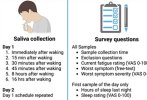
Could someone explain this saliva sample testing image posted by Prof. Akiko Iwasaki regarding the study?
View attachment 32476
Left is when the participants collected saliva samples relative to when they woke up. So they did 6 samples on two separate days with most of them within the first hour.

Right says what kind of info they had to write down when collecting the samples.
 
Really nice to see that Iwasaki together with the group from Mount Sinai has already managed to reproduce Jacqueline Cliff's HHV6 findings from ME/CFS in a Long Covid cohort.

I can't judge this precisely but it looks to me that the Americans have a lot more people and resources for their projects compared to the other herpes leaders in ME/CFS like Cliff, Ariza, and Prusty because it seems that Iwasaki is going at a really good pace.

I already look forward to what they will come up with next to further understand the role of HHV6 in ME. Also, Iwasaki is a chair woman of Roche so as soon as they will have anything substantial the Swiss pharmaceutical company is ready to try to develop blockbuster therapies.

On a personal note I am really looking foward to a cure for this illness and hopefully not spending the rest of my life on high doses of valaciclovir. :)
 
I experience repeated reactivations of herpes viruses from triggers such as stress, allergies and hormonal changes. I get them on my lips and my mouth bleeds starting Spring time. I also experience viral vestibular sickness that last for months that can be severe. All my lymphocytes (CD4, CD8 are all way below normal) so not surprised my immune system isn't keeping them in check.

They've been hypothesising persistent and relapsing HHV6 and EBV for decades in pwME/CFS.
Contrary to what many pwME believe, that herpes is a simple problem and that ME is "complex", herpes are not easy to research and it's only in the past twenty years or so that infectological dogma and research technologies have shifted and advanced respectively so that latent virus reactivation moves back to the center of ME research and begins to deserve the attention and investigation that it should have had for a long time.
 
Weird to me they enrolled ppl on anti-virals for herpes and possibly included them? Maybe I’m reading that flow chart wrong.
I think so too. :)
they stratify into such a small group then compare against mean controls I don’t think there’s enough power to make that correlation.

Weird to me they enrolled ppl on anti-virals for herpes and possibly included them? Maybe I’m reading that flow chart wrong.
This type of studies are called preliminary studies. They are so small because they want to test whether a hypothesis might make sense at all or not. They don't think that they have revolutionized ME research with these results but they now know that it makes sense to design a more elaborate and more expensive study and this study here will help them get these bigger studies funded.
 
Associations between salivary HHV-6 and long COVID severity in a cross-sectional, case–control analysis

Laxton, Claire S.; Tabachnikova, Alexandra; Cooke, Lily; Wang, Kexin; Blaser, Simone; Silva, Julio; Wood, Jamie; Nam, Henna S.; Lu, Zhenni; Miller, Christine; Rodrigues, Gisele; Fisher, Victoria; Guirgis, Christian; Hooper, William B.; Lee, Alexandra; Doerstling, Mackenzie; Bhattacharjee, Bornali; Guan, Leying; Putrino, David; Iwasaki, Akiko

Background
Reactivation of human herpesviruses (HHVs), particularly EBV, is associated with more severe acute SARS-CoV-2 infection and the development of Long COVID (LC). Reactivation of HHVs has been previously implicated in hormonal dysregulation, which has also been observed in LC, suggesting a potential link.

This study aims to examine the relationship between LC symptoms and salivary HHV DNA, cortisol, testosterone, and oestradiol levels.

Methods
Our cross-sectional, case–control study enrolled 45 participants with LC, and 45 age-sex-matched controls. Surveys and validated health questionnaires were used to collect demographics, medical history, and symptom profiles.

Saliva was self-collected at waking, 15, 30, and 45 min, and 8 and 16 h after waking, across two consecutive days. Salivary cortisol, testosterone and oestradiol were measured, and extracted nucleic acid was tested for EBV, HSV 1/2, HCMV and HHV-6 A/B using multiplex qPCR, and for SARS-CoV-2 and RNaseP using RT-qPCR.

Findings
Detection of salivary EBV and HHV-6 DNA copies was highest early in the morning. There were no significant differences in salivary cortisol, testosterone, or oestradiol, or in EBV or HHV-6 DNA between the LC and control groups.

However, salivary HHV-6 DNA levels were positively associated with a greater aggregated LC propensity score (r = 0.24, 95% CI = 0.02–0.44, p = 0.015, adj. p = 0.030), as well as anxiety (β = 0.69, 95% CI = 0.02–1.36, p = 0.045) and depression (β = 0.24, 95% CI = 0.05–0.42, p = 0.013) scores.

Interpretation
The observed correlation between salivary HHV-6 DNA and symptom severity suggests HHV-6 may contribute to post-acute disease, though mechanisms remain unclear.

While we did not identify a relationship between salivary EBV DNA and LC, EBV may still play a role at earlier time points in the disease course, or in compartments not sampled in this study.

These findings highlight the potential importance of HHV-6 in LC pathophysiology and underscore the need for longitudinal, multi-compartment studies of herpesvirus reactivation in LC.

Web | DOI | PDF | eBioMedicine | Open Access
 
Disease characterisation:
Our cross-sectional, case–control study enrolled 45 participants with LC
Disappointing to see this high profile team not characterising the Long Covid sample properly in the abstract. Long Covid could be all sorts of things, so the label does not mean much.

They talk about Long Covid in the paper itself as if it is just one thing too:
An estimated 400 million people have developed Long COVID, a debilitating disease in which symptoms persist after SARS-CoV-2 infection, potentially for years, affecting multiple organ systems.

Post-enrolment, based on the subsequently published 2024 NASEM LC definition,45 the LC case definition was narrowed to having symptoms persisting for >3 months after initial SARS-CoV-2 infection.
Yeah, that is so loose. 'Symptoms persisting for >3 months' - it means the results of this study don't mean much.


Recruitment
Participants were recruited by convenience sampling from the New York City area via social media posts and flyers posted throughout the
Mount Sinai Health System. Participants with LC were also recruited from the Cohen Center for Recovery from Complex Chronic Illness and Center for Post COVID-19 Care at the Icahn School of Medicine at Mount Sinai, including individuals that have previously attended the clinic/centre. If the physician reviewing the patient identified that they met the inclusion/exclusion criteria, with the patient’s permission, they connected patients with the study coordinator for enrolment. Control participants were also recruited via emails to an existing database of individuals who received clinical home monitoring from the Abilities Research Center team during a past acute COVID-19 infection.
In Results, it is clear that they excluded people on anti-viral medication, which was something queried in discussion of the preprint.
 
Last edited:
Long COVID propensity score composition

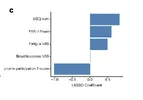
We constructed a LC propensity score (LCPS) using a LASSO logistic regression model from the following 14 survey-based measures: EQ-5D-5L USA-indexed score, FSS-7 mean, PHQ-2 sum, GAD-7 sum, ESS sum, PROMIS Participation T-score, NQ-Cognitive T-score, DSQ-PEM sum, MRC dyspnoea, SQS, GSQ-30 sum, eq5 VAS, Fatigue VAS, Breathlessness VAS.

This score followed the same conceptual framework as reported previously.23 All survey variables were standardised with LC status as the binary outcome.

Predictive performance was evaluated using nested cross-validation, with 10 outer folds for performance estimation and 10 inner folds for model tuning, summarised by AUROC. We then refit the model on the full dataset and selected the final penalty parameter using the one-standard-error rule to favour a parsimonious solution. The surveys with non-zero coefficients in the final model are shown in Supplementary Figure S3C.

For each participant, we then derived the model-based linear predictor as the LCPS, where higher values indicate survey profiles more strongly aligned with LC.

Screenshot 2026-10-28 at 7.21.13 PM.webp
This is Supplementary Figure 3C.
3C. LASSO coefficients of the non-zero contributors to the LCPS model (GSQ Sum= Sum of General Symptom Questionnaire 30, FSS-7 Mean= mean fatigue severity scale score, VAS= visual analogue scale for fatigue and breathlessness, promis participation T-score= Adult PROMIS Ability to Participate in Social Roles and Activities short form.
They got the participants to fill out those 14 surveys. Only the results of 4 surveys were used to produce the LC propensity score. They don't tell us which surveys contributed to the propensity score in the main text, I think, but this is one of the more interesting aspects of the paper.

The General Symptom Questionnaire is, I think, a survey that was developed for Chronic Lyme and adapted for use in Long covid. Notably, the DSQ-PEM isn't included.

Two simple visual analogue scales (for fatigue and breathlessness) are used, although it's hard to see what the breathlessness one is contributing with its LASSO coefficient of zero. Can someone explain that? The PROMIS measure seems to be a measure of function.


Demographic characteristics of the participants
While I'm looking at the Supplementary information:

Reported medication use (last 3 months)
Anti-hypertensives6.7% (3/45)4.4% (2/45)-0.097-2.2
Anti-platelet medication0% (0/45)8.9% (4/45)0.4428.9
Anti-psychotics0% (0/45)0% (0/45)-0
Antibiotics6.7% (3/45)2.2% (1/45)-0.217-4.4
Antivirals4.4% (2/45)6.7% (3/45)0.0972.2
Blood thinners2.2% (1/45)13.3% (6/45)0.42411.1
Coenzyme Q10 or N-Acetyl L-Cysteine4.4% (2/45)51.1% (23/45)1.22146.7
Depression/anxiety treatment13.3% (6/45)40% (18/45)0.63226.7
Diabetes treatment2.2% (1/45)4.4% (2/45)0.1242.2
Steroids (inhaled/nasal)0% (0/45)0% (0/45)-0
NSAIDs33.3% (15/45)33.3% (15/45)00
Nattokinase, serrapeptase or lumbrokinase2.2% (1/45)26.7% (12/45)0.74224.4
Opioids2.2% (1/45)0% (0/45)-0.213-2.2

We are told that people using anti-virals are excluded, so presumably those recorded as using them in the last 3 months stopped for the study. There are some large differences in medication use e.g. blood thinners, CoQ10/NAC, depression/anxiety treatment, nattokinase etc


Hormonal medications22.2% (10/45)22.2% (10/45)00
Hormonal intra-uterine device18.8% (3/16)31.2% (5/16)0.35412.5
Oral combined oestrogen-progestin31.2% (5/16)12.5% (2/16)0-18.8
Oral progestin-only6.2% (1/16)0% (0/16)-0.577-6.2
Other/unspecified6.2% (1/16)18.8% (3/16)0.57712.5

Of particular interest is the major differences in hormonal medications. That these differences were allowed seems incredible in a study looking at differences in hormones between the healthy cohort and the LC cohort.


DemographicsControlLong COVIDSMDΔ
Age, median (IQR)36 ± 1237 ± 130.3660.53
BMI, median (IQR)25 ± 6.423.5 ± 8.1-0.071-0.66

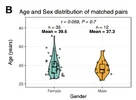
I also want to note the difference in age. The mean doesn't look different in any important way. But the SMD is Standard Mean Difference suggests there is a difference, and the description of the statistic given for the figure makes it sound as though it is 'indicative of a meaningful imbalance'.
SMD= Standardized mean difference between groups (mean difference / pooled SD of the matched pair differences for continuous variables; difference in proportions / pooled binomial SD for categorical variables, reported per category). SMD ≥0.20 is indicative of meaningful imbalance and is shown in bold.
Whether it is important, I don't know, but it's a shame the main text only gives the age data for females (controls and LC together) and males (controls and LC together) - see Figure 1B, and the text says nothing about how well the ages are matched.

There were no statistically significant differences in BMI, days since last COVID vaccine dose, or days since last SARS-CoV-2 infection (Fig. 1B–E). Prior COVID-19 incidence, levels of medication use, and co-morbidities were higher in the LC group.

Figure 1B:
Screenshot 2026-10-28 at 7.56.33 PM.webp
 
So,
  • a loose LC definition,
  • issues with the medications that are likely to affect hormones
  • no controlling for menstrual cycle or menopause !!!

Similarly, morning oestradiol levels did not differ by group, but had a greater range of production in females, likely reflecting variations related to menstrual cycle

It's not nearly sharp enough to find answers.

I note that no differences in cortisol, testosterone or estradiol were found.
 
Don't the results just show that salivary HHV6 tends to be a bit higher when people are not very well, maybe because people are not so well when their HHV6 is higher?

It looks like a reasonably strong negative result.
 
Back
Top Bottom