COFFI - The international collaborative on fatigue following infection

4. I object to this idea of a 'highly individual condition'.
A 'highly individual condition' seems to conveniently lead to 'a condition for which treatment is impossible to study in randomised controlled trials'.
And infinitely flexible 'treatment' regimes, in which if one approach doesn't work then you have an endless supply of minor variations on the mind-body theme. In this paradigm it is impossible to have tried enough, to 'give up', which is the greatest sin in their eyes.

This smells of bad faith interpretations of DecodeME, or a complete lack of understanding of genetics.
Or both.
 
Has the website been shared:


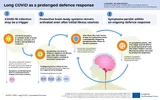
It has this explanation of LC as prolonged defence response

1782804868275.webp
There is also a FB page with 84 followers and an IG with 78 follows, and includes the clip stating that "of course the brain is biomedical"

Edit to add:

"No evidence was found that Long COVID is caused by microclots, gut dysbiosis, persistent viral infection or a distinct autoimmune disorder."

Based on what? Did they carry out research in each area? or just a (selective) literature search?

Second edit to further add;

"project has received funding from the European Union's Horizon Europe research and innovation program under grant agreement No 101057553. This work was supported by the Swiss State Secretariat for Education, Research and Innovation (SERI) under contract number 22.00094."
 
Last edited:


Panel discussion from the EU Long Covid Project final meeting, featuring Paul Garner and Rachel Whitfield. Not a COFFI event, but added to their YouTube, which was renamed to FatigueScienceTalks.

From a comment from reddit from someone who seems experienced in the field:
I’m writing this from the perspective of someone who has personally worked in consortia carrying out projects under EU framework programs, including those of the HE and its predecessor Horizon 2020.
Full comment:
I don’t know how many people here are from the EU, but for those who aren’t, just to clarify.

This is not an official publication by EU institutions, but a report summarizing a project carried out by a consortium under a Horizon Europe grant.

Horizon Europe is the European Union’s framework program for funding scientific research and innovation, designed to build the EU’s innovative edge and foster partnerships among various institutions within the community.

Like other funding programs, Horizon Europe suffers from certain issues that affect the nature of the projects carried out under its auspices.

To receive funding, applicants had to submit a detailed proposal outlining the project’s objectives, its timeline, and deliverables. Projects that receive funding must demonstrate that they have carried out what was outlined in the proposal. If they fail to meet the objectives, they will not receive payment.

In theory, proposals should be submitted by entities and consortia that have an idea for conducting significant research, know how they want to do it, and are confident they can achieve what they promise. The only thing they lack is the funding.

In practice, however, this is not the case at all.

Competition for funding is fierce. Funding is awarded to projects that almost fully meet the requirements (and there are quite a few of them - for example, regarding the significance of results, the composition of consortia, and the impact on EU competitiveness).

That is why an entire industry dedicated to writing grant applications has sprung up in the EU. External firms are often hired for this purpose. Applications are written to maximize the use of keywords that appear in the requirements and that reviewers pay attention to (and they do pay attention to them to ensure maximum objectivity and avoid being accused of bias). Project ideas are crafted when new calls for proposals open. Consortia are assembled on a turnkey basis. First, promises are made; then, only once funding is awarded, people figure out how to deliver on them. And they promise a great deal.

Unfortunately, very few interesting, well-thought-out initiatives can hold their own in the battle of proposals.

As a result, many projects funded by EU programs yield relatively mediocre results. They’re carried out in such a way as to present the promised deliverables regardless of their quality (since that’s hard to assess). Often with great difficulty, because large consortia struggle to coordinate their work. There are exceptions, of course. However, in each case, one must examine what the project’s objectives were and what might have been stretched just to meet them.

I’m writing this from the perspective of someone who has personally worked in consortia carrying out projects under EU framework programs, including those of the HE and its predecessor Horizon 2020.

ETA:
Anothter comment from the same person:
Oh. I almost forgot about that. HE projects are also evaluated on their dissemination. So they need to have some visibility hold a certain number of conferences with enough participants, publish materials, get website traffic, and so on. So it’s no surprise that they try to be visible.
 
Last edited:
The "Recovery Channel" site says that it is:

The associated Companies House listing shows two directors: Rachel Whitfield and Paul Garner.
I've looked at the details of this company following the link.

It was set up in January 2026. The company address is 40 Rodney Street Liverpool which is a building used by various organisations including a massage therapy clinic and includes rentable offices and meeting spaces.

The only people involved are Rachel Whitfield and Paul Garner.

It's registered as a Community interest company and not for profit but the directors can receive payment as agreed by the directors.

Its purpose is to provide online educational materials for pwME/LC and recovery stories.
 
Whitfield seems to be some sort of management or personal training consultant.
The whole thing seems as murky as usual.

Not for profit (except for the directors that is, presumably).

It sounds as if Paul Garner has become a professional alternative medicine practitioner.
 
We are seeing information from two different things here.
There is the EU funded 4 year Long Covid project which was based at Helsinki University and has a website:
https://longcovidproject.eu/

Separately, there is the Whitfied Garner Recovery Channel. They were invited to be part of a panel at the LC project's final conference and have put a report about it on their website:
https://recovery-channel.org/blog/
 
Back
Top Bottom