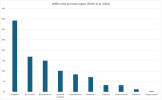
Eccentric medium spiny neuron (eMSN)

Here is a dropbox link with:
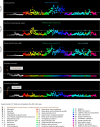
  • Data underlying the HBA MAGMA plot for DecodeME
  • Supplementary material from the Duncan et al. paper "Mapping the cellular etiology of schizophrenia and complex brain phenotypes" which I used to annotate the cell types in the plot.
Wow, thanks. Much appreciated! I noticed that cluster 133 (the yellow dot just below the significance threshold) is also upper-layer intratelencephalic neurons located in the cortex.

I do wonder what distinguishes cluster 136 and 133 of IT cells from other ITs that don't come near the significance threshold.
 
I do wonder what distinguishes cluster 136 and 133 of IT cells from other ITs that don't come near the significance threshold.
Cluster 136, mostly in the amygdala has only 152 cells compared to, for example 20.000 for cluster 133, so perhaps that makes it less reliable and more likely to be a fluke?

Cluster 133 has the following dissections:

V1C:62.92%, V2:17.60%, Pro:14.65%, M1C:2.37%, A1C:1.23%, Ig:0.32%, A29-A30:0.28%, STG:0.20%, S1C:0.17%, A5-A7:0.07%, TF:0.04%, A23:0.03%, A19:0.02%, MTG:0.01%, A13:0.01%, Cla:0.01%, A32:0.00%, A44-A45:0.00%, MEC:0.00%, MN:0.00%, A40:0.00%, TH-TL:0.00%, A43:0.00%, LG:0.00%,

The labels are explained here:
Human Brain Cell Atlas v1.0 - Overview - HCA Data Portal

V1C = Primary Visual Cortex
V2 = Peristriate Cortex
Pro = Area Prostriata

So 95% was taken from the visual cortex and related areas.
 
PCDH17
PCDH17 Gene - GeneCards | PCD17 Protein | PCD17 Antibody
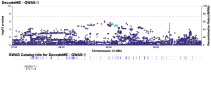
A bit speculative this one because the hit (13:58,456,743 T/C) only reached the 10^-6 threshold in DecodeME, and the gene is quite far off.

But PCDH17 "plays a pivotal role in synaptic development and neural circuit refinement. It is enriched at corticobasal ganglia synapses where it regulates presynaptic assembly, and its deficiency results in altered vesicle accumulation and synaptic transmission efficiency."

(To clarify: this is likely part of the same signal that points to eMSN, so a different way of looking at the same thing, not extra confirmation of it)

1779560618005.png
 
I am wondering about migraine or maybe some better understood disease like MS.
It was also tested but showed a completely different profile, pointing to B and T cells, rather than neurons. See the graph below. Same with Alzheimer's, which points to microglia.

Genetic evidence suggests ME/CFS is more like schizophrenia, autism, epilepsy, fibromyalgia, and anxiety/depression rather than MS or Alzheimer's.

1779623773773.png
 
Genetic evidence suggests ME/CFS is more like schizophrenia, autism, epilepsy, fibromyalgia, and anxiety/depression rather than MS or Alzheimer's.
Chris Ponting and team said that the genes identifyied in DecodeME are not related to anxiety/depression. Can someone explain how these are now apparently back in the conversation?
 
Chris Ponting and team said that the genes identifyied in DecodeME are not related to anxiety/depression. Can someone explain how these are now apparently back in the conversation?
Ponting statement was only about the 8 significant hits but if you look broader there are some similarities (noted here on several S4ME threads). Genetic evidence suggests they are all diseases of neural communication in the brain.
 
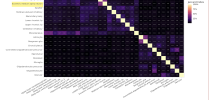
Supplementary figure from Yao et al. 2025. showing the overalp betweem eMSN and the other 30 cell type clusters in the human brain atlas. MSN and amygdala excitory show the highest overalp with a Jaccard index of 0.37 and 0.22 respectively.

1779641587736.png
Legend: Figure S6. Jaccard index heatmap. For all pairs of superclusters, we computed the Jaccard index for overlap of TDEP genes (these gene sets are the input annotation for S-LDSC). For two sets of genes, Jaccard index of 1 means complete overlap and 0 means no overlap.

Connecting genomic results for psychiatric disorders to human brain cell types and regions reveals convergence with functional connectivity | Nature Communications
 
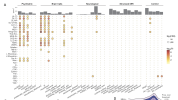
Here's more data from that Yao 2025 paper which Paolo also references in his paper.

It look at the 31 superclusters from the Siletti 2023 brain atlas, so a higher level than the 461 clusters trafalmadorian97 looked at or the 2082 that Paolo used.

It shows that the eMSN supercluster had a significant association with neuropsychiatric disorders such as schizophrenia, bipolair disorder and depression and with behavioral traits such as educational attainment, IQ and neurotocism. It looks like each other other cell types with lower p-values though.

1779642749693.png
Connecting genomic results for psychiatric disorders to human brain cell types and regions reveals convergence with functional connectivity | Nature Communications
 
So perhaps one way to picture this is to make the analogy to immune disorders where the evidence can suggest a particular cell type (e.g. B-cells) are important. In most immune disorders multiple immune cell types (B, T, NK, neutrophils, dendritic, mast cells, etc.) play a role but there is often one that stands out a bit more. Multiple disorders may have links to B-cells but the cells can be doing other things so that the outcomes are very different, from immune deficiencies, autoimmune disorders to cancers.

For these neuronal cells clusters, perhaps one could make a similar reasoning. I feel like it's one level further zoomed in from the brain, synapses, and neuronal communication we had before. We know have a slightly better view on it and know it is likely dominated by glutamergic signals, eMSN, intratelencephalic cells, amygdala excitatory cells etc. A lot of disorders involve these cells so we'll need to zoom in a couple of times more.
 
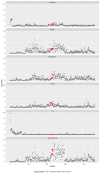
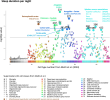
I've combined the MAGMA analysis that Duncan et al. 2025 did for other diseases and the analysis @tralfamadorian97 did for ME/CFS using the 461 cell type cluster in the human brain analysis. I've coloured the signals for eMSN (clusters 222-234 and cluster 426) in red.

eMSN are involved in many of these conditions. For bipolar disorder, major depressive disorder, and schizophrenia, the peak signal seems to lie a bit further along the cell numbering (230-300, where the interneurons lie, than for ME/CFS. Also note how different Alzheimer and Multiple Sclerosis look.

1779714050704.png
 
The plot above used p-values but these are also influenced by the size of the GWAS, so would like to use one that uses a standardized effect size that takes sample size and trait heritability into account.

There's a 'BETA_STD' in the columns which I suspect might be what I'm looking for but not entirely sure how it was calculated.
 
Tried to make an overview of the geographical distribution of eMSN. Found no sources on this so I counted up the cells per dissection from the Siletti et al. 2023 human brain atlas, mentioned here:
https://cellxgene.cziscience.com/e/e6b2ce27-681b-4409-a053-2681875936e5.cxg/

They had data on 40144 eMSN. Most are in the amygdala and basal ganglia, but some in the cortex, hypothalamus and thalamus.

Amygdala44.4%
Basal forebrain + nuclei32.0%
Cortex10.0%
Hypothalamus8.4%
Thalamus3.3%
Claustrum1.3%
Hipppocampus0.3%

1779739480165.png
 
Last edited:
It’s interesting that there are so many matches involving the amygdala. A friend of mine (who doesn’t have ME/CFS) has severe and completely irrational social anxiety, and he’s read a lot of academic papers highlighting the relationship between hyperactivity in this brain region and social anxiety. I wonder whether that could be one component of the so-called “sickness behaviour” response.
 
From this OCD GWAS:

"OCD genetic risk was associated with excitatory neurons in the hippocampus and the cortex, along with D1 and D2 type dopamine receptor-containing medium spiny neurons"

 
Back
Top Bottom