Efficacy and safety of rivaroxaban, colchicine, and famotidine–loratadine with specialist supportive clinical care for fatigue..., 2026, STIMULATE-ICP

Nightsong

Senior Member (Voting Rights)
Efficacy and safety of rivaroxaban, colchicine, and famotidine–loratadine with specialist supportive clinical care for fatigue in patients with post-COVID-19 condition in the UK: a multisite, open-label, randomised controlled trial (STIMULATE-ICP consortium)

Abstract:

Background​

Post-acute sequelae of COVID-19 or post-COVID-19 condition (also known as long COVID) affects 1–5% of adults globally, most commonly with fatigue, and no evidence-based therapies are available. We aimed to evaluate the efficacy of repurposed medications in fatigue management in adults with long COVID.

Methods​

We did a phase 3, four-group, randomised, controlled, adaptive platform, open-label drug trial nested within a pragmatic, multicentre, cluster-randomised trial of an integrated care pathway (ICP) for long COVID across 12 UK National Health Service (NHS) specialist long COVID care clinics in the UK. Participants had to be adults (>18 years) with long COVID who had not been hospitalised with COVID-19. In addition to NHS specialist-led long COVID care (hereafter, usual care), participants in the ICP trial could receive multiorgan MRI and clinical decision support and/or app-based rehabilitation. Initially, participants in the ICP trial were invited to enrol in the drug trial, but slow recruitment to the drug trial led to establishment of additional drug-only trial sites. Participants enrolled at either ICP trial sites or drug-only trial sites were randomly assigned (1:1:1:1) to receive colchicine 500 μg twice daily, rivaroxaban 10 mg once daily, famotidine 40 mg with loratadine 10 mg once daily, or no drug for 12 weeks. All participants received usual care. Randomisation was done electronically in blocks (various block sizes) and stratified by site, birth sex, ICP trial group allocation, and being a new or previous patient of a drug-only site. The primary endpoint was 12-week fatigue, assessed with the Fatigue Assessment Scale (FAS; with scores ranging from 10 [no fatigue] to 50 [debilitating fatigue], and a >10% change considered clinically meaningful) among randomly assigned individuals who had available baseline and 12-week data, adjusting for baseline fatigue and clinically relevant covariates. Secondary endpoints included 24-week FAS. The nested drug trial is registered, ISRCTN10665760. The trial is complete.

Findings​

Of 6035 eligible participants, 778 (383 co-enrolled in the ICP trial and 395 directly enrolled in the drug trial) were randomly assigned between Aug 22, 2022, and Aug 7, 2024 to colchicine (n=192), famotidine–loratadine (n=193), rivaroxaban (n=197), or no drug (usual long COVID care only; n=196). The mean age of participants was 46 years (SD 12·4), 495 (64%) of 778 were female, and 91 (12%) were from a non-White ethnic group. Across all trial groups, there was severe baseline fatigue (mean FAS score 36·8 [SD 7·49]) and a clinically relevant mean FAS reduction of 4·3 points to 32·5 (SD 9·13) at 12 weeks. Adjusted analyses showed small, statistically significant FAS reductions in the colchicine (–1·49 points [95% CI –2·92 to –0·06], p=0·041) and famotidine–loratadine (–1·48 points [–2·88 to –0·08], p=0·038) groups, but not in the rivaroxaban group (–1·06 points [–2·47 to 0·35, p=0·139), compared with no study drug at 12 weeks. However, 24-week FAS scores, 12 weeks after drug cessation, were not significantly different between groups. Treatment was well tolerated, with ten serious adverse events (requiring hospitalisation but unrelated to trial drugs) reported in eight (1·0%) of the 778 participants, five of which were in three participants in the rivaroxaban group.

Interpretation​

In participants with long COVID, severe fatigue reduced in all study groups—including the no drug group—over 12 weeks, with small additional reductions in the colchicine and famotidine–loratadine groups compared with the no drug group. Modest effects on FAS were not sustained after drug withdrawal. Long-term long COVID symptom benefit is unlikely with these drugs alone. Future trials could investigate the use of these or other repurposed drugs in specific subgroups of patients with long COVID, combination therapies, and how care is delivered.

Funding​

UK National Institute for Health and Care Research.

Link | PDF (The Lancet Infectious Diseases, July 2026, open access)

Building the evidence base for Long COVID treatments (associated commentary)
 
So, open label.

In participants with long COVID, severe fatigue reduced in all study groups—including the no drug group—over 12 weeks, with small additional reductions in the colchicine and famotidine–loratadine groups compared with the no drug group. Modest effects on FAS were not sustained after drug withdrawal.
Taking the open label nature of the study into account, it doesn't sound as though these drugs moved the dial on the mean level of fatigue.

Adjusted analyses showed small, statistically significant FAS reductions in the colchicine (–1·49 points [95% CI –2·92 to –0·06], p=0·041) and famotidine–loratadine (–1·48 points [–2·88 to –0·08], p=0·038) groups, but not in the rivaroxaban group (–1·06 points [–2·47 to 0·35, p=0·139), compared with no study drug at 12 weeks. However, 24-week FAS scores, 12 weeks after drug cessation, were not significantly different between groups.
I'm not sure that we would really expect there to be sustained benefits from anti-histamines after stopping the drug, even if the drugs did have some benefits. Clearly, there weren't any sustained benefits.

Perhaps we could check the detail to see if the drugs might have been useful for a subset. But, the conclusion is not really encouraging of that. It's such a shame that they didn't do a blinded study.

It was a big platform trial. For the same cost, I expect that they could have done much smaller blinded trials that would have actually told us something definitively. I doubt that this will be enough to stop people thinking that antihistamines are a treatment 'for some people'.

Funded by the NIHR.
 
Last edited:
This is what we would expect a negative result to look like. But it leaves a whole lot of questions still unanswered. It might have been better to do a separate trial on antihistamines looking at GI problems since there seems no particular reason why they should alter fatigue.

It seems a useful negative for anticoagulant use. Clotting was clearly not central to whatever sort of LC these people had.
 
From Wikipedia

Colchicine
Colchicine, ... is a medication used to prevent and treat gout, to treat familial Mediterranean fever and Behçet's disease, and to reduce the risk of myocardial infarction
...Colchicine works by decreasing inflammation via multiple mechanisms.

Famotidine–loratadine
Famotidine primarily works by blocking the effects of histamine and has some potential mechanisms of action that may contribute to its anti-inflammatory properties, including the inhibition of the production of certain pro-inflammatory cytokines such as TNF-alpha and IL-6

Rivaroxaban
Rivaroxaban, sold under the brand name Xarelto among others, is an anticoagulant medication (blood thinner) used to treat and reduce the risk of blood clots. Specifically it is used to treat deep vein thrombosis and pulmonary emboliand prevent blood clots in atrial fibrillation and following hip or knee surgery
 
I didn't realise that rivaroxaban is an anti-coagulant. This seems like a significant finding.

On outcomes:
When the trial was designed in 2021, most people with long COVID reported severe, debilitating fatigue, associated with slower recovery and reduced quality of life.2 Early reports of small changes in fatigue over the first 8 months after COVID-19 infection suggested that fatigue would be the most clinically meaningful primary outcome measure.
They say they measured fatigue because that is what people were complaining about. I'm pretty sure that people weren't just saying that they had fatigue. I think that is what was heard.

The Fatigue Assessment Scale (FAS), a 10-point questionnaire for physical and cognitive fatigue with scores ranging from 10 (no fatigue) to 50 (debilitating fatigue) and defined improvement criteria,23 was completed at baseline and weeks 12 and 24, as was the EQ-5D-5L visual analogue scale (EQ-VAS). EQ-VAS is a 100-point scale used to visually assess current health and wellbeing as a percentage of self-defined best health, where 0 is worst imaginable health and 100 is best health, which over 85% of patients can satisfactorily complete.2
Secondary outcomes reported in this Article include the 24-week FAS score (12 weeks after drug cessation) and 12-week and 24-week EQ-VAS scores.2 Other secondary outcomes (appendix pp 62, 178–87, and 217–19) will be analysed and reported after trial completion.
So there was also a measure of 'health and wellbeing', the EQ-VAS. Presumably there were no good results on that either.

And there are secondary outcomes that haven't been reported here.
 
It would be interesting to know why they thought it would be worth testing the effect of histamine blockade on fatigue. Antihistamines are notorious for making you sleepy. Mast cells were being talked about in terms of gut and maybe skin problems in ME/CFS but I am not aware of anyone suggesting that mast cell blockade helped fatigue.
 
The reasons they give for not using more objective outcome measures are...interesting:

Although the 6MWT is a well validated measure of cardiovascular and respiratory function, it should only be applied to people able to walk for 6 min; individuals with the most severe fatigue or fluctuating symptoms risk exacerbation of post-exertional malaise. Therefore, it is not recommended in routine clinical practice. The 6MWT does not have an established MCID in long COVID, further limiting interpretation of the observed mean difference of 5·6 m between allocation groups in the colchicine trial.14
OK, will let you away with that one, even though it has been used in ME/CFS trials, if you replace it with another objective measure.

We chose not to include unvalidated and potentially biased assessments of activity, including wearable device data, as these have not been fully evaluated in clinical trials and risk confounding individual clinical advice, such as pacing, provided as part of usual long COVID care.
Ah. So you didn't just choose not to include wearable device data, you chose not to include UNVALIDATED and BIASED wearable device data. It feels like we're on social media, not reading an academic paper. Again, they've been used in ME/CFS. Not letting you away with this one.

Regarding the potential of wearables themselves influencing behaviour in one direction or another, surely it would be possible to get FITBITs for studies that show a blank screen to the person wearing them, but collect data that researchers need?

All participants reported a change in FAS score at 12 weeks beyond the MCID, including those in the no drug group, potentially highlighting the importance of high-quality specialist care, including rehabilitation and pacing support, in obtaining meaningful clinical improvement.
But more likely highlighting the ability of an open-label trial with subjective outcomes to add more than a soupçon of bias to spontaneous change, with uninterpretable results.

Our report of improvement in fatigue with usual long COVID care provided by specialist NHS clinics is in line with our previous observational evaluation of UK services,4 and serves as an important addition to growing evidence supporting a multifaceted approach to long COVID rehabilitation.
It doesn't. It replicates the same ill-founded confidence in rehab that we have seen in ME/CFS. The authors need to read Woolie's list.

the long symptom duration and high baseline FAS scores in our participants argue against FAS score reduction being due to spontaneous recovery alone, as observed fatigue reductions were of greater magnitude than observed in contemporaneous longitudinal data from non-specialist centres.26
Hm. That sentence does not make sense to me. X and Y argue against spontaneous recovery, because another study had lower fatigue reductions. What?

I've looked at reference 26, and I don't see comparable FAS data in the published study or supplementary material. Can someone else point me to where I should be looking?

Regarding duration of illness, this is from Crawley et al. 2013 on treatment outcome in ME/CFS specialist centres:
Duration of illness was inversely associated with baseline physical function [mean change in SF-36 score -0.03; 95% confidence interval (CI) -0.05 to -0.01; P = 0.01] per additional month of illness) and associated with baseline pain (mean change in visual analogue pain score 0.05; 95% CI 0.02 to 0.07; P = 0.001 per additional month of illness), but was not associated with baseline fatigue or mood or with any outcomes at 8–20 months in fully adjusted models.

Regarding high baseline scores:
High baseline scores + regression to the mean + spontaneous resolution + participating in a trial + that trial being open label = changes in subjective outcomes
 
Last edited:
I didn't realise that rivaroxaban is an anti-coagulant. This seems like a significant finding.
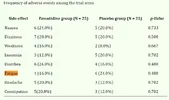
Agree. It is useful to know it definitely did not help. Particularly considering its adverse effects (from the appendix):

1783592003595.webp

And the fact that they used the FAS rather than the Chalder Fatigue scale is a small mercy.
 
Last edited:
I actually don't understand why they went with rivaroxaban. Triple therapy (Pretorius, Kell, Laubscher,...) uses apixaban, so I suspect apixaban might've been the one most widely used for "microclots".


Side note: I was offered apixaban by doctors in the UK who suspected I had microclots. No other anticoagulants have been offered to me.
 
It would be interesting to know why they thought it would be worth testing the effect of histamine blockade on fatigue. Antihistamines are notorious for making you sleepy. Mast cells were being talked about in terms of gut and maybe skin problems in ME/CFS but I am not aware of anyone suggesting that mast cell blockade helped fatigue.
Yes, even the supposedly non-drowsy ones knock me for six. Including loratadine/Claritin which was given with famotidine in this study.

They said:
Uncontrolled case series and small trials have reported improved fatigue and cognitive function with H₁ and/or H₂ histamine receptor blockade (famotidine or fexofenadine).10,11

References 10 and 11 are:

Glynne et al. 2022:
However, as the study progressed, all patients were offered empiric treatment trials with a combination of H1 (loratadine 10 mg two times per day or fexofenadine 180 mg two times per day) and H2 (famotidine 40 mg once daily or nizatidine 300 mg once daily) receptor antagonists (HRAs) for a minimum of 4 weeks as part of their ongoing care. Of the 49 long COVID-19 study participants, 26 patients consented to try HRA.

1783594654524.webp
So a few people reported better scores on a subjective outcome in an open-label study.

Momtazmanesh et al. did not use fatigue as an outcome measure, but famotidine alone, without the loratidine included in the study this thread is about, did not increase fatigue:

1783594584877.webp
 
So this trial could provide a useful null result to stop more money being thrown at these ineffective drugs, but instead it's being spun as "Future trials could investigate the use of these or other repurposed drugs in specific subgroups" etc etc. Sigh.
 
The paper by Glynne et al. has had a massive impact and it's the one used to support the rationale behind prescribing antihistamines, not just privately but even by some NHS GPs.


Overall, I'm afraid that saying
Treatments X and Y significantly reduced fatigue during the treatment but the improvement was not sustained after drug cessation.
will be translated to practice as:
You have to keep taking it.
which is how it's been done this whole time anyway.
 
The only mention of ME/CFS is this:
This Article is an important resource for future design of large-scale long COVID trials and other conditions characterised by debilitating fatigue, such as myalgic encephalomyelitis/chronic fatigue syndrome.
Eh, no thanks.

The STIMULATE-ICP trial shows that long-term symptom benefit in long COVID is unlikely with these drugs alone. We provide evidence in support of comprehensive clinical management pathways, including multifaceted rehabilitation, as the foundation of care for long COVID...future trials should evaluate synergy between individual care components for long COVID and pharmacological agents as the optimal management strategy. Our findings, including reversion of drug effect on cessation, justify investment in further platform studies of new and repurposed medicines as mechanistic understanding of long COVID evolves.
Oof. Reversion of drug effect on cessation? Or reversion of placebo response?

We chose an open-label design in this publicly funded trial, supported by the funder, our PPIE team, and ethical committee, with two aims: (1) to avoid estimated delays of 1 year and excessive costs (estimated £1 million) of developing placebo controls matched across all trial arms; and (2) to retain the trust of our patient population, many of whom experienced substantial stigma and barriers to care, reducing their trust in researchers and clinicians.22
Spend the money and you'll get some trust.
 
The paper by Glynne et al. has had a massive impact and it's the one used to support the rationale behind prescribing antihistamines, not just privately but even by some NHS GPs.
Wow.

I don't see why. Here's the full table from Glynne et al:
1783597114186.webp

I feel like a good chunk of the medical profession has a blind spot about what you can conclude from a study where the participants know whether they're getting a treatment or not.
 
The STIMULATE-ICP trial shows that long-term symptom benefit in long COVID is unlikely with these drugs alone.
I can see that being spun as yes, of course it's unlikely on these drugs alone, we've known that, you need the right combination that works for you and even with that people feel symptom relief but they're not cured. And if you're feeling worse after stopping a drug, it means it works.
 
Back
Top Bottom