Genetics: Chromosome 17, SHISA6

forestglip

Moderator
Staff member
The locus near SHISA6 wasn't quite genome-wide significant, but it was close at p=8.26e-08.

From GeneCards:
NCBI Gene Summary for SHISA6 Gene

Predicted to enable ionotropic glutamate receptor binding activity. Predicted to be involved in several processes, including excitatory chemical synaptic transmission; modulation of chemical synaptic transmission; and negative regulation of canonical Wnt signaling pathway. Predicted to be located in asymmetric, glutamatergic, excitatory synapse. Predicted to be part of AMPA glutamate receptor complex. Predicted to be active in dendritic spine membrane; glutamatergic synapse; and postsynaptic density membrane. [provided by Alliance of Genome Resources, Apr 2025]
GeneCards Summary for SHISA6 Gene

SHISA6 (Shisa Family Member 6) is a Protein Coding gene. Diseases associated with SHISA6 include Myopia. An important paralog of this gene is SHISA7.
UniProtKB/Swiss-Prot Summary for SHISA6 Gene

Involved in maintenance of high-frequency synaptic transmission at hippocampal CA3-CA1 synapses. Regulates AMPA-type glutamate receptor (AMPAR) immobilization at postsynaptic density keeping the channels in an activated state in the presence of glutamate and preventing synaptic depression. May play a role in self-renewal and differentiation of spermatogonial stem cells by inhibiting canonical Wnt signaling pathway. ( SHSA6_HUMAN,Q6ZSJ9 )

Here is a plot of this locus (LocusZoom link):
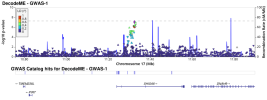
Edit: The lead variant at this locus is: 17:11,325,637:G:C / rs1546559
 
Last edited:
I posted on the CA10 thread about a website called the Genotype-Phenotype Map, where you can upload summary stats, and it tests for colocalization (testing if traits share a causal variant) of the uploaded trait with thousands of other GWAS traits and millions of molecular traits.

I thought it'd be worth copying the traits identified as potentially colocalizing with ME/CFS at other loci onto the forum, just in case they may be important.

These are the traits that show evidence of colocalization with ME/CFS at the SHISA6 locus:
TraitData TypeGeneTissueCis/TransP-value
SHISA6 Whole blood cg10227024 methQTLMethylationSHISA6Whole bloodcis1.99e-43
SHISA6 Whole blood cg25510591 methQTLMethylationSHISA6Whole bloodcis2.49e-11
Pork consumptionPhenotype (Behavioural Measures)1.02e-7

Candidate Variant: 17:11329387 G/A
LD Region: EUR/17/10322869-12659834
 
Last edited:
I posted on the CA10 thread about a website called the Genotype-Phenotype Map, where you can upload summary stats, and it tests for colocalization (testing if traits share a causal variant) of the uploaded trait with thousands of other GWAS traits and millions of molecular traits.

I thought it'd be worth copying the traits identified as potentially colocalizing with ME/CFS at other loci onto the forum, just in case they may be important.

These are the traits that show evidence of colocalization with ME/CFS at the SHISA6 locus:
hmm does this indicate more evidence for glutamate, reading the gene card for SHISA6 "Predicted to be part of AMPA glutamate receptor complex. Predicted to be active in dendritic spine membrane; glutamatergic synapse; and postsynaptic density membrane."

 
Maybe a connection with IBS in the following study which found an association of a SNP near SHISA6 with nausea after general anesthesia:

Genome-Wide Association Study Identifies Novel Candidate Variants Associated with Postoperative Nausea and Vomiting (2023, Cancers)
In another GWAS conducted only on patients who received propofol, rs7212072 and rs12444143 SNPs in the SHISA6 and RBFOX1 gene regions, respectively, were significantly associated with the frequency of nausea
Significant associations were found for the rs7212072 SNP on chromosome 17 (p = 3.919 × 10⁻⁸), [...] in the additive model (Table 3, Figure 2a). Associations were also significant for the rs7212072 SNP (p = 3.412 × 10⁻⁸) [...] in the recessive model (Table 3, Figure 2c). However, no significant associations were found in the dominant model for this phenotype.
For SHISA6 and RBFOX1, although no relationships with [postoperative nausea and vomiting] have been reported, two SNPs in these genes, rs2908972 and rs10500355, respectively, were interestingly shown to be strongly associated with myopia (p = 5.000 × 10⁻²⁴ for rs2908972; p = 2.000 × 10−63 for rs10500355) [48] according to the Phenotype-Genotype Integrator (PheGenI), which is available in the NCBI database. This might imply that these two genes are commonly involved in mechanisms of myopia and nausea.
 
In addition to the papers already posted:

Genetic variants in the SHISA6 gene are associated with delayed cognitive impairment in two family datasets

Shisa6 mediates cell-type specific regulation of depression in the nucleus accumbens

also a reference in Disruption of the autism gene and chromatin regulator KDM5A alters hippocampal cell identity:
Cluster CA3.4 is marked by the expression of Shisa6 and Smad3, both genes encode molecules involved in regulating synaptic transmission in the hippocampus. . . the percentage of cells expressing Shisa6 is decreased in Kdm5a−/− compared to WT
 
Back
Top Bottom