Genetics: Chromosome 17, SHISA6

forestglip

Administrator
Staff member
The locus near SHISA6 wasn't quite genome-wide significant, but it was close at p=8.26e-08.

From GeneCards:
NCBI Gene Summary for SHISA6 Gene

Predicted to enable ionotropic glutamate receptor binding activity. Predicted to be involved in several processes, including excitatory chemical synaptic transmission; modulation of chemical synaptic transmission; and negative regulation of canonical Wnt signaling pathway. Predicted to be located in asymmetric, glutamatergic, excitatory synapse. Predicted to be part of AMPA glutamate receptor complex. Predicted to be active in dendritic spine membrane; glutamatergic synapse; and postsynaptic density membrane. [provided by Alliance of Genome Resources, Apr 2025]
GeneCards Summary for SHISA6 Gene

SHISA6 (Shisa Family Member 6) is a Protein Coding gene. Diseases associated with SHISA6 include Myopia. An important paralog of this gene is SHISA7.
UniProtKB/Swiss-Prot Summary for SHISA6 Gene

Involved in maintenance of high-frequency synaptic transmission at hippocampal CA3-CA1 synapses. Regulates AMPA-type glutamate receptor (AMPAR) immobilization at postsynaptic density keeping the channels in an activated state in the presence of glutamate and preventing synaptic depression. May play a role in self-renewal and differentiation of spermatogonial stem cells by inhibiting canonical Wnt signaling pathway. ( SHSA6_HUMAN,Q6ZSJ9 )

Here is a plot of this locus (LocusZoom link):

Edit: The lead variant at this locus is: 17:11,325,637:G:C / rs1546559
 
Last edited:
I posted on the CA10 thread about a website called the Genotype-Phenotype Map, where you can upload summary stats, and it tests for colocalization (testing if traits share a causal variant) of the uploaded trait with thousands of other GWAS traits and millions of molecular traits.

I thought it'd be worth copying the traits identified as potentially colocalizing with ME/CFS at other loci onto the forum, just in case they may be important.

These are the traits that show evidence of colocalization with ME/CFS at the SHISA6 locus:
TraitData TypeGeneTissueCis/TransP-value
SHISA6 Whole blood cg10227024 methQTLMethylationSHISA6Whole bloodcis1.99e-43
SHISA6 Whole blood cg25510591 methQTLMethylationSHISA6Whole bloodcis2.49e-11
Pork consumptionPhenotype (Behavioural Measures)1.02e-7

Candidate Variant: 17:11329387 G/A
LD Region: EUR/17/10322869-12659834
 
Last edited:
I posted on the CA10 thread about a website called the Genotype-Phenotype Map, where you can upload summary stats, and it tests for colocalization (testing if traits share a causal variant) of the uploaded trait with thousands of other GWAS traits and millions of molecular traits.

I thought it'd be worth copying the traits identified as potentially colocalizing with ME/CFS at other loci onto the forum, just in case they may be important.

These are the traits that show evidence of colocalization with ME/CFS at the SHISA6 locus:
hmm does this indicate more evidence for glutamate, reading the gene card for SHISA6 "Predicted to be part of AMPA glutamate receptor complex. Predicted to be active in dendritic spine membrane; glutamatergic synapse; and postsynaptic density membrane."

 
Maybe a connection with IBS in the following study which found an association of a SNP near SHISA6 with nausea after general anesthesia:

Genome-Wide Association Study Identifies Novel Candidate Variants Associated with Postoperative Nausea and Vomiting (2023, Cancers)
In another GWAS conducted only on patients who received propofol, rs7212072 and rs12444143 SNPs in the SHISA6 and RBFOX1 gene regions, respectively, were significantly associated with the frequency of nausea
Significant associations were found for the rs7212072 SNP on chromosome 17 (p = 3.919 × 10⁻⁸), [...] in the additive model (Table 3, Figure 2a). Associations were also significant for the rs7212072 SNP (p = 3.412 × 10⁻⁸) [...] in the recessive model (Table 3, Figure 2c). However, no significant associations were found in the dominant model for this phenotype.
For SHISA6 and RBFOX1, although no relationships with [postoperative nausea and vomiting] have been reported, two SNPs in these genes, rs2908972 and rs10500355, respectively, were interestingly shown to be strongly associated with myopia (p = 5.000 × 10⁻²⁴ for rs2908972; p = 2.000 × 10−63 for rs10500355) [48] according to the Phenotype-Genotype Integrator (PheGenI), which is available in the NCBI database. This might imply that these two genes are commonly involved in mechanisms of myopia and nausea.
 
In addition to the papers already posted:

Genetic variants in the SHISA6 gene are associated with delayed cognitive impairment in two family datasets

Shisa6 mediates cell-type specific regulation of depression in the nucleus accumbens

also a reference in Disruption of the autism gene and chromatin regulator KDM5A alters hippocampal cell identity:
Cluster CA3.4 is marked by the expression of Shisa6 and Smad3, both genes encode molecules involved in regulating synaptic transmission in the hippocampus. . . the percentage of cells expressing Shisa6 is decreased in Kdm5a−/− compared to WT
 
I've been skimming through some of the extant work on AMPA, & on trials of AMPAkines, recently; in case others are interested as well -

Regulation of AMPA receptors in spinal nociception (Molecular Pain, 2010, open access)

Modulation of TARP γ8-containing AMPA Receptors as a Novel Therapeutic Approach for Chronic Pain (J. Pharmacol. Exp. Ther., 2019, open access)

Potentiation of AMPA receptors for rapid therapeutic gain in psychiatry (Neuropsychopharmacology, 2023, open access)

Glutamate receptors and pain (Seminars in Cell & Developmental Biology, 2006)

The last paper, while from 2006, includes a review of the then-current evidence implicating AMPA receptors in nociceptive signalling & in chronic pain states.
 
From a rather old review (link) that I came across:
Recent attention has focused on the role of postsynaptic AMPA receptor trafficking in the development of synaptic plasticity associated with chronic pain states [26]. AMPA receptor trafficking has been extensively studied in hippocampus where increased expression of AMPA receptors (particularly GLUA1) may be involved in the establishment of NMDA receptor dependent long-term potentiation (LTP). In spinal cord, recruitment of GLUA1 (but not GLUA2/3) into the plasma membrane in response to mechanical hyperalgesia could underlie a similar type of synaptic plasticity [27,28]. Protein kinase A (PKA) and C (PKC)-dependent phosphorylation of AMPA receptors in the spinal cord following noxious stimuli [29] and up-regulation of GLUA1 flop, GLUA2 flip, and GLUA3 flop splice variants following an inflammatory response in rats [28], are further evidence of AMPA receptor plasticity in pain pathways.
AMPA receptors are ubiquitously expressed in brain regions associated with nociception [30]. These receptors likely underlie the rapid excitatory synaptic transmission associated with glutamatergic signaling between many nodes within the ascending nociceptive pathways, including inputs from sensory neurons in the spinal cord to brainstem and thalamus, as well as from thalamic neurons to sensory cortices. Likewise, descending facilitatory pathways from amygdala and anterior cingulate cortex to the periaqueductal grey (PAG) and the rostral ventral medial medulla (RVM) exert some of their effects via AMPA receptor-mediated synaptic inputs.
[26] is A new view on how AMPA receptors and their interacting proteins mediate neuropathic pain.
 
Chromatin openness
Had a closer look at this region. The credible set has 25 SNPs and lies in the second intron of SHISA6 itself. There were three regulatory elements that included one of these SNPs of which the one to the right EH38E1847030 had the highest probability. It's mostly open in (fetal) brain and spinal cord and matches with chromatin openness peaks in the Li 2023 brain atlas.

1793872450215.webp
3D-folding
The Hi-C data from ENCODE suggestions that the domain of 3-D folding lies around SHISA6 and includes only DNAH9 as the another potential protein coding gene.

1793872570445.webp

eQTL
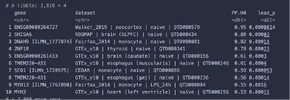
Looking at datasets on gene expression, only 3 weak eQTLS colocalise (PP. H4 >= 0.8 ), two of them in brain: SHISA6 in adult prefrontal cortex and the SHISA6-intronic IncRNA ENSG00000264727 in fetal neocortex and a DNAH9 microarray probe in monocytes.

The ME/CFS risk allele was predicted to increase SHISA6 in the prefrontal cortex.
1793872709579.webp

Phewas
Looking at other genetic studies that found a similar hit, I found sleep disorders, schizophrenia, irritable bowel syndrome (Eijsbouts 2021) and bipolar disorder.

1793872806807.webp
 
DNAH9 as the another potential protein coding gene.
I think SHISA6 is the most likely candidate (FLAMES predicted it as well) but in case it's DNAH9, there might be a possible connection with (other weak candidates) DNAH10, and ERICH3 as they are all involved in cilia: the hair-like structures that stick out from the surface of certain cells and also have a neuronal function.
 
Back
Top Bottom